

Overview
City-builders have a pacing problem. The genre’s great works—Anno, Cities: Skylines, the Civilization lineage—demand hours of setup before the interesting decisions arrive. You build the infrastructure of a society so that, eventually, you can play with the society. Kainga inverts that bargain.
Developed entirely by Erik Rempen under the Silk Softworks banner, Kainga: Seeds of Civilization is a roguelite village-builder structured around short, self-contained runs of 30 to 90 minutes. You guide a small tribe through specific challenges—survive a duration, reach a population, defeat a rival—and unlock new maps, Thinkers, and technologies upon success. Failure isn’t a wipeout; between runs you spend accumulated Karma on permanent unlocks that widen your tactical palette.
The design thesis is audacious: strip away the genre’s accounting apparatus. No tech trees to grind, no stockpile ledgers, no happiness meters ticking in the corner. What remains is decision-making in the present tense—reading your biome, your challenge, and your hand of technology options, then committing.
This is an indie in the truest sense—one person, one vision, one persistent technical debt. It shows, in both the best and worst ways.
Key features
- The Thinker: Your village’s leader is the tech tree. Innovation happens where the Thinker physically stands, so exploration and discovery are embodied actions, not menu clicks.
- Roguelite run structure: Complete challenges in 30–90 minute runs; fail gracefully and convert your experience into permanent Karma unlocks.
- Colossal creature taming: Giant beasts roam each map—domesticate them for economic output or weaponize them against rival tribes.
- Eight distinct biomes: Deserts, archipelagos, icy mountains, and jungles each impose different environmental pressures that reshape your strategy.
- No meters, no ledgers: Survival emerges from context rather than from managing happiness or hunger sliders.
Analysis
The Loop, Compressed
Kainga’s central strength is its friction economy. Traditional builders front-load tedium: place houses, wait, place farms, wait. Rempen has compressed the entire arc—settlement, expansion, crisis, triumph—into something that fits inside a lunch break. Each run begins with a choice of Thinker, and that choice cascades. A Thinker suited to aggressive expansion flounders on a resource-poor archipelago; a cautious one withers against aggressive rivals on the open plains.
The Thinker-as-tech-tree mechanic is the design’s sharpest idea and its cruelest joke. Because technologies are discovered by your leader standing in inspiring places, the most valuable unit on the map is also the most fragile. Lose your Thinker and your civilization loses its ability to advance—a tension that transforms routine exploration into real risk assessment. Do you send your Thinker toward that glowing anomaly near the colossal beast’s territory, or play it safe and stagnate? Kainga asks this question every ninety seconds, and it’s a good question every time.
Freedom Without a Framework
Removing tech trees and happiness meters sounds like removing the game. In practice, it removes the spreadsheet, not the strategy. Technology choices arrive as contextual offers shaped by environment and circumstance, and the absence of an optimal build order means every run is a genuine puzzle rather than a solved checklist. It’s the difference between playing chess and following an opening book.
The tradeoff is legibility. Without explicit systems, new players must infer why a village collapsed or a raid succeeded. The onboarding friction is baked into the design—early runs can fail in ways that feel opaque rather than instructive. Roguelite veterans will relish this; genre newcomers may bounce.
Where the Wheels Wobble
Villager AI is Kainga’s persistent flaw. The pathing and behavior systems leave room for fog—workers idling, carriers taking scenic routes—that undermines the otherwise tight decision loop. In a game where minutes matter, a wandering villager is aggravation distilled. Difficulty spikes compound this: some biome-and-Thinker combinations are simply cruel, and because runs are short, a bad opening hand can end things before a meaningful decision has been made.
Interface
The UI is admirably restrained, matching the design philosophy of subtraction. Context-sensitive prompts replace sprawling menus. But the same minimalism that makes the game elegant makes it occasionally too quiet—critical status information about your Thinker’s danger level is built to whisper when it should shout.
Visuals & performance
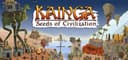
The hand-drawn art style is Kainga’s silent ambassador. Every biome has a distinct palette and personality—the sun-bleached ochres of the desert, the saturated greens of the jungle—and the colossal creatures lend real scale and wonder. A tamed behemoth lumbering past your huts is the game’s signature image.
A 2D game of this scope is light on hardware, and the modest system requirements reflect a design that subtracts rather than assumes. The audio design is pleasant if unremarkable—competent ambient work that stays out of the way.
Platform nuances
Kainga is PC-only via Steam, with no Switch, iOS, or Android release. That’s the correct call: the game’s interface assumes mouse precision, and its session length suits desktop play. The mouse-driven UI doesn’t lend itself to touch, so this is a desk game, unapologetically.
Final verdict
Kainga: Seeds of Civilization is a small game with a big idea executed by exactly one person, and the seams show. The AI wobbles, the scope is modest, and the difficulty curve has teeth in the wrong places. None of it outweighs the core achievement: Rempen has demonstrated that civilization-building doesn’t require a hundred hours—only a hundred interesting decisions. It’s a solid, flawed experiment we recommend to the right audience, and an idea worth building on.
Reviewed by the Rankeno Strategy & Sim Desk. Scores are out of 10; the overall score is the desk’s editorial judgement, informed by the four sub-scores above. How we review