

Overview
Most puzzle games give you a tool. Kine gives you a body, then a second one, then a third, and asks you to work out how each one falls over.
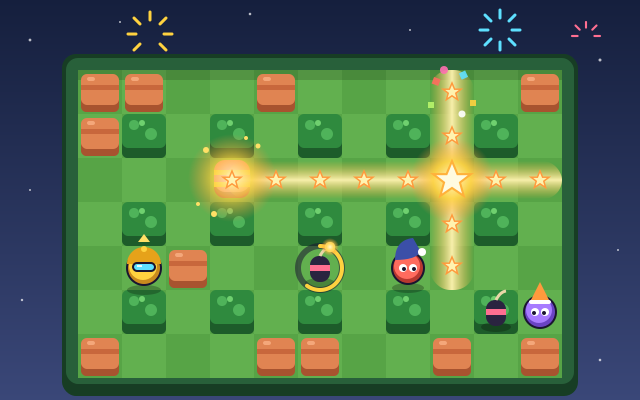
Kine comes from Chump Squad, the studio of Gwen Frey, who built it largely by herself. That matters because it explains both how focused the game is and why it has a few rough edges. It launched on October 19, 2020, and is available on PC via Steam and on Nintendo Switch for $14.99. The setup is simple. Three machines who love music, Euler, Quat and Roo, want to start a band and reach the main stage. Standing in their way are more than 120 puzzles, most of them on small 3D grids inside a dreamlike world built like a theatre stage.
It’s easy to see where Kine fits. Its small, self-contained 3D levels recall Captain Toad: Treasure Tracker, but its difficulty sits much closer to hardcore block-pushers like Stephen’s Sausage Roll than the friendly art suggests. That mismatch explains most of how people received it. The complaints are consistent: difficulty gets uneven late in the game, the story is thin, and some questioned whether the asking price was justified.
Those complaints are fair. But they describe the price of a game that won’t hold your hand, not a sloppy one. Kine is a spatial-reasoning test with a jazz record’s style. It rewards the kind of player who enjoys being stuck.
Key features
- Three characters, three ways of moving: Each machine moves differently. Across the cast, they roll, stretch, flip and brace against the level. Learning those moves is the whole curriculum, and everything else builds on them.
- 120+ handcrafted 3D puzzles: The grids are small but dense. Later puzzles reuse earlier ideas and combine them in ways that demand real planning ahead.
- Music built into the design: The award-winning original soundtrack is tied into the puzzles and the world rather than just playing in the background.
- A light story between chapters: Short scenes follow the trio’s love, labor and loss on the way to the main stage. It’s a small story about the cost of trying to make art.
- A stage-like dream world: Levels look like sets on a stage, which gives the whole game a clear visual theme.
Analysis
The Gameplay Loop: Learn the Body, Then Beat the Room
Kine’s main idea is easy to explain and hard to master. You don’t control a cursor; you control a shape. Each machine has its own physical rules: how it tips, how far it reaches, what it can push against. A puzzle is a question about whether that body can reach the goal on this grid.
The loop has three steps, and the game repeats them with discipline. First it introduces a movement idea in a safe room. Then it adds a complication, like a gap, a ledge or an awkward angle, that forces that idea to be used in a way it hadn’t been before. Finally it combines ideas across puzzles until one room tests everything learned. When this works, and in the first two-thirds it almost always does, it delivers the best feeling in the genre: the solution was there all along, and the player just learned to see it.
What sets Kine apart from flat grid puzzlers is how much thinking in 3D it demands. A body that tumbles across a grid changes its footprint as it moves. Something that fits now may not fit after one more flip. That means picturing two or three moves ahead in space, not just on a map. Players who are good at that will love it. Players who aren’t will hit a wall, and when they do, it will feel like a failure of their own imagination, not a gap in their knowledge. That’s a harder kind of frustration to recover from.
The Difficulty Curve: Where the Tempo Slips
This is Kine’s real weakness. The late puzzles are structured in a way that invites frustrating trial and error.
A good puzzle has a narrow gap between understanding and carrying out the answer. Once the solution is visible, entering it should be quick. As Kine’s grids get more complex and its bodies get harder to predict, that gap widens. It’s possible to know roughly what needs to happen and still fail to visualize the exact order of moves. At that point, many players stop reasoning and start guessing. The game hasn’t broken its rules. The solution space has simply grown past what a person can comfortably picture on a flat screen.
The pacing also gets uneven. A punishing room can be followed by an easy one, and then another spike. For a game so concerned with rhythm, the late game lacks a steady beat. Expert puzzle players will enjoy the challenge. Everyone else will feel the game became something they didn’t sign up for.
Music and Story: One Carries Its Weight, One Doesn’t
The soundtrack is the game’s identity, not decoration. Its jazz sound, and the way music ties into the puzzles and the world, makes Kine feel written rather than just assembled. It also helps with long stretches of thinking. A lot of time gets spent staring at one small room, and the music makes that pleasant rather than tense.
The story is weaker. The trio’s journey toward the main stage has real themes: ambition, the grind of creative work, what the dream costs. They land better when you remember one developer made the game. But the scenes between chapters are brief, and the puzzles take over the attention. The story takes a back seat. It’s a pleasant frame, not a reason to keep playing.
Onboarding and Value
The first chapters teach well. Each new movement idea arrives on its own and gets space before the game complicates it. The trouble comes later, as the puzzles start assuming spatial skills the early rooms never really trained.
At $14.99, the value question depends on how far you get. More than 120 carefully built puzzles is plenty for the price if you can reach the end. If you stall at a late spike, part of what you paid for is locked behind a skill check. That’s a fair concern, not a fatal one.
Visuals & performance
Kine’s art direction is clean, toy-like and very readable, which is the most important thing for this genre. The three machines have clear silhouettes and personality, and the stage theme gives each chapter a clear identity without cluttering the grid. Everything decorative serves the puzzle, and nothing competes with the playing field.
The interface stays out of the way, which suits a game built around long stretches of looking.
A 2D game of this scope is light on hardware. The scenes are small and static, so raw performance is unlikely to be the issue. The metric that matters is how clearly depth can be read: whether a ledge sits one tile away or two, and whether a stretch will clear a gap. Most of the time Kine gets this right. In the busiest late rooms, reading depth off a 2D screen becomes part of the challenge, and that makes the trial-and-error problem worse.
Platform nuances
Steam (PC): Kine’s moves are discrete, one step at a time, so keyboard input works fine and there’s no precision aiming to worry about. A gamepad still seems like the natural fit, and it suits a slow, comfortable session. The PC version’s main advantage is screen size. A large monitor makes depth easier to read, and that matters most in the late puzzles where the game is toughest.
Nintendo Switch: Kine fits the Switch well. Each puzzle is a self-contained, short session, which makes handheld play and picking it up for ten minutes at a time feel natural. The small screen is the trade-off. In the dense late-game rooms, a handheld display makes spatial reading harder, so the hardest chapters are best played docked on a TV.
Final verdict
Kine is a capable piece of design with real flaws. Its three-body movement system is original, its puzzles are carefully built, and its music gives it more personality than most of its genre — all the more notable given that one person made it. But the late game stops reliably teaching and starts demanding, the story never matters as much as the setup suggests, and the trickiest rooms strain against the limits of reading depth on a flat screen.
The result is a game that will delight patient spatial-reasoning fans and frustrate almost everyone else. For the first group, Kine is a rewarding 3D puzzle game worth the price of admission. For everyone else, it’s a well-made game that will probably beat you before the final curtain. We recommend it to the right audience only.
Reviewed by the Rankeno Strategy & Sim Desk. Scores are out of 10; the overall score is the desk’s editorial judgement, informed by the four sub-scores above. How we review