

Overview
Most fighting games ask you to read a person. Lethal League Blaze asks you to read a physics object traveling at roughly the speed of a bad decision.
The premise is absurd on paper and airtight in practice. Up to four fighters share a small arena with one anti-gravity ball. You do not hit each other. You hit the ball, and the ball hits someone — and every contact makes it faster, until a lazy opening lob has become a screaming neon streak that crosses the stage in a couple of frames and deletes whoever blinked. That’s it. That’s the game. Everything else — the bunts, the smashes, the parries, the character specials that bend the ball’s angle mid-flight — exists to let you cheat that escalation in your favor.
This is the sequel to 2014’s Lethal League, from Dutch studio Team Reptile, the same small outfit that would later go on to make Bomb Rush Cyberfunk. That lineage matters, because the studio’s obsession is legible here: sound, motion, and attitude treated as load-bearing design elements rather than decoration. Blaze trades the original’s pixel art for chunky cel-shaded 3D characters against hand-detailed backdrops, and drops the whole thing into Shine City, a rain-slick, sign-cluttered place where the sport has been outlawed and the league went underground anyway.
Positioning-wise, it occupies a strange and mostly empty market slot. It’s too mechanically deep to be dismissed as a party game and too structurally weird to sit next to Street Fighter or Guilty Gear on a tournament stream — though it has, repeatedly, shown up at fighting-game events and stolen the room. The closest honest comparison is Super Smash Bros., and even that undersells how differently Blaze thinks. Smash is about controlling space. Blaze is about controlling one object, and the terrifying arithmetic of what that object becomes after the ninth hit.
The market has responded warmly. The Steam audience has embraced it at a level that usually signals a game that knows exactly what it is. This one does.
Key features
- The Escalating Ball: A single shared projectile that gains speed with every strike. Rallies begin readable and end at velocities where you’re not reacting anymore — you’re predicting. The on-screen speed counter is the whole game’s tension meter.
- A Real Fighting-Game Toolkit: Swings, bunts (soft, angle-resetting taps), smashes, parries, grabs, taunts and character-specific specials. Every one of them is a way to rewrite the ball’s trajectory or steal tempo from the person across the stage.
- Distinct, Non-Cosmetic Roster: Candyman’s bat, Doombox’s walking-soundsystem bulk, Raptor’s bruiser pressure, Latch’s mobility — each character alters how you’re allowed to interact with the ball, not just how you look doing it.
- Rule Variants That Actually Change Strategy: HP matches, one-hit knockouts, point scoring, Strikers and Lethal Volley each reshape risk tolerance rather than just re-skinning the timer.
- A Soundtrack With Credits That Read Like a Festival Lineup: Hideki Naganuma (Jet Set Radio), Frank Klepacki (Command & Conquer), Pixelord, Bignic and Klaus Veen. Breakbeat, hip-hop and house, and it is doing structural work — more on that below.
- Four-Player Local, Plus Online, Arcade and a Story Campaign: Full couch support up to four, with online play, an arcade ladder and a short narrative mode.
Analysis
The Gameplay Loop
The onboarding is the best trick here. Two buttons get you playing: swing and jump. A first-timer will have a functional rally going within thirty seconds and will win a round by accident within five minutes. That accidental win is the hook — it convinces people they understand the game, which is exactly when Blaze starts teaching them that they don’t.
Because the real game is the speed curve. Each hit ratchets the ball’s velocity permanently upward for that rally, and the reaction window compresses accordingly. Early exchanges are conversational. By the mid-rally you’re leaning forward. By the late rally, human reaction time has quietly exited the building and been replaced by something closer to reading a pitcher’s windup — you’re not tracking the ball, you’re tracking your opponent’s animation and inferring where the ball must be going. Blaze understands this and helps: the camera punches in, the world desaturates, time crawls at the decisive moment. It reads as spectacle. It’s actually a readability system.
That’s where the toolkit earns its keep. A bunt kills the ball’s momentum and drops it into a slow, awkward arc — a reset button that costs you tempo and hands your opponent a free setup if you flub it. A smash does the opposite: maximum commitment, maximum consequence. Parrying is the high-wire act, a precision counter that turns a lethal incoming shot back into an offensive opportunity, and whiffing it is exactly as fatal as it sounds. Grabs — new to Blaze — plug the gap the original left open, giving you an answer to opponents who camp near the ball’s landing zone. These aren’t options in a menu. They’re a genuine rock-paper-scissors layer running underneath a physics problem.
What makes it feel different from a traditional fighter is the shared-object structure. In Street Fighter, your offense is your offense. Here, the thing that will kill you is the thing an opponent just touched — and the thing that will kill them is the same object, one exchange later. Every attack is also a loaded gun handed back to the person you’re pointing it at. That single design decision generates a psychology no conventional fighter can: the person winning the rally is also the person in the most danger, and both of you know it.
Where It Gets Uncomfortable
Four-player free-for-all is where Blaze goes from sharp to chaotic-sharp, and it’s worth being honest that “sharp” and “fair” are different words. With four bodies on screen and a ball at terminal velocity, the game becomes a scramble that even strong players can’t fully parse. That’s a feature at a party and a liability at a tournament — which is why the serious community lives in 1v1, where the mind games are legible and the skill ceiling is genuinely brutal.
The soundtrack deserves more than a bullet point, because it isn’t set dressing. The music sits at a fixed, driving tempo, and the ball’s escalation plays against it as counter-rhythm. Naganuma’s contributions in particular do the Jet Set Radio thing — vocal chops and breakbeats that make forward momentum feel mandatory. The design leans on that audio so heavily that the game is built to be read with sound on; muted, its rhythms lose a structural layer. That’s rare, and it’s not an accident.
The Content Problem
Here’s the firm part. Blaze is a multiplayer game with single-player content stapled on, and the staples show.
The story mode is short — an evening, maybe less — and delivered largely through static portraits and dialogue rather than anything resembling directed scenes. It builds out Shine City and gives the cast some texture, and it’s charming. It is not a campaign. Arcade mode is a ladder, and a shallow one; it exists to give you something to do while you wait for a friend, and it’s honest about that in a way that’s almost respectable.
Anyone buying this to play alone will exhaust the entertainment in a few hours and then be looking at a lobby. Which brings us to the harder issue.
The Online Reality
The player base is small and it is very good. That combination is unforgiving. Matchmaking can take a while, and when it lands, there’s a meaningful chance of being paired with someone who has internalized every parry timing in the game. There’s no gentle mid-ladder to grow in, the way there is in a game with millions of concurrent players.
Netcode is the other asterisk. In a game where the decisive window is a handful of frames, connection quality is not a forgiving variable, and lag complaints are a recurring theme in player feedback. If your fighting-game standards were set by modern rollback implementations, calibrate expectations. This is a game to buy for the room you’re in, with online as a bonus rather than the pitch.
Visuals & performance
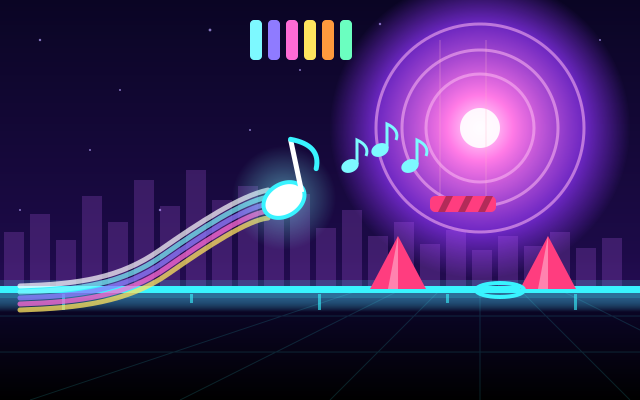
The art direction is the most confident thing about it. Cel-shaded characters with heavy, deliberate silhouettes read instantly at speed against densely illustrated Shine City backdrops — wet asphalt, sign clutter, magenta-and-cyan light bleeding into everything. It’s a neon-noir look that a hundred indies have attempted and most have flattened into a Blade Runner screensaver. Blaze avoids that because its palette serves legibility: characters and ball pop hard off backgrounds that are busy but never competing for attention. That is a harder problem than it looks, and the design solves it.
As a 2D game of modest scope, it’s light on hardware, and its presentation is built around immediacy: hit feedback designed to be crunchy, slow-motion kill flourishes timed to punctuate rather than interrupt. Nothing here asks much of the machines it runs on.
The interface is the weakest link. Menus are competent and stylish but not especially informative, and the game does a mediocre job of teaching its deeper systems. Parry timing, special meter behavior, character-specific properties — most of that gets learned by getting killed, or by leaving the game and finding a community guide. For a title whose entire appeal is a high skill ceiling, the climbing gear is oddly hard to find. A real training mode with frame data and clear system explanations would meaningfully widen this game’s audience, and its absence is the one place laziness is a fair charge.
Platform nuances
Steam is the home version, and not by a small margin. It carries the population — such as it is — so it’s where online has any chance of matching you promptly. It’s where the competitive scene and its guides live. Full controller support is there, and it’s the right call: keyboard is playable but the game’s timing precision wants a d-pad or stick. The practical catch on PC is local multiplayer logistics — four gamepads and a couch is a setup most PC players have to assemble deliberately.
Nintendo Switch is the better social purchase. Multiple controllers in the box, a console that travels, and a control scheme simple enough that the button count never fights the hardware. The game’s readability at high ball speed is built on those heavy character silhouettes, which should survive handheld’s smaller screen better than most. Docked, it’s the party machine this game was born for.
The trade-off is real, though. The Switch online population is thinner than Steam’s, which turns an already-slow matchmaking problem into a slower one, and wireless play in a latency-critical game is a variable you don’t control. Nintendo’s US store page carries no user rating, so there’s no crowd signal there either. Pick Switch if the plan is friends in a room. Pick Steam if the plan includes strangers on the internet.
Final verdict
Lethal League Blaze is a small game that does one thing at a high level, and it does not pretend otherwise. The escalating-ball mechanic is a legitimately novel idea executed with the precision of a studio that understood exactly what it had — the feedback, the readability tricks, the music locked to the tempo of escalation. Four people in a room with this game will produce more shouting than most twenty-hour campaigns manage.
The limits are structural and honest. There isn’t much single-player content, the community is small and sharp-elbowed, and the game does too little to help newcomers cross the gap between “I hit the ball” and “I understand why I lost.” Those are real costs, and they’re why we rate this as solid rather than essential — a good game to recommend to the right audience, not a blanket one.
At $19.99, the value calculation for the right buyer isn’t close. Buy it for the room you’re in, and it will pay for itself the first night someone parries a ball moving at ridiculous speed and the whole couch loses its mind.
Reviewed by the Rankeno Action Desk. Scores are out of 10; the overall score is the desk’s editorial judgement, informed by the four sub-scores above. How we review