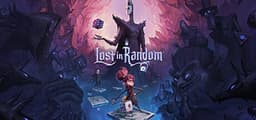
Lost in Random
game
•Updated Aug 2026SteamIndie Games

Lost in Random

Zoink built one of the most inventive combat systems of its generation — a real-time brawler crossed with a deckbuilder crossed with a literal dice roll — then stretched it across twelve hours it can't quite fill. Buy it for the writing and the art direction. Forgive it for the fourth realm.

Where it ranks in Action

Scores 7.6 against a category average of 8.6 — below the Action average, ranking 680 of 742 Action games we've reviewed.

Scores

Score breakdown

How the overall score splits across the categories we review.

Design
8.2/10
Innovation
8.8/10
Value
7.2/10
Utility
6.9/10
Price
$29.99
one-time or subscription
Released
Sep 10, 2021
Platforms
Steam · Nintendo Switch
Developer
Zoink, Thunderful
Publisher
Electronic Arts
Metacritic
78 / 100
Website
ea.com

More Steam / PC app reviewsMore Indie Games ranked by score

Quick summary

Lost in Random (Steam) — scored 7.6: Zoink built one of the most inventive combat systems of its generation — a real-time brawler crossed with a deckbuilder crossed with a literal dice ro...

Pros

  • Genuinely novel combat: real-time action, deckbuilding, and dice all doing real work
  • Ryan North's script is funny, warm, and never talks down to the player
  • Best-in-class gothic art direction with committed stop-motion animation

Cons

  • Enemy variety runs dry well before the credits, making fights repetitive
  • Uneven difficulty spikes and slack pacing in the later realms
  • Card pool isn't deep enough to force meaningful deck reinvention

Verdict

Is Lost in Random worth it?

Lost in Random is the kind of failure I'd rather have than most successes. It gambled on a hybrid nobody asked for, executed the first six hours of that hybrid brilliantly, and then discovered it didn't have the enemy variety or card depth to sustain the next six. That's a content problem, not a design problem — and content problems are what happen to studios working at this budget with this much ambition.

The 89% player score versus the 73-ish critic average isn't a mystery. Critics finish games; players fall in love with them. If you go in for Even, Dicey, and a kingdom where the poor live at the mercy of a rich woman's dice, you will get everything you came for and shrug off the fights that overstay. If you go in expecting a combat system that keeps unfolding, the fourth realm will tell you the truth.

Full price is a stretch. On sale, it's an easy recommendation and a reminder that EA Originals, whatever else the publisher does, occasionally funds something with a genuine idea in it.

Pros

  • Genuinely novel combat: real-time action, deckbuilding, and dice all doing real work
  • Ryan North's script is funny, warm, and never talks down to the player
  • Best-in-class gothic art direction with committed stop-motion animation
  • Theme and mechanic are fully aligned — chance as both metaphor and verb
  • Strong voice acting and memorable NPCs make exploration worthwhile

Cons

  • Enemy variety runs dry well before the credits, making fights repetitive
  • Uneven difficulty spikes and slack pacing in the later realms
  • Card pool isn't deep enough to force meaningful deck reinvention
  • Linear structure, negligible replay value after one ~10–12 hour run
  • Frame pacing hitches on Switch; dense card text is rough in handheld

Pricing: $29.99

From Rankeno

Our verdict, on your site

A scored review out of 10 and a permanent review page on rankeno.com. Submit your app and see where it stands.

Get reviewed

Gallery

Screenshots

4 screenshots · tap to enlarge

What stands out

Key features

  1. Dice-Gated Card Combat: Even's slingshot shatters crystals on enemies, generating energy that draws cards. Throwing Dicey freezes time entirely; the roll dictates how many card-pips you can spend on weapons, traps, buffs, or summons before the world unpauses. It is a tactical pause layered inside an action game, and it works.
  2. A Deck You Actually Build: Cards are bought, earned, and quested for. You curate a ~15-card deck that shapes your entire approach — cheap weapon-spam, expensive summon-and-hide, or a trap-heavy control build. Dicey's faces are upgradable, letting you skew the randomness in your favor.
  3. Six Realms, Six Rulesets: The kingdom of Random is carved into distinct zones, each with its own visual identity, social order, and relationship to chance — from a slum where nothing is decided by dice to a gleaming capital where everything is.
  4. Ryan North's Script: Roughly a hundred NPCs who are all someone, delivered with genuinely strong voice direction. The narrator alone is worth the price of entry.

Full review

Lost in Random in depth

Bottom Line: Zoink built one of the most inventive combat systems of its generation — a real-time brawler crossed with a deckbuilder crossed with a literal dice roll — then stretched it across twelve hours it can't quite fill. Buy it for the writing and the art direction. Forgive it for the fourth realm.

The Gameplay Loop

Combat is where the design thesis lives, so let's be precise about how it actually feels moment to moment.

You enter a board-game arena — the game literally frames its fights as tabletop dioramas, tiles and all — with zero cards in hand. Even is nearly defenseless. Your only tool is the slingshot, and your only job is to find the glowing crystals studding each enemy and pop them. Each crystal yields energy. Energy fills your hand. When you have cards worth playing, you throw Dicey, time stops, and you get a roll: one through six, spend that many pips, close the menu, and watch your decisions resolve in real time.

The dodge-and-harvest phase is the best part of the system, and almost nobody says so. It inverts the usual action-game rhythm. You are not looking for openings to attack; you are looking for openings to earn the right to attack. It makes Even feel appropriately small — a kid with a rock and a slingshot against clockwork horrors — and it makes the moment your deck comes online feel like a genuine turn of fortune rather than a cooldown expiring.

The problem is what happens on hour six.

Where It Thins

The system has a ceiling, and the game reaches it fast. Enemy variety is the culprit. Once you have internalized the four or five archetypes — the shielded one, the ranged one, the swarm, the big one with crystals on its back — the crystal-harvesting phase stops being a read and starts being a chore. You know where the crystals are. You know the dodge timing. You are executing a known sequence to unlock a card draw you already planned three fights ago.

The deckbuilding is supposed to be the answer to that, and it partly is. Committing to a summon-heavy build genuinely changes your positioning priorities; a trap build turns arenas into puzzles. But the card pool isn't deep enough to sustain repeated reinvention, and the game never applies real pressure to make you rebuild. A system with this much theoretical expressiveness needed encounter design that punished a stale deck, and it doesn't have one. You can finish the game on the build you settled into by realm three.

Difficulty compounds this. The back half spikes unevenly — a mid-realm fight that walls you, followed by a set piece that folds immediately — which reads less as an intentional curve than as a team running out of tuning time. Combined with a mostly linear critical path and almost no replay incentive, the tail end of the campaign is where enthusiasm goes to cool.

The Parts That Carry It

What saves the runtime is everything around the fighting. Exploration is light — chat with eccentrics, solve a modest puzzle, hunt a collectible — but the writing is dense enough that talking to a random townsperson is reliably a better use of five minutes than most open-world side content. North writes children's-adventure dialogue with actual teeth: jokes that assume you're paying attention, grief handled without a sermon, and a central relationship between Even and Dicey that earns its ending.

Dicey is the achievement here. A silent die, animated with enough personality to sell a friendship, functioning simultaneously as narrative device, combat resource, and randomness metaphor. That's tight design. The game's central theme — that chance is a system the powerful rig and the poor live under — is baked directly into the mechanic you press a button to invoke. Very few games get their theme and their verb to agree this completely.

Onboarding and Friction

The first hour asks a lot. You are being taught a slingshot, a card economy, a dice-pip budget, and a time-stop UI simultaneously, and the tutorial pacing is generous to the point of drag. Push through it. The system clicks around the second realm and never confuses you again.

Your rating for Lost in Random:
Was this helpful?

Alternatives

If not Lost in Random, then what?

Best alternatives to Lost in Random

FAQ

Common questions

Is Lost in Random worth it in 2026?

Lost in Random is the kind of failure I'd rather have than most successes. Our experts scored Lost in Random 7.6 out of 10 — recommended.

Is Lost in Random good?

With a score of 7.6 out of 10, Lost in Random lands in our recommended band. Innovation is its strongest category at 8.8 out of 10. Utility is the weakest at 6.9.

How much does Lost in Random cost?

Lost in Random costs $29.99. Its Value category scores 7.2 out of 10.

What do users like most about Lost in Random?

Genuinely novel combat: real-time action, deckbuilding, and dice all doing real work. Ryan North's script is funny, warm, and never talks down to the player.

What do users dislike most about Lost in Random?

Enemy variety runs dry well before the credits, making fights repetitive. Uneven difficulty spikes and slack pacing in the later realms.

What platforms is Lost in Random available on?

Lost in Random is available on Steam, Nintendo Switch.

Who makes Lost in Random?

Lost in Random is made by Zoink, Thunderful.

What are good Lost in Random alternatives?

The closest alternatives to Lost in Random are Whisker Squadron: Survivor, Deadlink, Mortal Shell.

Is our Lost in Random review up to date?

We last refreshed our Lost in Random review in Aug 2026.

About this review

How we scored Lost in Random

Lost in Random was scored on Design, Innovation, Value and Utility — each from 1 to 10, with the same rubric as every other game in its category — for an overall 7.6. Research and drafting follow Rankeno's fixed editorial rules; the rubric, the checks before publishing and the decision to publish are ours. Published Aug 11, 2026.

Editorial disclaimer The reviews and scores on this site are based on our editorial team's independent analysis and personal opinions. While we strive for objectivity, gaming experiences can be subjective. We are not compensated by developers for these scores.

For developers

Get your app or game reviewed

A scored review on the same rubric as this one and a permanent review page on rankeno.com. Paid tiers buy a place in the queue — never a score.

Submit for review
Embed this score badge on your site

Embed this review badge

Paste this snippet on your site to show your Rankeno score. The link back to rankeno.com is a normal link — no redirect, no tracking.

From Rankeno

Finished reading? Get your own verdict.

Submit your app for a scored review out of 10, published as a review page on rankeno.com.

7.6Lost in RandomSteam