
Overview
There’s a particular kind of nostalgia project that deserves suspicion: the one that mistakes ugly for authentic. Slap a chromatic aberration filter over some untextured cubes, add a vertex-wobble shader, call it a PS1 tribute, ship it for five dollars. The indie storefronts are lousy with them.
Lunistice is not one of those. Released November 10, 2022 by solo-ish developer A Grumpy Fox and published by Deck13 — a partnership that reads odd on paper, given Deck13’s usual business is grim Souls-likes — it is a linear 3D platformer that borrows the visual vocabulary of the 32-bit era while categorically refusing to inherit its controls. This distinction matters more than anything else about the game. The Saturn and PlayStation were graveyards for 3D platforming. Tank controls, cameras with minds of their own, jump arcs you had to negotiate with rather than command. Lunistice keeps the low-poly geometry, the flat lighting, the dithered skyboxes, and quietly throws the rest in the bin.
You play Hana, a tanuki moving through her own dreams toward the Moon. The narrative is thin by design — short interstitial text between stages, delivered with more melancholy than the pastel art direction suggests, hinting that these dreamscapes are assembled from memory rather than invention. A handful of themed worlds: an old shrine, a neon water park, an entire level built out of food. It’s the kind of premise that gives a small team permission to make whatever looks fun that week.
The market position is aggressive to the point of being unfair. At $4.99, Lunistice undercuts nearly every 3D platformer on Steam. Nintendo Life called the Switch version “an exhilarating 32-bit Sonic that never was,” which is both accurate and slightly misleading — the Sonic comparison sets an expectation of speed-as-spectacle, when what’s actually here is speed-as-precision. This is a score-attack game wearing a platformer’s clothes.
Key features
- Momentum-first movement kit: Run, double-jump, wall-jump, air dash, and spin attack — a compact set with almost no dead frames between them. Chaining is the entire skill ceiling.
- Per-stage grading with S-Rank targets: Every level closes on a screen scoring clear time, collectibles, and combo chains. The S-Rank thresholds are tuned tight enough to convert a casual run into de facto speedrun practice without ever using the word.
- Brief, tightly authored stages: Linear, no fluff, measured in minutes. Ideal for handheld bursts and near-perfect for repeat attempts.
- Unlockable second character: Finishing the game opens a second playable character with genuinely different movement properties — a lineage nod to the studio’s earlier Toree games — that forces a re-route and re-timing of stages already solved.
- A short achievement list and a tiny install footprint on Steam, a soft checklist for engaging with the ranking system.
Analysis
The Gameplay Loop
Lunistice’s loop is a two-stage bait-and-switch, and it’s the smartest thing about the design.
Stage one: it plays like a platformer. Move through a level, look around, find some collectibles, reach the goal. A couple of minutes. Pleasant, a little slight, and — reasonably — it feels understood.
Then the grading screen appears and shows a C.
Stage two is where the game actually lives. That letter grade reframes everything as a rough draft. Suddenly the level isn’t a space to explore, it’s a route to optimize. The wall bounced off was a shortcut. The spin attack conserves momentum instead of killing it. The combo counter — easily treated as decoration — is the difference between a B and an S. The game never lectures about any of this. It just shows the letter and lets ego do the teaching.
This is the correct way to build a score-attack game, and most don’t manage it. The failure mode of the genre is front-loading complexity: dumping ranking rules, multiplier systems, and leaderboard talk on players in the first ten minutes, which selects for people who already like score attack and repels everyone else. Lunistice hides the depth behind a completely functional casual experience. It can be finished in an afternoon having never engaged with a single S-Rank, and that alone is five dollars’ worth. Or the letter gets noticed, gets annoying, and eats a weekend.
The Movement Model
The physics are the load-bearing wall here, and the design holds. Hana’s air control is generous without being floaty — mid-jump adjustment is possible but a bad launch can’t be rewritten, which is precisely the balance a game built on route memorization needs. The double-jump has a clean, readable arc. The dash is a commitment: it fires fast, it fires far, and it will absolutely put a careless player into a pit.
What separates this from the crowd is friction management. In a lot of indie platformers, hitting a wall means the run is over — velocity zeroes out and rebuilds from nothing. Here, walls are surfaces to be converted. A wall-jump preserves and redirects speed rather than dumping it, which means the difference between a novice and an expert run isn’t reflexes so much as spatial planning. Experts don’t move faster. They just stop losing speed.
The spin attack deserves specific credit. It’s nominally a combat move, but its real function is as a combo tether, letting chains extend through sections that would otherwise force a reset. Enemies stop being obstacles and become momentum checkpoints. That’s an elegant piece of design economy: one button, two purposes, no tutorial required.
Onboarding and Friction
The onboarding is close to invisible, which is the right call for a game of this length. Prompts are minimal, there’s no forced tutorial stage, and the movement set is introduced by level geometry that makes the correct verb obvious. Restarts are built to be instant — critical, because S-Rank chases mean constant retries. Any perceptible load between a failed run and a fresh attempt would poison the whole design.
The friction that does exist is the camera. In fast vertical sections, particularly extended wall-jump chains, it can’t always keep up with where the player is going, and the next surface can vanish from view at exactly the wrong moment. It’s the single most consistent complaint in the user reviews and it’s a fair one. It never becomes unplayable. But on an S-Rank attempt where ninety seconds of clean routing have been nailed, losing a run to a camera swing rather than a player mistake is the kind of thing that ends a session early.
The Second Character
Post-game unlocks in short games are usually cosmetic apology gifts. This one isn’t. The second character’s altered movement properties mean the optimal route through a stage is no longer the optimal route — jump heights differ, chain timings shift, and shortcuts that worked for Hana close while new ones open. It’s not new content in the strict sense. It’s a remix key applied to content already memorized, which for a game about route optimization is worth considerably more than another two hours of levels would have been.
Visuals & performance
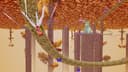
The art direction is disciplined in a way that separates it from the retro-shader crowd. A Grumpy Fox understood that the aesthetic constraint of the 32-bit era wasn’t “low resolution” — it was flat, saturated color doing the work that geometry couldn’t. The dreamscapes are built from bold blocks of pink, teal, and gold, with silhouettes readable at speed. That last part is the technical achievement. At Hana’s pace, a busy environment becomes noise, and the deliberate polygon budget doubles as legibility engineering. It’s always clear what’s a wall, what’s a platform, and what’s about to hurt.
The variety earns its keep too. A shrine, a neon water park, a world made of food — these read as a child’s dream logic rather than a designer running out of themes, and the tonal shifts land because each world commits fully to its palette.
Hardware demands are light — a low-poly game of this scope is easy on modest machines — and the design treats fast restarts as a core feature rather than a nice-to-have. For a game built around retrying a two-minute stage twenty times, that’s not a bonus; it’s the product.
The soundtrack, consistently singled out in user reviews, matches the visual brief: synth-forward, propulsive, structured around the pace of a clean run rather than sitting under it as wallpaper.
Platform nuances
Nintendo Switch is arguably the definitive version. Brief levels and instant restarts map perfectly onto handheld play — this is a game for a train ride, a lunch break, or fifteen minutes before sleep. Sleep-mode suspension means no lost progress mid-session. The Joy-Con stick is the weak link for precision dash timing; a Pro Controller is a meaningful upgrade for S-Rank chasers. The lower resolution is essentially free here, because the art style was designed for it.
Steam wins on resolution headroom and leaderboard-adjacent community infrastructure, plus the achievements act as a soft checklist for engaging with the ranking system. One firm recommendation: play it with a controller. Keyboard input works, but analog stick control over run speed is part of the momentum model, and binary WASD input flattens it. On Steam Deck it’s well suited — small download and a form factor that suits burst play as well as the Switch does.
Neither version is compromised. Pick based on where the playing will actually happen.
Not For
- Players who measure value in hours and won’t touch a grading screen.
- Anyone wanting open-world collectathon sprawl in the Banjo or Mario Odyssey mold.
Final verdict
Lunistice is not innovative. Let’s be honest about that: nearly every mechanic here has a clear ancestor, and the retro-3D aesthetic is a crowded lane. What it has instead is execution discipline — a small team that knew exactly what game it was making, built the movement system first, and refused to pad the runtime to hit an arbitrary hours-played number.
The length complaint is real but misdirected. Judging this on a short first clear is like judging a fighting game on its arcade mode. The first run is the tutorial. The actual game is the letter grade and everything done to fix it.
At $4.99 the value proposition is hard to argue with. But the reason to recommend Lunistice isn’t the price — it’s a movement model built with real care in a genre where that’s rarer than it should be. The flaws — a camera that lags in vertical sections, a thin story, a runtime that will feel slight to anyone who ignores the grading — are real, and they’re why this lands as a solid recommendation rather than an essential one. For the right player, though, the five dollars removes the last excuse.
Reviewed by the Rankeno Action Desk. Scores are out of 10; the overall score is the desk’s editorial judgement, informed by the four sub-scores above. How we review