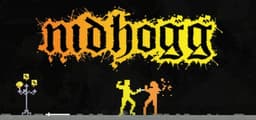
Nidhogg
game
•Updated Sep 2026SteamIndie Games

Nidhogg

Nidhogg turns fencing into a one-stab, high-speed game of chicken that you understand in 30 seconds and can keep studying for years. It is one of the best local multiplayer games ever made, but its single-player mode, arena count and netcode are all thin.

Get it$9.99

Where it ranks in Action

Scores 8.6 — in line with the Action average of 8.6 across the 745 Action games we've reviewed.

Scores

Score breakdown

How we weighted the criteria

Design
9.3/10
Innovation
9.2/10
Value
8.5/10
Utility
7.4/10

Our strongest category here is Design (9.3/10); the weakest is Utility (7.4/10).

Price
$9.99
one-time or subscription
Released
Jan 13, 2014
Platform
Steam
Developer
Messhof
Metacritic
81 / 100
Support
discord.gg

More Steam / PC app reviewsMore Indie Games ranked by score

Quick summary

Nidhogg (Steam) — scored 8.6: Nidhogg turns fencing into a one-stab, high-speed game of chicken that you understand in 30 seconds and can keep studying for years. It is one of the ...

Pros

  • Brilliantly simple stance system with enormous competitive depth
  • Tug-of-war structure keeps matches tense and comebacks always possible
  • Near-zero onboarding friction; ideal for parties and newcomers

Cons

  • Single-player content is thin and exhausted quickly
  • Only a handful of arenas for a game built on replay
  • Online play suffers from lag and a small player pool

Verdict

Is Nidhogg worth it?

Nidhogg makes an argument that a lot of modern game design has forgotten: depth comes from interaction, not accumulation. It has no skill trees, no unlock grind and no roster to balance. It has two people, two swords, three stances and a hungry worm at the end of the road, and it produces moments of tension that big-budget fighting games often struggle to match.

The limitations are real, and they're structural. If you play mostly alone, or rely on online matchmaking, you'll hit the bottom of this game fast. Give it a second controller and a willing rival, though, and Nidhogg becomes one of the most exciting 10-minute sessions available on PC. It isn't a complete package. It's a nearly perfect core, and for local multiplayer, that core is more than enough.

Pros

  • Brilliantly simple stance system with enormous competitive depth
  • Tug-of-war structure keeps matches tense and comebacks always possible
  • Near-zero onboarding friction; ideal for parties and newcomers
  • Striking, highly legible pixel art and an excellent Daedelus soundtrack

Cons

  • Single-player content is thin and exhausted quickly
  • Only a handful of arenas for a game built on replay
  • Online play suffers from lag and a small player pool
  • Value depends almost entirely on having local opponents

Pricing: $9.99

From Rankeno

Today's top charts

The daily chart ranks our newest scored reviews — see which titles lead today.

Open the daily chart

Gallery

Screenshots

3 screenshots · tap to enlarge

What stands out

Key features

  1. Three-Stance Fencing System: You hold your blade high, middle or low. Matching your opponent's height parries. Striking from the right angle disarms them. Switching stance at the right moment gets you past their guard. The whole combat model rests on this one idea.
  2. One-Hit Kills: A single stab ends an exchange. That removes health-bar attrition entirely and turns every approach into a high-stakes read.
  3. Expanded Movement Vocabulary: You can lunge, throw your sword, dive-kick, roll, jump over an opponent, wall-jump, or fight with your fists after losing your blade. Each option has a clear risk and a clear counter.
  4. Territorial Tug-of-War Structure: Kills earn you forward movement, not points. The match flows back and forth across multi-screen arenas.
  5. Multiple Modes: A single-player tournament against AI, local versus, online matchmaking, and bracket-style tournament modes for groups.
  6. Distinct Arenas: Castle, mines, clouds and a wilderness stage. Each one changes sightlines, footing and chokepoints.
  7. Daedelus Soundtrack: The electronic score from producer Daedelus shifts with the action and gives each run a jittery, propulsive pulse.

Full review

Nidhogg in depth

Bottom Line: Nidhogg turns fencing into a one-stab, high-speed game of chicken that you understand in 30 seconds and can keep studying for years. It is one of the best local multiplayer games ever made, but its single-player mode, arena count and netcode are all thin.

The Gameplay Loop: Chess at 60 Frames per Second

Nidhogg's genius is in what it leaves out. There are no combos, no meter management and no character select. There's spacing, timing and stance, and those three variables produce a surprising amount of depth.

A typical exchange goes like this. You and your opponent close the distance with swords at mid height. They flick theirs low. Do you match them and parry, or go high and risk them reading you? Maybe you back off half a step to bait a lunge, then punish the recovery. Or maybe you throw your sword, a desperate, committal move that wins instantly if it lands and leaves you unarmed if it doesn't. Either way, the exchange usually ends in under two seconds, and the loser has already respawned in front of you.

That respawn is the game's most important design decision. Because the losing player reappears ahead of the winner, the game constantly tests the winner's aggression. You have right of way, but you also have a problem: someone fresh, armed and angry is standing between you and the goal. Do you engage or try to slip past? Jumping over an opponent is legal, and against a player who has fixated on your blade height, it's often the correct play. Rolling under a high guard works too. In Nidhogg, evasion is as important as offense. Few fighting games dare to make running away a legitimate win condition.

Depth Without Friction

The onboarding friction is close to zero. Hand a controller to someone who has never played a fighting game, and within a minute they'll understand what up and down do to the sword. Within five, they'll be throwing it. That accessibility is why the game shines at parties. Nobody needs a tutorial, and nobody feels locked out.

The skill ceiling is steep, though. Experienced players learn to feint stance changes, flickering the blade between heights to draw a parry attempt and then punishing the commitment. Disarms become a primary goal rather than a lucky accident, because an unarmed opponent is forced into fistfights or a scramble for the dropped blade. Arena knowledge matters too. The mines' tight corridors reward patient pokes, while the open clouds stage invites aerial dive-kicks. Two skilled players produce matches that look chaotic to onlookers but are really dense sequences of reads and counter-reads.

This is the same quality that makes Street Fighter endure, compressed into a game with about eight inputs. It's a remarkable feat of design reduction.

The Weak Link: Playing Alone

Nidhogg's structure is also its biggest limitation. The game gets nearly all of its value from another human's psychology, so the single-player mode is a practice room at best. The AI tournament teaches you the systems, but the computer doesn't bluff the way a person does. It doesn't get tilted after losing three screens of ground, and it doesn't do anything stupid out of spite. Once you've beaten it, there's little reason to go back.

The content footprint is small too. Four core arenas carry a game meant to be played for dozens of hours. The mechanics are deep enough that the matches stay fresh, but the scenery doesn't. Anyone hoping for unlockables, cosmetic progression or a meaningful solo campaign will be let down. Nidhogg doesn't pretend to offer those things, and that's honest. It also means the game's value depends almost entirely on your social circle.

Online Play: The Asterisk

Nidhogg's design is extremely sensitive to latency. When one stab kills and exchanges resolve in a few frames, a network hiccup of 100 milliseconds isn't a small annoyance. It's the difference between a parry and a death. Player reports consistently describe online matches as laggy, inconsistent and hard to find, and the shrinking player pool of an older title makes matchmaking worse. Online play works as a backup option, but you shouldn't buy the game for it. Nidhogg was built for two people sitting next to each other, and that's still where it belongs.

Tournament Mode and Group Play

The tournament and bracket modes are an underrated strength. At a gathering of four to eight people, Nidhogg becomes a spectator sport. Its readability is excellent: anyone watching can instantly see who has right of way, where the fight is, and how close someone is to winning. Every comeback gets a reaction from the room. Few games handle a pass-the-controller format this well.

Your rating for Nidhogg:
Was this helpful?

Alternatives

If not Nidhogg, then what?

Best alternatives to Nidhogg

FAQ

Common questions

Is Nidhogg worth it in 2026?

Nidhogg makes an argument that a lot of modern game design has forgotten: depth comes from interaction, not accumulation. Our experts scored Nidhogg 8.6 out of 10 — recommended.

Is Nidhogg good?

With a score of 8.6 out of 10, Nidhogg lands in our recommended band. Design is its strongest category at 9.3 out of 10. Utility is the weakest at 7.4.

How much does Nidhogg cost?

Nidhogg costs $9.99. Its Value category scores 8.5 out of 10.

What do users like most about Nidhogg?

Brilliantly simple stance system with enormous competitive depth. Tug-of-war structure keeps matches tense and comebacks always possible.

What do users dislike most about Nidhogg?

Single-player content is thin and exhausted quickly. Only a handful of arenas for a game built on replay.

What platforms is Nidhogg available on?

Nidhogg is available on Steam.

Who makes Nidhogg?

Nidhogg is made by Messhof.

What are good Nidhogg alternatives?

The closest alternatives to Nidhogg are Nex Machina, Into the Radius, Killer7.

Is our Nidhogg review up to date?

We last refreshed our Nidhogg review in Sep 2026.

About this review

How we scored Nidhogg

Nidhogg was scored on Design, Innovation, Value and Utility — each from 1 to 10, with the same rubric as every other game in its category — for an overall 8.6. Research and drafting follow Rankeno's fixed editorial rules; the rubric, the checks before publishing and the decision to publish are ours. Published Sep 28, 2026.

Editorial disclaimer The reviews and scores on this site are based on our editorial team's independent analysis and personal opinions. While we strive for objectivity, gaming experiences can be subjective. We are not compensated by developers for these scores.

Publish an app? Submit it for review

Embed this score badge on your site

Embed this review badge

Paste this snippet on your site to show your Rankeno score. The link back to rankeno.com is a normal link — no redirect, no tracking.

From Rankeno

Keep reading

More scored reviews from our editors — verdicts, alternatives and head-to-heads.

8.6NidhoggSteam