
Overview
Most music software starts by asking a question most people can’t answer. What tempo? What key? Which of these 47 drum kits? ODDADA never asks. It hands you a train.
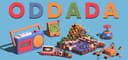
Built by a three-person German team — Sven Ahlgrimm, Mathilde Hoffmann and Bastian Clausdorff — and published by Ahlgrimm, ODDADA is a music-making toybox wearing the clothes of a puzzle game. It launched on Steam August 15, 2024 at $9.99. You shepherd a small tune-train through a chain of miniature dioramas. Each stop is a self-contained contraption stuffed with odd creatures, crooked little houses and machinery that looks assembled from a cuckoo clock and a toolbox. Each contraption is also an instrument. Poke it, drag it, wind it, rearrange its guts — and everything done to it is recorded as a layer in a track that’s quietly accumulating underneath. Melody stacks on harmony stacks on percussion stacks on texture. At the last stop, those layers get arranged into a finished song, pressed onto a virtual cassette, decorated, and exported as an audio file.
That’s the whole pitch, and the positioning is unusually honest about it. This is not a DAW, not a rhythm game, not Fuser or Dropmix or any of the other licensed-stem karaoke machines the industry keeps producing. The closest relatives are the “digital toy” lineage that runs from Toshio Iwai’s Electroplankton through Plasticity’s Fract and the Playdead-adjacent world of tactile Flash experiments — software you play the way you play a kaleidoscope. The market for that is real but small, and ODDADA’s warm critical and community reception fits: outlets including TheGamer, Digital Trends and Console Creatures filed it under “best digital toys of the year,” a category that is either a compliment or a ceiling depending on your mood.
There are no scores, no timers, no failure states. The explicit target is people who don’t consider themselves musicians — which is nearly everyone, including people who own guitars. Windows and macOS, with Steam Deck support.
Key features
- Layer-by-travel composition: Every world is one instrument and one recording pass. Progression through the level is the arrangement process, so structure emerges without anyone ever showing you a timeline.
- Randomized level and instrument pools: Runs draw from a shared pool, so no two journeys assemble the same set of machines. New contraptions unlock as you keep playing.
- The cassette: Finished songs are pressed onto a decorateable virtual tape — reorderable, collectible, and exportable as a real audio file you can keep or share.
- Zero-friction onboarding: No key selection, no tempo picker, no scales menu. Theory is enforced by the instruments themselves rather than taught.
- No fail states whatsoever: No score, no timer, no lose condition. The only way to make a bad song is to stop early.
Analysis
The Gameplay Loop
ODDADA’s central design trick is that it removes every decision that would produce a wrong answer, then makes the remaining decisions feel enormous. You cannot play an out-of-key note because the contraption in front of you doesn’t contain one. You cannot fall off the grid because the grid is doing the timekeeping. What’s left is expression — when, how hard, in what order, how many — and that turns out to be plenty.
Each stop follows the same rhythm: arrive, prod, understand, perform. The prodding phase is the good part. A machine gives almost nothing in the way of instruction; the affordances are found by grabbing things. A creature’s beak opens when dragged. A hatch on a house is actually a step sequencer. A winding handle changes the pitch envelope rather than the speed — a discovery that comes from cranking it and being wrong about what would happen. The moment where a contraption stops being a picture and becomes an interface is the single most reliably delightful beat in the software, and it lands again at every stop.
Then the discovery ends, and it ends fast. This is the structural tension at the heart of ODDADA. Its best resource is surprise, and surprise is not renewable. A machine that’s been solved is a machine that’s now merely operated. The randomized pool is the team’s mitigation — shuffle the deck, unlock new cards — and it works for a while, but a shuffled deck of known cards is a different pleasure than a new deck. Within a handful of runs the setups start repeating; past that point, the game stops being exploration and becomes performing a repertoire.
Where the Design Stops Short
The most common player complaint, and the one worth co-signing hardest, is the shallowness of the final arrangement stage. A run generates six or seven layers of raw material with real character, and then the tool for shaping them into a song is comparatively blunt. Layers can be arranged. They cannot really be edited — no punching in a fix on one bad take, no trimming a phrase that overstays, no tightening a transition that lands a half-beat off. When a layer is 90% right, the option is to accept the 10% or regenerate the whole thing.
That’s a defensible line for a toy to draw. The entire proposition is “no intimidating controls,” and every editing affordance added is a step back toward the blank-timeline anxiety ODDADA was built to abolish. But there’s a version of this that ships an optional, dead-simple post-pass — mute a layer, retake a layer, shorten the outro — that would cost almost no cognitive load and would meaningfully raise the ceiling on what leaves the export dialog. The team chose purity, and overcorrected by one notch.
Onboarding and Flow
The onboarding is close to exemplary, and it’s worth being specific about why: ODDADA never separates learning from doing. There is no tutorial layer, no tooltip regime, no gating. The instruments are legible because they’re physical metaphors, and physical metaphors carry their own instructions. A crank suggests cranking. A row of pegs suggests a sequence. This is skeuomorphism used for the reason skeuomorphism was invented, rather than as decoration.
The flow state the design produces is genuinely notable. There’s no timer, no meter draining, nothing asking for attention beyond the machine in front of you, and the audio feedback is built to be immediate, so experimentation never has to feel like a submitted guess. Tight input-to-sound timing isn’t a bonus here — it’s a structural requirement, because the illusion of touching an instrument dies the instant a poke and the resulting note stop feeling simultaneous.
One friction point deserves flagging: the run length is fixed by the journey, not by the player. Anyone deep in a contraption they love still gets nudged onward by the train’s structure, and there’s no real facility for camping on one instrument and milking it for ten minutes. The pacing is the game’s, not yours — a reasonable call for a first-time player, an increasingly noticeable one for a returning one.
Visuals & performance
The art direction is the reason this thing gets written about, and it earns the attention. Everything reads as handmade: slightly wobbly linework, materials that suggest felt and painted tin and cardboard, creatures designed with the specific unsentimental weirdness of good children’s-book illustration rather than the rounded corporate cuteness that dominates the indie storefront. Nothing is glossy. Nothing is chrome. The palette runs warm and a little dusty.
Crucially, the visual design is functional as well as pretty. Interactive things look grabbable — they have handles, hinges, knobs, and a slight idle animation that invites touching. The UI proper is nearly invisible; ODDADA builds a multi-track recording tool with essentially no menus, which is a harder engineering and design problem than the friendly surface lets on.
Performance demands are unremarkable by design. The art style is stylized rather than expensive, the scenes are bounded dioramas, and a 2D toy of this scope is light on hardware. The technical requirement that actually matters here isn’t framerate — it’s audio timing, and the design is built around keeping it tight.
Platform nuances
On Steam with a mouse, ODDADA is in its natural habitat. The cursor is a precise, single-point pointer, which maps cleanly onto a design built around grabbing one small thing at a time. Drag, release, crank, repeat. There’s no awkward translation layer.
Steam Deck is where things get more interesting, and slightly more compromised. Driving a fundamentally point-and-drag interface with a thumbstick or trackpad adds a layer of mediation between hand and object — steering a cursor toward a knob instead of reaching for it. It’s perfectly playable, and the Deck’s form factor suits the couch-toy use case beautifully. But the Deck has a touchscreen sitting right there, and every minute spent nudging a cursor across a diorama that could be poked directly is a minute the design is quietly arguing with its own hardware.
This is also the cleanest explanation for the loudest unfulfilled community request: an iPad version. That request isn’t a platform preference, it’s a design critique. ODDADA’s entire vocabulary — poke, drag, wind, rearrange — is the vocabulary of fingers on glass. The mouse is a very good translation of that. It is still a translation. No mobile or tablet release has materialized, and until one does, the software runs slightly below its own ceiling on every platform it ships on.
Final verdict
ODDADA does the hardest thing in its category: it makes a person who “isn’t musical” produce something they’re proud of, without lying to them about it. The song that comes out is really theirs. Every decision in it was one they made. That’s a design achievement that a hundred better-funded music apps have failed at while offering ten times the features.
What it doesn’t do is sustain. This is a strong short-form experience with a long, gentle tail rather than a hobby to return to for a year, and the missing edit layer sets its ceiling lower than its craft deserves. Three people built something with more personality than most studios manage with forty; that’s a trade worth having. But the wish list here isn’t nitpicking — it’s a roadmap the team could still walk, and the community requesting an iPad build and finer song control isn’t complaining, it’s asking for more of something it loves.
At $9.99, it’s an easy recommendation for the right audience — digital-toy devotees, DAW-shy beginners, families — and a weekend rather than a season. Export everything.
Reviewed by the Rankeno Puzzle & Casual Desk. Scores are out of 10; the overall score is the desk’s editorial judgement, informed by the four sub-scores above. How we review