

Overview
Most games sell you a fantasy. Ravenfield sells you a dial.
Johan “SteelRaven7” Hassel’s low-poly first-person shooter arrived on Steam Early Access on 18 May 2017, supporting Windows, macOS, and Linux, and its entire design philosophy fits in one slider: how many bots do you want? Dozens. Hundreds. As many as a given machine will tolerate. You play a single rifleman on the Blue team, fighting the Red team across large conquest maps, capturing and holding flag points while an AI war grinds on around you with or without your help. That last part matters more than it sounds.
Positioned against the genre’s institutional heavyweights — the Battlefield machine, Arma‘s simulation orthodoxy, the endless live-service treadmill — Ravenfield is something closer to a toy. A very good toy. It has no official multiplayer, no seasons, no battle pass, no roadmap that anyone can meaningfully hold the developer to. What it has instead is scale unusual at this price point and Workshop support deep enough to function as a second development studio.
The market response has been lopsided in a way professional criticism never quite accounted for. Steam’s aggregate user sentiment is overwhelmingly positive — a reception that puts a one-person Early Access project in the same neighborhood as games with a hundred credited designers. Contemporary press coverage was markedly cooler: PC Gamer and Kotaku both flagged it as glitchy, with Kotaku describing portions of it as barely functional. Both readings are correct. That contradiction is the most interesting thing about this game, and it’s where any honest review has to start.
Ravenfield is not a polished product. It’s a physics playground with an unusually generous attitude toward what you’re allowed to do inside it, and in the years since launch, the community has done considerably more with that permission than the developer has.
Key features
- Scalable bot counts: The headline feature and the load-bearing one. Set infantry numbers from a skirmish to a mass-casualty event; the same build serves a laptop and a desktop alike. Performance is a setting, not a lottery.
- Active ragdoll physics: Soldiers aren’t animated corpses — they’re simulated bodies fighting to stay upright. Firefights read as half tactical engagement, half slapstick, and the difference between those two registers is often a single unlucky grenade.
- Full combined-arms arsenal: Infantry weapons plus ground vehicles, tanks, helicopters, jets, and boats. Nothing is gated behind unlocks or grind.
- Steam Workshop modding: The real product. A vast catalog of community maps, weapons, vehicles, skins, and total-conversion game modes, installed with one click. This is where Ravenfield stopped being a game and became a platform.
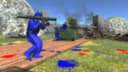
- Team-colored blood splatter: A genuinely smart readability hack — blue and red spray tells you at a glance which way a contested point is trending, no minimap required.
- Granular match configuration: Difficulty, team sizes, vehicle availability, and match parameters are all exposed. The game will coddle a newcomer or bury a veteran depending entirely on how it’s set up before pressing start.
Analysis
The Gameplay Loop
Ravenfield’s loop is conquest, stripped to the studs. Capture flags. Hold flags. Deplete the enemy ticket pool. Repeat on a different map with different toys. There is no campaign, no progression system, no narrative scaffolding. If you need a game to tell you why you’re fighting, this is the wrong purchase.
What replaces structure is emergent scale. Because the AI actually fights the war independently of you, every match produces a front line you can read — a place where blue and red gore has soaked into the same patch of hillside. You can slot into that line as a grunt. You can flank it in a jeep. You can take a helicopter behind it, land badly, and spend the rest of the round as an accidental one-man insurgency in the enemy backfield. All three are viable, and the game never signals a preference. That’s rarer than it should be in a genre obsessed with funneling players toward intended experiences.
The AI is the load-bearing element and the weakest link simultaneously. At its best, it produces convincing pressure: bots push objectives, pile into vehicles, and generate the chaotic mid-field churn that makes the whole thing sing. At its worst — and it reaches its worst regularly — bots drive a tank into a lake, sprint past an undefended flag, stall out at a piece of terrain geometry, or unload a full magazine into a wall. Erratic is the fairest word. The scale papers over it, because when the field is crowded, the few doing something stupid become background texture rather than a broken encounter. Drop the count low and the seams show immediately. That’s a real design dependency, not a nitpick: Ravenfield’s AI is only convincing in aggregate.
Combat Feel
Gunplay is serviceable rather than exceptional. Weapons have distinct handling and enough kick to feel consequential, but nothing here approaches the tactile authority of a Tarkov or the crispness of a modern Call of Duty. The recoil and hit feedback are functional. They’re the delivery mechanism, not the attraction.
The attraction is what happens after the bullet lands. Active ragdoll turns every death into a small, unrepeatable piece of physical comedy — soldiers stumbling, pinwheeling off ledges, getting launched by explosions into arcs no animator would ever have approved. It’s the same trick Totally Accurate Battle Simulator built a career on, applied to a first-person shooter and, critically, played mostly straight. Ravenfield isn’t winking at you. It presents its war seriously and lets the physics engine undercut it, which is funnier than a game trying to be funny.
Onboarding and Interface
Onboarding friction is low, and mostly by accident. There’s no tutorial worth the name; there’s a configuration screen, and then there’s a battlefield. The controls are standard WASD-shooter convention, so anyone who has played a military FPS in the last two decades is oriented within moments.
The menus are where the age shows. The pre-match setup screen is a utilitarian stack of sliders and dropdowns — clear enough once you know what you’re looking at, but it commits the classic sandbox sin of exposing every knob without explaining which ones change the game and which ones change the feel of the game. A first-timer will scroll past three settings that would have transformed their session. There’s no preset system worth using, no “recommended” configuration, no guidance at all. Form isn’t losing a war against function here so much as both sides have gone home.
The Workshop Is the Real Game
Strip the mods away and Ravenfield is a good, rough, limited curiosity. With the Workshop attached, it’s effectively bottomless. A vast library of community items covers everything from detailed historical weapon packs to full conversions that rebuild the game around Vietnam, Star Wars, World War II, or whatever a modder felt like at the time. The barrier is one click.
This is where the developer made his smartest decision: the modding pipeline is deep enough to replace maps, weapons, vehicles, skins, and game modes. When a community can rewrite your game modes, you’ve stopped shipping a game and started running an engine. That stretch of infrequent official updates would have killed most Early Access titles. Ravenfield survived because the Workshop kept shipping on a schedule the developer did not.
That’s an achievement and an indictment in the same breath. The most common complaint in the game’s reviews isn’t a bug — it’s the absence of official multiplayer, a feature the game’s own architecture practically begs for and has never received. A hundreds-of-bots conquest sandbox with co-op would be a substantially different, arguably better game. Instead it’s a solo experience with an asterisk that has now outlived several console generations.
Visuals & performance
The low-poly art direction is an engineering decision dressed up as an aesthetic one. Flat-shaded, angular soldiers and blocky terrain are a stylistic nod to a decade of indie minimalism, and they’re also what makes very large numbers of simulated combatants possible on modest hardware. Style and performance budget are the same decision here, and it holds up better than photoreal contemporaries from 2017 do.
It has a distinct visual identity. Silhouettes read cleanly at distance, team colors are unmistakable, and the team-colored blood turns the environment itself into a battle log. Late in a long match, a map tells you its own history: the ridgeline soaked in blue, the courtyard entirely red. Few shooters communicate match state this clearly.
Performance flexibility is a strong technical pillar. Because the primary cost driver is exposed as a user-facing slider, the design makes unplayable configurations largely a matter of user choice — tune down until it runs. That said, the physics simulation is the bottleneck, not the rendering, so bot counts near the ceiling will strain processors in ways resolution settings can’t offset. Know which dial you’re turning.
Stability is the soft spot, and the professional criticism was not wrong. Vehicle physics can go haywire. Bots get stuck. Mod combinations can conflict in ways nobody has any incentive to debug, and a session can end in a frozen or broken state. None of this is fatal to a sandbox — you restart and get a different war — but it would be disqualifying in a product charging a premium, and it deserves naming rather than excusing.
Platform nuances
On Steam, the storefront doubles as infrastructure. Workshop integration is the game’s life-support system, and it works exactly as it should — subscribe, launch, content is there. No external mod managers, no manual file surgery, no dependency hell. For a genre where modding usually means a Discord link and a folder full of DLLs, that friction reduction is worth real money.
The mouse-and-keyboard control scheme is the only one that makes sense, and the game is built accordingly: precise aim, instant weapon switching, and flight controls for helicopters and jets that reward practice more than analog input. Controller play is possible and consistently worse, particularly in aircraft.
Cross-platform support for macOS and Linux is a welcome and increasingly rare courtesy, though Windows remains the primary target and the Workshop ecosystem is built and tested by Windows users first. Linux and Mac players should expect the base game to behave and the more ambitious total-conversion mods to be a coin flip.
The Early Access tag is its own platform nuance. Steam’s refund window and review system have effectively functioned as the game’s QA department for years, and the overwhelmingly positive aggregate suggests buyers made peace with the arrangement a long time ago.
Final verdict
Ravenfield is the rare case where the crowd and the critics were both right and simply weighted the same facts differently. The press saw an unfinished, buggy Early Access shooter from a solo developer and said so. Players saw a war sandbox that costs $17.99, is light on hardware, never stops producing new situations, and comes bolted to a modding community that has kept it alive through years of infrequent official updates. Neither group is wrong. One of them is having more fun.
What holds up under scrutiny is the engineering judgment. Choosing an art style that doubles as a performance budget, exposing the primary cost driver as a slider, and building mod hooks deep enough to let strangers replace your game modes — those are three decisions that compound, and together they explain the game’s longevity. Most live-service shooters with real budgets can’t claim that.
What doesn’t hold up is the follow-through. A game this architecturally suited to co-op shipping years without multiplayer amounts to an unrealized feature, and anyone who has ever wanted to show a friend the tank they just flipped into a lake will feel its absence. The Early Access label has stopped meaning “in progress” and started meaning “this is the shape it will keep.”
We recommend it — for the right audience. Set the bot count higher than is reasonable, install a stack of mods, and accept that this is a physics engine with opinions rather than a finished product. On those terms, at $17.99, the value is easy to defend; as a complete game, it remains a solid but flawed proposition.
Reviewed by the Rankeno Action Desk. Scores are out of 10; the overall score is the desk’s editorial judgement, informed by the four sub-scores above. How we review