Overview
Rhythm games have a bad habit of confusing difficulty with depth. Somewhere between DDR and Guitar Hero, the genre decided that legitimacy meant more lanes, more buttons, more plastic peripherals bolted to your living room floor. SURT, a small Norwegian studio, went the other way. Rhythm Sprout: Sick Beats & Bad Sweets, published by tinyBuild and released February 1, 2023, asks for exactly three inputs: left, right, and forward. That’s the whole instrument.
The pitch is deliberately stupid, and the game knows it. You are Sprout, the Chosen Onion, a career-ambivalent hero conscripted to save the Vegetable Kingdom from an invading army of sentient candy that has made off with the princess. It’s a setup engineered to justify boss fights against anthropomorphic gummy bears, and it never pretends otherwise. The script breaks the fourth wall constantly, the NPCs hand you side requests with the cheerful bureaucracy of an MMO quest board, and the whole thing plays like a Saturday morning cartoon that read too much internet.
Positioned against the genre’s heavyweights, this is a boutique release, not a platform. Where Beat Saber and osu! sell an infinite content firehose of user charts and licensed DLC, Rhythm Sprout sells a small set of handcrafted levels, each an original track paired with a bespoke 3D environment built to match its genre — EDM, K-pop, drum’n’bass, disco, metal, lo-fi hip-hop. Nothing here is procedurally spat out or licensed off a Spotify playlist. Every stage is authored.
The market has responded warmly. On Steam the game sits at Very Positive, a healthy showing for a rhythm title with no marketing budget and no plastic guitar attached. That reception also tells the honest truth about its commercial footprint: this is a cult favorite, not a phenomenon. It earned its audience one word-of-mouth recommendation at a time, and that audience is remarkably consistent about both what it loves and what it wishes were different.
Key features
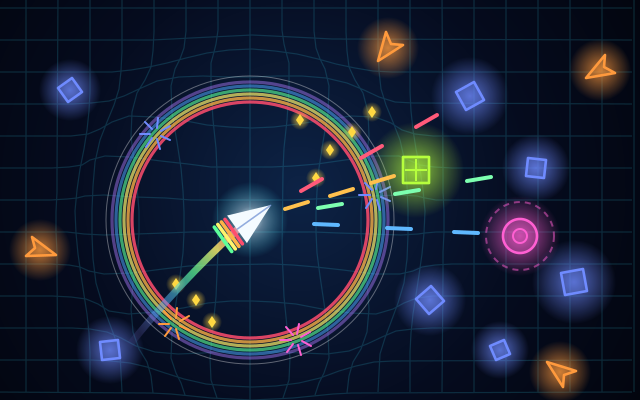
- Three-Lane Input Model: Notes travel down a winding path toward Sprout; you tap left, right, or forward on the beat. Chained hits slash through candy enemies, dodge hazards, and carry you through boss phases. The entire skill ceiling is built on timing and pattern reading, not finger gymnastics.
- Original Tracks, Bespoke Environments: Each level is a matched pair — an original composition and a 3D world designed around its musical identity. The K-pop stage doesn’t look like the metal stage. This is the game’s single largest production investment and it shows.
- Stackable Modifiers: Turbo, Mirror, Shuffle, and Totally Random can be layered on top of one another, turning memorized charts into fresh problems. Stack Turbo and Mirror on a chart you’ve S-ranked and you’re effectively sight-reading again.
- Hardcore Remix Charts (EX): Post-story unlocks that re-chart existing songs at genuinely punishing density. This is where the game finally stops holding your hand, and where veterans should have been aimed from the start.
- Fourth-Wall-Breaking Narrative: Dialogue-driven interstitials, pop-culture gags, and kingdom-resident side quests stitched between stages.
- Score Chasing: Leaderboards, gimmick bonus levels, cosmetic character customization, and a Steam achievement track.
Analysis
The Gameplay Loop
Three inputs. That’s the design thesis, and everything good and frustrating about Rhythm Sprout radiates outward from it.
The immediate consequence is near-zero onboarding friction. There is no tutorial to endure, no chart-reading vocabulary to learn, no moment where a wall of eight-lane notes convinces anyone the genre isn’t for them. The game makes sense in eight seconds. Compare that to osu!mania‘s hostile first hour or the physical learning curve of a Guitar Hero fretboard, and the appeal is obvious — SURT built a rhythm game for people who bounced off rhythm games.
But three lanes force a specific compositional strategy, and this is where the design gets clever. With so few positions, difficulty can’t scale horizontally — it can only scale through density, syncopation, and speed. The charts respond by getting rhythmically ambitious rather than mechanically wide. A hard section in Rhythm Sprout isn’t hard because of six columns to track; it’s hard because the note spacing has slipped into triplets against a four-on-the-floor kick and the hands want to resolve to the wrong subdivision. That’s a more musical kind of difficulty. It teaches listening instead of scanning.
The winding path is the second smart call. Rather than a static vertical highway, notes approach along a curving track through the level geometry, which means chart readability becomes a level-design problem as much as a UI one. It mostly works. Turns are telegraphed, the approach lane stays legible at speed, and the camera resists the temptation to show off during passages where stable information matters. Mostly.
Where the Model Strains
Here’s the honest criticism, and Steam reviewers hit it consistently: for the first few hours, the ceiling is too low.
Anyone who has spent real time with rhythm games will find the story mode’s normal charts feel like a warmup that never ends — stages cleared on a first attempt while reading NPC dialogue with the other half of the brain. The satisfaction of a rhythm game comes from the gap between what a player can do and what the chart demands — and for a veteran, that gap doesn’t meaningfully open until the EX remixes unlock. Gating the best content behind the easiest content is a structural mistake. Those charts are the real game. They should be reachable sooner.
The other structural issue is duration. The story wraps in a handful of hours. For a rhythm game, that’s a defensible number — the genre has always been about replay rather than runtime, and nobody complains that Tetris is short. But Rhythm Sprout spends a lot of its energy on narrative, jokes, and character, and narrative sets expectations that a score-attack loop doesn’t. When the story ends that quickly, the ending lands as an interruption rather than a resolution.
The Replay Answer
To SURT’s credit, the modifier system is a real answer rather than a checkbox. Stackability is the key insight: Mirror inverts muscle memory, Shuffle rearranges note assignments, Turbo compresses the reaction window, and Totally Random throws out the chart’s structure entirely. Combine them and a mastered song becomes a legitimately different exercise. This is a smarter approach to longevity than most rhythm games manage — it multiplies a short track list into a much larger practical library without asking the composers for another note.
The caveat is that modifiers only extend content a player already likes. The song list is small. If a few tracks don’t land — and with genres this scattered, some won’t — Turbo doesn’t fix that. Compared with the effectively infinite catalogs of the games it will inevitably be shelved next to, the track list is the ceiling nobody can mod their way past.
The Comedy
The writing is funnier than it needs to be, which is a real compliment in a genre where story is usually a loading screen. The fourth-wall gags land more often than they don’t, and Sprout’s reluctance is a good running joke. But comedy is the most perishable content in games. On a second run it’s mashing through dialogue already heard, and a game built substantially on jokes has a shorter shelf life than one built on charts alone. That’s a structural cost, not a criticism of the jokes themselves.
Visuals & performance
The art direction is the most confident thing here. Bright, saturated, chunky low-poly worlds with a candy-store palette that never tips into eye strain — impressive restraint given the subject matter. The commitment to giving each track its own environment is the kind of expensive decision small studios usually cut first, and it’s the reason the game reads as handcrafted rather than templated.
More importantly, the visual language serves the mechanic. Enemy silhouettes are designed to be readable at speed. Hit feedback is punchy without smearing the screen in particles that would obscure the next note — a discipline a lot of flashier rhythm games lack. The interface stays out of the way. UI in this genre has exactly one job — show where the note is and whether it was hit — and Rhythm Sprout is built to do that job without decoration.
Performance design is the other non-negotiable. A rhythm game with inconsistent frame pacing isn’t a flawed game; it’s a broken one, because input latency is the entire product. A low-poly game of this scope is light on hardware, which matters more than any visual feature it could have shipped. The calibration tooling is present and functional, and it should be used — on any modern display, running uncalibrated is the difference between charts that feel tight and a game that feels like it hates you.
Platform nuances
Steam is the definitive version, and not by a small margin. PC offers the lowest-latency path, leaderboards with a populated pool of competitors, the full achievement track, and the option to play on a keyboard. Keyboard is the right call here — three inputs mapped to three keys means zero travel, zero stick deadzone, zero controller-polling overhead. Purists will use a low-latency wired setup and a display in game mode, and the design rewards that.
Nintendo Switch is the version most people will actually enjoy. The three-button scheme was practically designed for a handheld — this is the rare rhythm game that works on a commute, and the pick-up-and-play cadence of five-minute stages fits Switch sessions well.
The tradeoff is real, though, and worth stating plainly. Handheld displays inherently add latency that calibration can’t fully remove, and the Joy-Con’s face buttons are a worse instrument than a keyboard for high-density EX charts. For leaderboard chasing, PC is the platform. For a solid rhythm game on a train, the Switch version is the one to buy — just calibrate before complaining.
Final verdict
Rhythm Sprout is a small game that is very good at being small. SURT identified a real gap — the rhythm genre’s habit of gatekeeping through complexity — and addressed it with a three-input scheme that never feels like a compromise. The soundtrack is strong. The art direction punches above its budget. The jokes mostly land.
The problems are all problems of quantity, not quality, and they’re the specific problems a small studio can’t buy its way out of. A short track list. A brief story. A skill ceiling that arrives before some players are ready to stop climbing. The warm Steam reception isn’t a mystery — nearly everyone who plays this enjoys it. The ones who don’t recommend it mostly wanted more of it.
That’s the most honest way to sum up Rhythm Sprout: the complaints are almost entirely about wanting a bigger version of exactly this. We recommend it to the right audience — buy it, play it in one or two sittings, then go back for the EX charts. It’s a good evening, and the soundtrack will outlast the playthrough.
Reviewed by the Rankeno Action Desk. Scores are out of 10; the overall score is the desk’s editorial judgement, informed by the four sub-scores above. How we review