
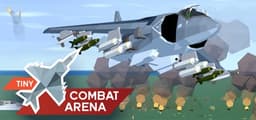
Bottom Line: Tiny Combat Arena is the most honest combat flight sim on Steam. It skips the procedures, keeps the physics and turns energy management into a weapon. Its long Early Access and thin roster are real flaws, but the core loop is excellent.
The Flight Model: Physics as a Decision Engine
Most "accessible" flight games make flying easier by removing the physics. Tiny Combat Arena makes it easier by removing the bureaucracy and keeping the physics. That's the right call, and the game gets real value out of it.
Take the missile-range rule. In an arcade shooter, a missile has a fixed lock distance and you fire when the reticle turns red. Here, launch range depends on your altitude and speed at the moment you fire. So the pre-merge phase of a dogfight becomes a real negotiation. Do you climb to extend your reach and bleed speed doing it? Do you dive to build energy and give up the high ground? Do you take a marginal shot now or close the gap and risk the enemy getting the first launch?
These are the questions real combat pilots train on, and the game makes them readable without a 300-page manual. Energy management stops being a hidden skill and becomes the main mechanic. Once it clicks, and it clicks quickly, you'll catch yourself planning engagements two or three moves ahead. The flight model also holds up past the missile phase. Burn too much energy in a turning fight and you'll feel the aircraft go sluggish, then realize you've become the target.
Arena Mode: Context Makes the Dogfight Matter
A good flight model on its own is a toy. Arena mode is the game's attempt to turn it into a game, and it largely succeeds.
The campaign map asks you to act as a commander before you act as a pilot. You pick objectives, read the threat picture and decide which friendly ground units get your air support. Then you fly the mission, and how it goes changes the state of the war. Lose your escort and an armored push stalls. Knock out the air defenses and the next sortie is safer.
This is the dynamic campaign idea that flight sim fans have wanted for decades, scaled down to something manageable. It's what separates Tiny Combat Arena from a dogfighting sandbox. Your choices carry forward, and a victory counts for more when it opens up the next move on the map.
The execution is uneven, though. Players report that the AI can feel inconsistent: sharp in some engagements, passive or confused in others. In a mode built around the idea that friendly and enemy forces react to you, weak AI does more than annoy. It undercuts the premise. When a wingman or ground column behaves irrationally, the sense of a living war breaks down.
The Quick Mission Builder: Low Friction, High Replay
The Mission Builder is the least glamorous feature and possibly the most useful one. It cuts setup friction to almost nothing. Want to practice energy fights against a single bandit? Done. Want to fly a quiet sightseeing loop to learn how an aircraft handles? Done. Want a ground-attack run against layered air defenses to test whether you understand threat envelopes? That takes about thirty seconds to set up.
For a game this dependent on learning its systems, having a practice sandbox this quick to use matters a great deal. It's where you get good.
The Database: Onboarding Done Right
Flight sims have a long history of poor onboarding. Tiny Combat Arena's in-game database handles the problem directly. It covers vehicle stats and, more usefully, tactical guidance on how to approach specific aircraft and threats. This is the kind of knowledge that usually lives on forums and wikis, and putting it inside the game is a quiet, meaningful quality-of-life choice. It respects the player's time.
The Early Access Problem
Now for the uncomfortable part. Tiny Combat Arena entered Early Access in February 2022. More than four years on, it's still there. The developer is visibly active and updates keep coming, which players credit. But progress is slow, and the aircraft and map roster is still limited compared with what the systems could support.
This is the central tension of the product. The foundation is excellent and the building on top of it is only partly finished. Steam Workshop does a lot of work to fill the gaps, and the modding community has responded well, but official content shouldn't depend this heavily on volunteers. Buyers should judge the game on what it is today and not on what it might become.


