
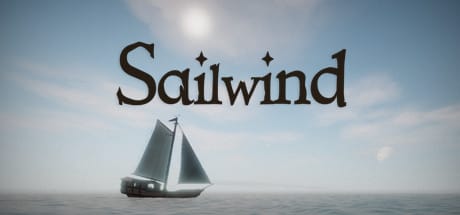
Bottom Line: Sailwind is the rarest thing in simulation — a game that refuses to explain itself and is better for it. If you can accept that a single voyage may cost you three real hours and end in a reef you couldn't see coming, it offers a kind of tension and satisfaction almost nothing else on Steam can.
The Gameplay Loop
The loop is deceptively plain: accept cargo, load it, sail somewhere, sell it, buy a better boat. Written out, it's a spreadsheet. In practice it's the most consequential loop in the genre, because the sailing between those two points is not travel time — it is the game.
Here's what a run actually looks like. You take a delivery contract. You check the wind. You decide whether the direct route means beating upwind for six hours or whether a longer arc catches a favorable reach. You buy water — how much? Too little and you die a stupid death two days out. Too much and you've displaced cargo and margin. You leave harbor. Two hours later you take a sun sight with the quadrant, work out your latitude, mark the chart, and discover you're forty kilometers off where you assumed. And then you correct, using nothing but your own reasoning.
That moment is the entire pitch. Sailwind's core innovation isn't a mechanic — it's the deliberate removal of an interface layer that every other open-world game treats as non-negotiable. The knowledge lives in your head and on a physical chart, not in a HUD. When it clicks, the payoff is the specific, unfakeable satisfaction of having actually learned something. Players consistently describe the navigation as genuinely educational, and they're not exaggerating: this teaches real dead reckoning and celestial fixing well enough that the skills transfer.
Onboarding Friction
Now the hard part. Sailwind's onboarding is brutal, and not always in interesting ways.
There's a difference between a game that's hard to master and a game that's hard to start, and Sailwind blurs the line. New players routinely die of thirst, run aground, or spend their first five hours drifting because nothing told them that trimming a sail past a certain angle kills their speed. Some of that opacity is thematic and defensible — the game wants you humbled. But some of it is simply missing teaching. The gap between "the game respects you" and "the game hasn't bothered" is thinner than the design admits, and a first-time player can't tell which side of it they're on. Most people who bounce off Sailwind bounce in hour one, before any of the good stuff is visible.
Pacing, and the Chore Problem
The second structural issue is upkeep. Bailing, patching, eating, drinking, cooking. In a storm, these are fantastic — frantic, tactile, genuinely tense. On a calm crossing, they're an interruption tax on an experience whose whole appeal is uninterrupted immersion. Community criticism lands here repeatedly and it's fair: the survival layer is best when it's a crisis and worst when it's a metronome.
Pace is the honest dealbreaker. Voyages consume hours of real time, much of it uneventful by design. Sailwind is comfortable with dead air in a way modern game design almost never permits, and it's right to be — the loneliness is where the emergent stories come from, the ones players write essays about. But you cannot half-play this. It doesn't work in twenty-minute sessions.
The Early Access Question
Sailwind entered Early Access in October 2021. That's a long runway, and the content ceiling shows. Once you've learned the routes, priced the goods, and worked out which winds run when, the economy stops surprising you. The trading layer is a scaffold for the sailing, not a rival system, and it doesn't have the depth to carry the back half of a long playthrough. That's the strongest argument against buying today rather than in another year — though the sailing model itself is finished enough that the ceiling is a content problem, not a foundation problem.