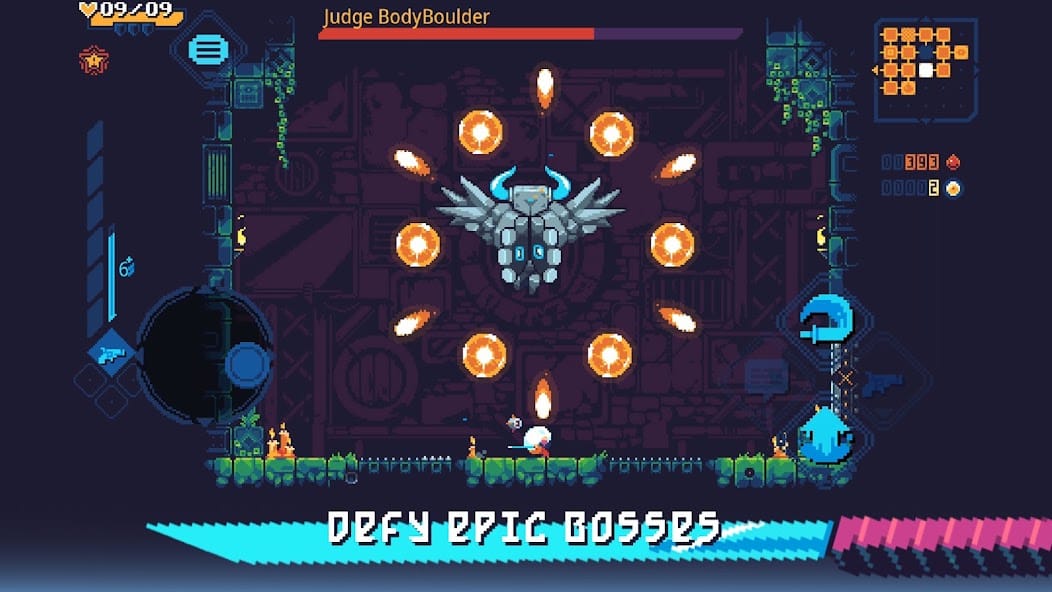
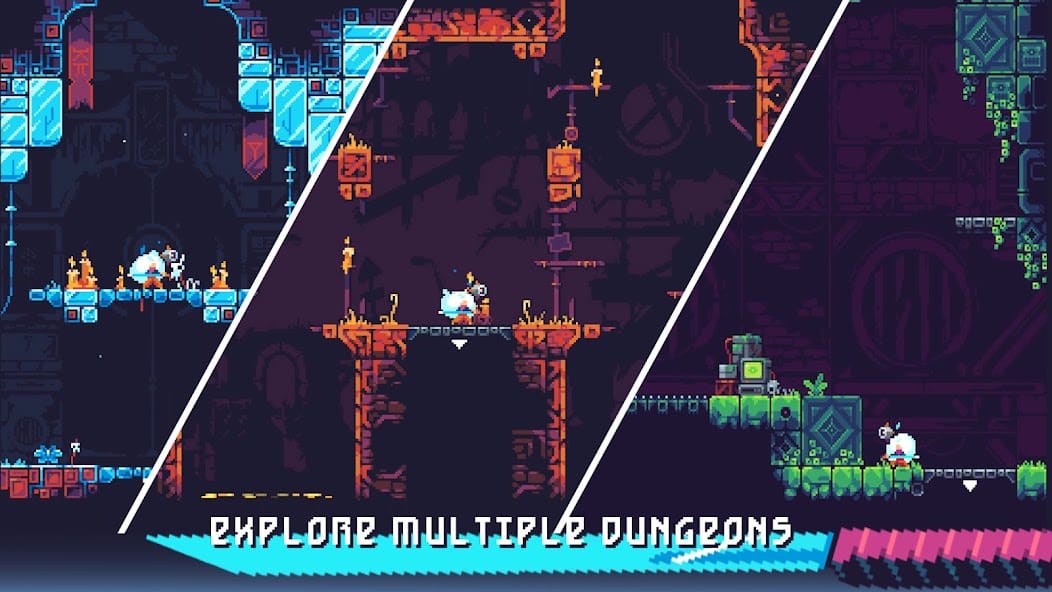
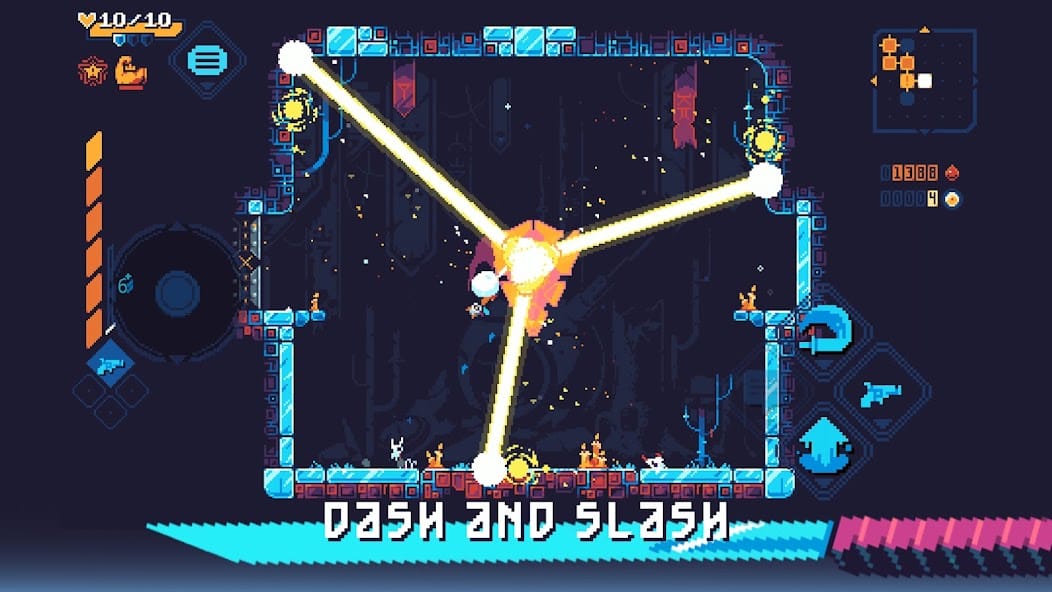
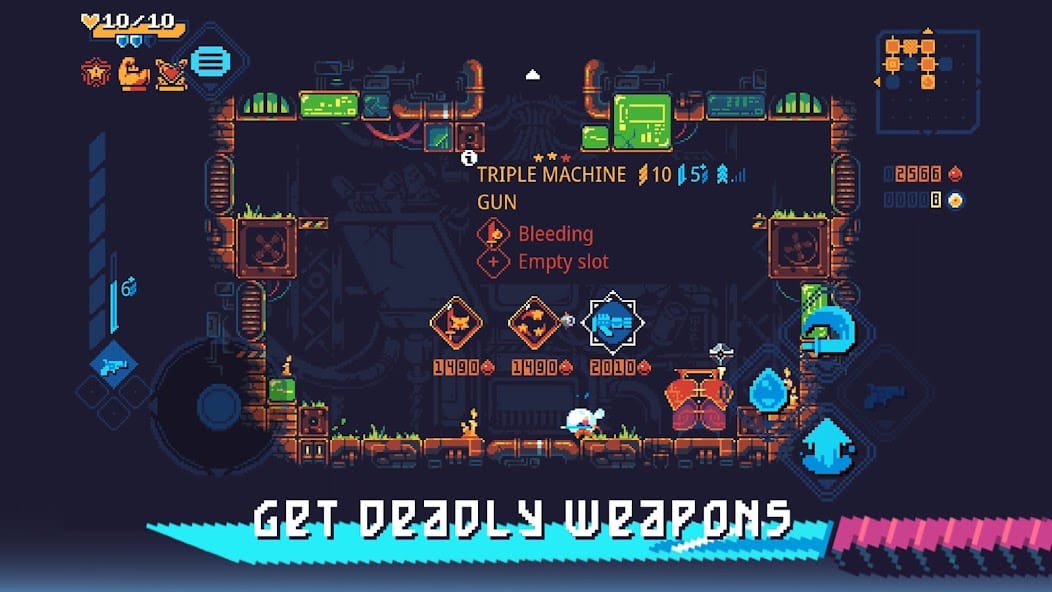
Bottom Line: ScourgeBringer strips the action-roguelite down to one idea — attack or die — and executes it with a precision most of its peers never reach. It's shorter and thinner than Dead Cells, but pound for pound it's faster, meaner, and more honest about what it wants from you.
The Gameplay Loop
Most roguelites ask you to manage risk. ScourgeBringer asks you to abandon it.
The design's central mechanic — the dash refreshing on hit — is a small rule with enormous downstream consequences. In a conventional platformer, your air options are a finite resource you spend carefully. Here, they're a renewable resource you earn by being violent. The result is that the optimal play pattern and the exciting play pattern are the same thing, which is far rarer in game design than it sounds. Most games have to bribe you into playing aggressively with damage bonuses or combo meters. ScourgeBringer just makes aggression the only way to stay in the air, and lets physics handle the motivation.
The consequence is a combat rhythm that feels closer to a fighting game than a platformer. You're reading enemy tells, choosing targets by their position in space rather than their threat level, and constantly solving a spatial problem: which enemy do I hit next so that I land somewhere I want to be? When it clicks, the game produces some of the cleanest flow-state in the genre. Rooms that took you thirty seconds of careful poking get cleared in four.
When it doesn't click, you die a lot. The difficulty curve is steep and unapologetic, and it's the single most common criticism in player reviews. This isn't a game with a gentle onboarding ramp. Early runs are punishing in a way that will read as unfair until the dash economy internalizes, and the game does very little to teach that economy explicitly. It expects you to discover it. Some players will find that respectful. Others will bounce off in the first hour, and I don't think they're wrong to.
Progression and the Repetition Problem
The blood-and-judgement skill tree is the game's most conventional system, and also its weakest link. Between runs, you spend currency on permanent upgrades that make Kyhra fundamentally stronger — more health, better dash properties, new weapon unlocks, companion abilities. It's the same meta-progression contract Rogue Legacy popularized and Dead Cells refined: death isn't loss, it's deposit.
The problem is what happens after the tree is full. Once you've bought everything, the between-run layer stops generating anticipation, and the moment-to-moment combat has to carry the entire experience on its own. It's good enough to do that for a while — the ceiling on execution skill is high — but runs do start to blur. Multiple reviewers report the same arc: exhilarating for twenty hours, noticeably repetitive after. The authored-room approach helps here more than pure procedural generation would, since individual encounters retain their identity, but there's a finite pool of them and you will see repeats.
This ties into the other structural criticism: the critical path is short. ScourgeBringer is not attempting to be a hundred-hour game, and it doesn't have Dead Cells' sprawling biome tree or Hades' narrative engine to sustain a long tail. What it has is a very high skill ceiling and a level editor. Whether that's enough depends entirely on whether you're the kind of player who replays for mastery or for novelty. Mastery players will get their money's worth several times over. Novelty players should calibrate expectations.
Onboarding Friction and the UX Flow
The interface is refreshingly quiet. Health, currency, weapon state — that's essentially it, and it stays out of the way of a game where reading the screen fast is a survival skill. The skill tree is legible without being over-explained, and menu navigation between runs is quick enough that death-to-next-attempt latency stays low. That matters enormously in a genre built on repetition; every extra second of menu friction compounds across a hundred deaths.
Where the UX is weaker is the tutorialization gap around advanced movement. The game teaches you the buttons. It does not teach you the system, and the gap between those two things is where most of the frustration lives.