
Overview
Music has been decorating video games for forty years. It almost never is the game. When developers do try, they usually cheat: rhythm titles like Guitar Hero or Crypt of the NecroDancer use music as a metronome, a timing gate, a scaffold for button-pressing. The notes themselves don’t matter. Hit the beat, any beat, and you advance.
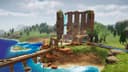
Sonority, from the small German studio Hanging Gardens Interactive and published by veteran indie house Application Systems Heidelberg, released May 25, 2022, takes the harder road. Here the specific pitch matters. The interval matters. The order matters. You play as Esther, a girl with a pan flute who wanders into the Rockery — a hidden valley where the stones sing back — and every obstacle in your path is a lock whose key is a sequence of notes. Play the right arrangement and rock formations shift, platforms rise, paths illuminate. Play the wrong one and nothing happens, which is its own kind of feedback.
That premise sounds like it should exclude anyone who can’t read a staff. It doesn’t, and this is the single smartest decision in the design. Every puzzle can be solved two ways: by ear, if you have one, or by reading the on-screen symbolic notation, if you don’t. The game never asks you to know what a perfect fifth is. It asks you to notice that this shape goes up and that shape goes down.
Commercially, Sonority sits in a modest position — a compact, hand-crafted puzzle adventure sold at indie pricing that has flown under the radar. It’s a cult title in the making rather than a breakout. It deserves better than that, with caveats.
Key features
- Melody-as-mechanic puzzle design: Terrain responds only to sound. Progress requires playing the correct note sequence on your instrument — starting with single tones and escalating to intricate multi-note compositions.
- Dual-solution accessibility: Solve by ear or by reading on-screen symbolic notation. No music theory required, and the game never condescends to players who lack it.
- Expanding instrument roster: New notes and new instruments are collected as you explore, each one widening your range and layering fresh complexity onto puzzles you thought you understood.
- Fully voiced narrative: A gentle story carried by Esther, a cantankerous old talking raccoon, and his stone companions — with full voice acting throughout.
- Extensive original score: A large body of original music with both English and German vocal tracks, which matters more than usual in a game where music is the verb.
Analysis
The Gameplay Loop
The core loop is simple: arrive at an obstacle, observe what the environment tells you, play notes, watch the world reconfigure. What makes it work is the escalation curve, which is impressively well-tuned for a puzzle game this size.
You begin with a pan flute and a pitiful handful of notes. Early puzzles are almost tutorial-transparent — a stone glows, you match it, done. Then the game hands you another note. Then another instrument. Each addition doesn’t just add options; it multiplies the puzzle space, because now sequences can move between timbres as well as pitches. By the back half, you’re not matching a tone. You’re reconstructing a melody from fragmentary environmental cues, holding a phrase in working memory while you navigate to the plinth that will accept it.
This is real puzzle design. The difficulty comes from the mechanic itself, not from obscured information or fussy execution. There’s no twitch component, no failure state to punish experimentation, no timer breathing on you. The game is built so you can stand in front of a puzzle and just noodle, and noodling is a legitimate solving strategy — which is exactly right for a game about music. Trial and error here feels like practice, not like flailing.
The dual-solution system deserves specific credit. Games that gate content behind a skill most players don’t have usually solve it by making the skill optional and then making the optional path boring. Sonority instead builds two parallel representations of the same information — auditory and symbolic — and lets you toggle between them fluidly. Musicians can ignore the notation and play by ear because it’s faster. Non-musicians can read the symbols and, over time, find themselves recognizing intervals they couldn’t have named. The game teaches without ever announcing that it’s teaching. That’s rare.
The Interface Problem
And now the problems.
The control scheme remaps the note buttons every time you acquire a new instrument. This is not a minor annoyance. It’s a structural design failure that undercuts the game’s own best idea.
The whole appeal of playing by ear is internalization — building muscle memory so that reaching for a note stops being a lookup operation and becomes reflex. Instrument acquisition should be a reward. Instead, each new instrument resets fluency to zero and forces the on-screen button guide back into permanent residence at the edge of the player’s vision. The game keeps yanking players out of the flow state it spent the previous hour building.
A fixed layout with instrument-relative offsets, or even a simple option to lock a preferred mapping, would have solved this. Its absence is the difference between a very good puzzle game and a great one.
Pacing and Length
Sonority is short — a handful of hours for most, and the most common complaint in user reviews isn’t that the game overstays its welcome but that it doesn’t stay long enough. There’s no filler here — no padding, no backtracking busywork, no artificially inflated puzzle count. The game says what it has to say and stops.
But the escalation curve is still climbing when the credits roll. Players reach the point where they’re finally fluent, where the complex compositions are landing, and then it’s over. That’s a design that peaks correctly but too early. At $19.99, the length is a hard sell. On sale, it’s a non-issue.
Story and Voice
The narrative is soft-edged and unhurried — Esther, the grumpy raccoon, the talking stones. It’s not going to devastate anyone, and it isn’t trying to. The full voice acting is the load-bearing element, and the raccoon in particular does a lot of work: cantankerous, funny, and a useful tonal counterweight to a world that could easily have tipped into preciousness. The writing knows when to get out of the way of the puzzles.
Visuals & performance
The art direction is hand-crafted rather than technically ambitious, and that’s the correct call. The Rockery is a cohesive 3D world with varied locations — not a texture-swapped corridor pretending to be five biomes — rendered in warm, storybook-adjacent tones that suit a game about singing rocks. It has a look. Small studios often don’t manage that.
The camera does not have a look. It has a habit. It settles on uncomfortable angles with irritating regularity — clipping awkwardly near geometry, framing puzzles at pitches that force manual correction mid-solve. In a game where players are often trying to read environmental cues and on-screen notation simultaneously, a camera that fights them is more than cosmetic. It’s a tax on the core mechanic.
Audio, unsurprisingly, is the technical high point. The original score is extensive, the English and German vocal tracks are both fully realized rather than one being an afterthought dub, and the mixing is designed to keep puzzle-critical tones legible against the background music — a hard problem that many audio-driven games botch.
Platform nuances
Steam (PC/Mac/Linux): The definitive version. The notation overlay is crisp at desktop resolutions, and keyboard-and-mouse or a gamepad both work. If the button remapping is going to bother anyone less, it’s here, where the guide can stay visible without eating half the screen. Linux and Mac builds are first-class rather than ports of convenience.
Nintendo Switch: The most natural fit conceptually — a gentle, handheld-length puzzle game is exactly what the platform is for — and the most compromised in practice. User reviews consistently flag frame-rate dips, though the consensus is that they annoy rather than ruin. The dips don’t create failure states, since nothing here is timing-sensitive. But a stuttering camera pan in a game that already has camera problems compounds badly.
iOS: The most interesting version, and underrated. Touch input maps to note-triggering more directly than any gamepad does — tapping notes is what you’d do on an actual instrument. It also partially defuses the remapping complaint, since on-screen buttons are already the interface rather than an overlay competing with one. The tradeoff is screen real estate: the notation and the 3D world crowd each other on a phone. An iPad is the better bet.
Final verdict
Sonority had one idea, and it’s a good one — good enough that this flawed execution of it beats a polished version of something more familiar. Making pitch the puzzle variable, then building two parallel input languages so that musical literacy is an advantage rather than a prerequisite, is thoughtful design from a studio that clearly cared.
What holds it back isn’t ambition. It’s finish. A camera that needs another pass. A control scheme that actively fights the fluency the game is trying to build. A runtime that stops climbing while the curve still has room. These are fixable problems, and their presence in an otherwise considered game reads as a small team running out of runway rather than running out of ideas.
We rate it a mixed recommendation: not for most people at full price, but worth a look for puzzle devotees on PC, or on an iPad, ideally on sale. The foundation here is strong enough to build something exceptional on top of — here’s hoping Hanging Gardens gets to make the longer, tighter version.
Reviewed by the Rankeno Puzzle & Casual Desk. Scores are out of 10; the overall score is the desk’s editorial judgement, informed by the four sub-scores above. How we review