Overview
Survival horror spent most of the last decade eating itself. The genre’s revival has largely meant remakes, remasters, and indie titles cosplaying as 1998 — grainy filters, low-poly models, fixed cameras deployed as nostalgia signifiers rather than design decisions. Sorry We’re Closed shows up wearing exactly that costume, then does something almost nobody else in the retro-horror wave has managed: it uses the old grammar to say something new.
Developed by à la mode games and published by Akupara Games, it launched on Steam and Nintendo platforms on November 14, 2024, at $24.99. You play Michelle, a shop worker in a cramped, rain-slick London borough whose life is coming apart in the ordinary way — bad breakup, dead-end job, neighbors with their own problems — until an archdemon called the Duchess curses her with obsessive love and opens a Third Eye in her forehead. She has three days. The clock is metaphysical, but the stakes are domestic: what Michelle owes the people around her, and what she’s willing to want.
Positioned against the crowded field of PS1-throwback horror, it competes on identity rather than fidelity. The neon palette is closer to a Soho night bus than Raccoon City. The cast is queer-led, mouthy, and specific in a way most horror ensembles aren’t. And the central mechanic isn’t a gimmick bolted onto a Resident Evil skeleton — it’s a perspective switch that reorganizes how you look at every room, every enemy, and eventually every character. Its critical reception has been strong, and that is not an accident, and not just goodwill.
Key features
- The Third Eye: Snap your fingers and the fixed-camera world flips to first person, revealing hidden objects, angelic entities, and the glowing weak points on demons. It’s the exploration tool, the combat system, and the story’s central metaphor, all bound to one button.
- Arcade-Grammar Combat: Fast target-switching and precise weak-point shots, scored and rhythmic — closer to a light-gun game than to deliberate tank-control shooting. Ammo and inventory scarcity keep the classic tension underneath the speed.
- Consequential Neighbors: An interconnected district of streets, shops and apartments populated by characters whose problems you can solve, botch, or ignore. Those choices feed directly into multiple distinct endings — not a slider between good and bad, but different resolutions.
- Accessibility and Replay Scaffolding: Optional tank controls, aim assist, New Game+, and a score-based Time Attack mode that reframes the whole game as a speed-and-precision challenge.
Analysis
The Gameplay Loop
The structure is old-school and unapologetic. You explore a hub district in fixed-camera third person, collecting key items, unlocking shortcuts, and pushing outward as new areas open. There are locked doors, item-based puzzles, and a map you will learn by heart. If you played anything on a gray plastic disc in 1999, your muscle memory is already loaded.
What changes everything is the eye. Holding it up shifts you into first person, and the shift isn’t cosmetic — it’s an information layer. Objects invisible in the third-person view materialize. Angelic figures loiter in corners you’d otherwise walk past. Demons that read as amorphous threats resolve into targets with specific, glowing vulnerabilities. The game is constantly asking a question: have you actually looked at this room, or have you only walked through it?
Combat inherits that question and adds a stopwatch. Enemies swarm from multiple angles; the eye view narrows your field of vision while giving you the only shots that matter. The design asks for whipping between targets, landing weak-point hits, and chaining them cleanly for a multiplier. It’s arcade logic — momentum, precision, score — running inside a survival horror ammo economy. Miss too often and you’re out of bullets in a genre where that means running.
That tension is the design’s best trick. Most survival horror punishes speed. This punishes hesitation. The eye’s tunnel vision means going fast is also going blind, and the game keeps putting something behind you.
Where the Loop Frays
It isn’t flawless, and pretending otherwise would be doing the game a disservice. On lower difficulties the combat can settle into rote pattern-clearing — the weak points stop being a puzzle and become a checklist. The easiest setting flattens the arcade layer into busywork, which is a shame, because the higher difficulties are where the scoring system actually sings. Play it harder than you think you should.
Backtracking is the other friction point. The interconnected district is a genuine strength — shortcuts click open with real satisfaction — but the item-fetch structure sends you across it more often than the pacing wants. In a game this short, a single round trip is a meaningful chunk of the runtime.
Navigation, too, carries the old sins along with the old virtues. Fixed cameras hand off awkwardly at room boundaries by their nature, and camera-angle changes can reverse Michelle’s controls mid-stride. Tank controls are offered as an option and they’re the historically correct answer to fixed cameras — but modern players who bounce off them will hit the seams. The option is there. It is not a fix so much as a trade.
The Writing
Here’s the part that makes the writing work. The dialogue is funny, mean, tender and specific. These aren’t horror archetypes reciting exposition; they’re people with grudges and crushes and unpaid rent, and the demonic apparatus is refracting problems they already had. Michelle’s curse — compulsory, obsessive love — is a horror premise that lands because the game is interested in the difference between wanting someone and being made to. The multiple endings aren’t a completionist checkbox. They’re arguments.
Visuals & performance
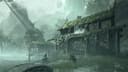
The art direction is the reason screenshots of this game circulate. It’s low-poly PS1 pastiche, yes, but the palette is doing heavy lifting: hot magenta and sodium-orange bleeding across wet brick, character portraits rendered in a hand-drawn 2D style that cuts against the crunchy 3D world. It reads as Silent Hill filtered through a British night out, and the contrast between the flat, expressive portrait art and the murky environments gives conversations a jolt of intimacy the polygons couldn’t carry alone.
The soundtrack is the other standout — synth-forward, moody, and willing to drop into something almost danceable when the combat picks up.
As for performance, a 2D-and-low-poly game of this scope is light on hardware by design; the fidelity target is deliberately low, so demanding hardware isn’t part of the equation.
Platform nuances
Steam is the definitive version and the one to buy if you have a choice. Mouse aim is the natural fit for the first-person combat — the weak-point targeting was clearly designed with a cursor’s precision in mind, and the scoring system rewards exactly that precision. The aim assist exists for controller players and it’s competent, but it’s compensating rather than matching.
Nintendo Switch is the more interesting proposition and the more compromised one. Handheld is the right form factor for a game this atmospheric and this short — a two-evening portable horror session is a good pitch. The low-poly aesthetic is a natural fit for the hardware, and the art should hold together on the smaller screen. But stick aiming caps your ceiling in Time Attack. Buy it on Switch for the atmosphere and the portability; buy it on Steam if you want to actually chase the scoring system.
No mobile version exists, and none is planned.
Final verdict
Most retro-horror indies borrow a look and hope the vibes carry them. Sorry We’re Closed borrowed a look and then built a real idea underneath it. The perspective snap could have been a flashlight with extra steps; instead it restructures exploration, combat, and the story’s whole argument about seeing people clearly around a single button press. That’s design confidence, from a small team, on a first major outing.
It’s short. It backtracks. The camera is a period-accurate nuisance. None of that is disqualifying, and the strong critical reception reflects an audience that correctly identified where the value sits: in the specificity, the style, and the sense that someone with a real point of view made every choice here on purpose. We rate it a clear recommendation with real reservations.
Play it on hard. Talk to your neighbors. Get more than one ending.
Reviewed by the Rankeno Action Desk. Scores are out of 10; the overall score is the desk’s editorial judgement, informed by the four sub-scores above. How we review