
Overview
Landfall is a studio best known for controlled chaos. Totally Accurate Battle Simulator and Content Warning made their money on physics comedy and viral clips — games designed to be laughed at as much as played. Haste: Broken Worlds is something else entirely. It’s the Swedish studio’s most disciplined, mechanically serious game to date, and a genuine surprise: a third-person runner built around a single verb — go fast — executed with a precision most movement-focused games never approach.
The premise is thin by design. Reality is collapsing. You are Zoe, a courier sprinting across procedurally generated worlds a half-step ahead of the void eating them. The narrative exists mostly as scaffolding for the campaign’s ten Shards — themed gauntlets of stages cleared with a limited pool of lives — and it knows exactly how much weight it can bear. Nobody is here for the lore. They’re here for the slope.
And what a slope it is. Haste’s core mechanic is momentum management: surf downhill to build speed, launch off ramps, and — critically — stick landings on descending terrain to preserve velocity. That last bit is the game’s masterstroke. Landing well isn’t a binary; it’s graded, telegraphed, and endlessly optimizable, which turns every second of every run into a micro-skill test.
Market positioning is smart. At an indie price point, straddling Steam and Nintendo Switch 2, with online co-op and full Steam Workshop support, Haste sits in the gap between SUPERHOT-style single-mechanic showcases and roguelite comfort food. It’s a game with a clear idea of who it’s for, and a design that keeps rewarding the people it’s for.
Key features
- Momentum-based movement: Speed is earned, not given. Surfing slopes, chaining ramps, and grading every landing creates a skill ceiling that keeps climbing long after the credits.
- Ten-Shard campaign with lives-based runs: Procedurally generated stages grouped into distinct Shards, cleared under the pressure of a finite life pool — enough roguelite tension to matter, not enough to punish.
- Roguelite upgrade layer: Currency from skillful play buys ability and gear upgrades between levels, letting builds lean into a play style without drowning the run in menus.
- Online co-op and Steam Workshop: Race the full campaign with friends, then hand the level design keys to the community — the two features that convert a short game into a long one.
Analysis
The Gameplay Loop
Haste understands something most runners don’t: speed isn’t a reward, it’s a responsibility. The faster Zoe moves, the less time there is to read terrain, and the more each landing matters. The game grades landings in real time — nail a descending slope at the right angle and you gain speed; slap down flat and you bleed it. This transforms procedurally generated terrain from a novelty into a sight-reading exercise. It’s not about memorizing levels. It’s about learning a language.
The feedback loop is ruthless in the best way. A perfect landing produces a hit of audiovisual confirmation that sits somewhere between Tony Hawk‘s combo chime and a rhythm game’s “PERFECT.” Miss three landings in a row and the run visibly deflates. The design is built so that, quickly, players stop thinking about individual inputs and start thinking in lines — where the next slope is, whether that ramp is worth the airtime, whether the gap can be threaded without scrubbing speed. That’s flow state, and Haste’s design manufactures it more reliably than most games in recent memory.
Structure and Friction
The Shard structure gives the campaign real stakes without roguelite cruelty. Each Shard is a series of stages; run out of lives and the Shard restarts, not the game. It’s a well-judged middle ground — enough pressure that a boss stage with one life left genuinely spikes the pulse, not so much that a bad night erases progress. The between-level upgrade economy is light, and honestly, that’s fine. The upgrades nudge; they don’t define. Purists will call the roguelite layer thin; it’s better described as appropriately deferential to the movement, which is the actual product.
Where the friction shows is longevity of the base campaign. Ten Shards move quickly when the whole point is moving quickly, and the procedural generation — excellent at producing playable terrain — is less good at producing memorable terrain. By the back third, most of the generator’s vocabulary has been seen, and stages start rhyming. The endgame answer is chasing rank thresholds and community content, which will be plenty for the leaderboard-brained and thin for everyone else.
Co-op and Community
Online co-op through the full campaign is the quiet headline. Racing a friend through collapsing worlds turns the game’s solitary flow state into something competitive and loud, and it papers over the repetition problem — procedural stages that feel familiar feel new when someone is beating you through them. Steam Workshop support is the long-tail insurance policy. Landfall has cultivated modding communities before, and giving players the tools here is the difference between a game that peaks at launch and one that compounds.
Visuals & performance
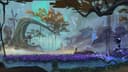
Haste’s art direction is doing more work than it first appears. The saturated, painterly worlds — all impossible geology and fracturing skies — are legible at speed, which is the harder design problem. Slopes read instantly. Hazards contrast cleanly. The collapsing-world effects chasing you communicate urgency without ever obscuring the line ahead. Zoe herself is an expressive, likable anchor, animated with a looseness that sells velocity better than any speed-line shader could.
Performance is where a game like this lives or dies, and a 3D game of this scope is light on hardware by design — the clean geometry and restrained effects are choices that leave headroom for the frame rate a speed game demands. The UI is restrained — speed, lives, landing feedback, done — though the between-stage upgrade screens are visually flatter than the game around them. A small sin, but noticeable when everything else is this polished.
Platform nuances
On Steam, this is the definitive version, full stop. Mouse-assisted camera control gives finer terrain-reading at top speed, Workshop content lives here natively, and an uncapped framerate matters in a game about parsing geometry at velocity. For leaderboards or mods, PC is the call.
The Switch 2 version is the more interesting artifact. Haste’s stage-based structure — three-to-five-minute runs with natural stopping points — is almost suspiciously well-shaped for handheld play. Analog stick control is entirely viable; the game’s inputs are about timing, not aiming. What’s sacrificed is the Workshop pipeline and some visual headroom. What’s gained is the ability to chase a landing grade on a train, which fits this game’s rhythm better than it fits most.
Final verdict
Haste: Broken Worlds is what happens when a studio famous for jokes decides to be serious about one thing. The movement system is good outright, not just “good for an indie,” and Landfall had the discipline to build everything else in service of it rather than around it. The campaign’s brevity and the generator’s eventual repetition are real costs, and the roguelite trimmings won’t satisfy anyone who came for the roguelite. But those complaints describe the container, not the contents. The contents are a finely tuned sense of speed in modern games, with co-op and Workshop support standing by to multiply it. We rate it a solid Good: recommend it to the right audience without hesitation, and expect everyone else to wait for a deeper sale.
Reviewed by the Rankeno Action Desk. Scores are out of 10; the overall score is the desk’s editorial judgement, informed by the four sub-scores above. How we review