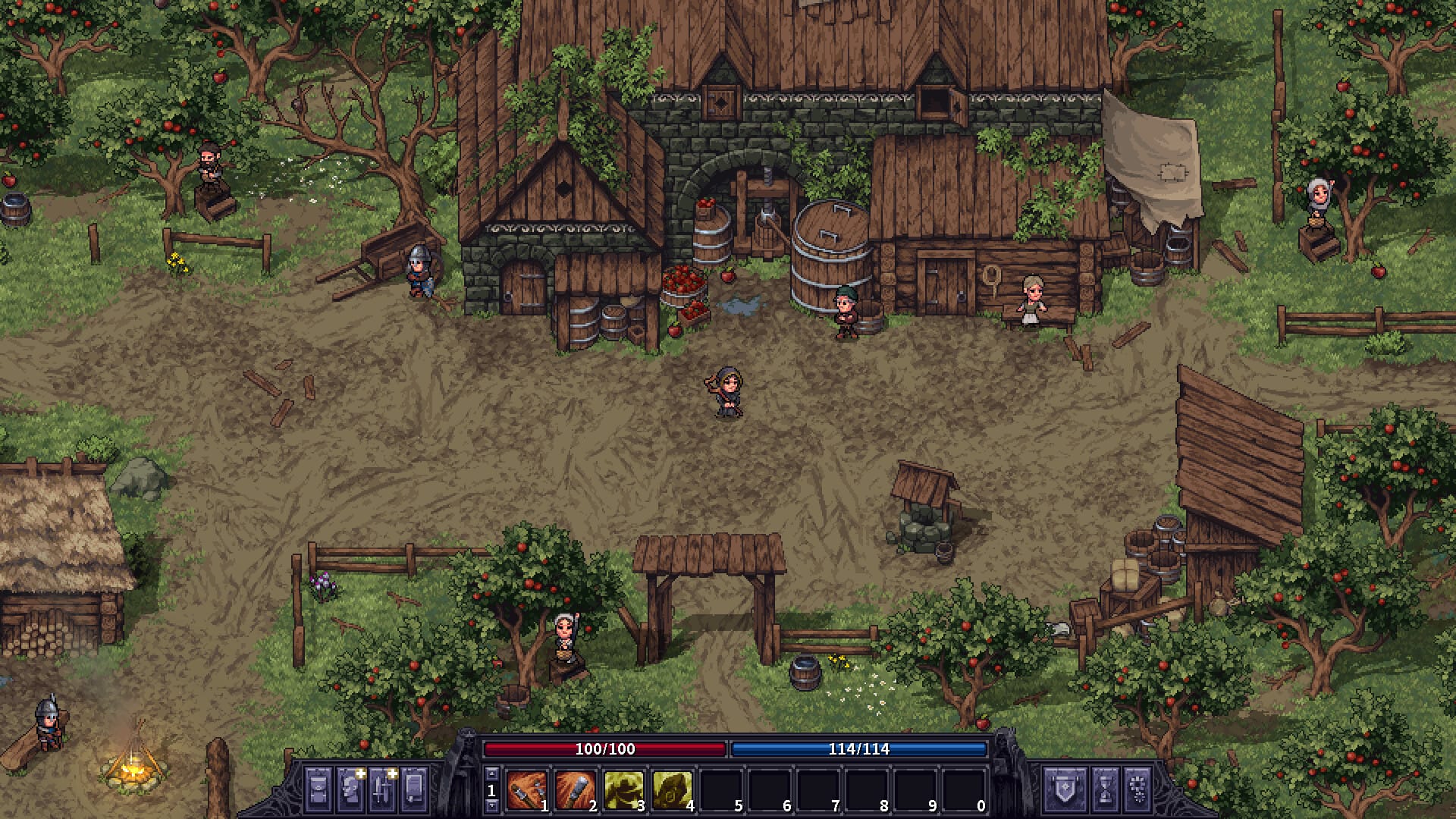




Bottom Line: Stoneshard is a masterclass in tactical, consequence-driven RPG design wrapped in one of the most punishing onboarding experiences on Steam. Survive the first ten hours and you'll find a systems-driven roguelike with almost no equal — but it will not meet you halfway, and after six years in Early Access, patience is part of the purchase price.
The Gameplay Loop
Stoneshard's loop is deceptively simple and quietly ingenious. You take a contract from a board. You provision — food, bandages, splints, healing draughts, torches, booze. You travel to a dungeon. You fight your way down, one careful turn at a time. You come home with loot, injuries, and a psyche meter in the red. You spend money and days recovering. You take another contract.
What elevates this above the standard mission-board grind is that every one of those steps is a real decision with a real cost. Provisioning isn't a formality — pack weight matters, money is scarce, and the item you didn't buy is the one you'll need. The dungeon run isn't a health-bar-versus-health-bar exchange, because your health bar doesn't come back on its own. Recovery isn't a menu click; it's days of in-game time during which contracts expire and the economy shifts.
The result is a game where the tension lives between the fights rather than inside them. Most RPGs make combat the crescendo and downtime the reward. Stoneshard inverts it. Combat is a controlled expenditure of a stockpile you spent an hour building, and the real drama is watching that stockpile drain three floors deeper than you planned.
Combat: Small Numbers, Big Consequences
The tactical layer is where the craftsmanship shows. Every action costs stamina, and stamina doesn't come back fast. Positioning determines whether you're fighting one bandit or four. Armor isn't a damage sponge, it's a mitigation profile with real gaps. Attacks can crit into fractures, sever, or bleed, and a bleed you don't stop will kill you two rooms later while you're congratulating yourself on the kill.
The classless build system pays off here in a way that most "play how you want" marketing never does. Because abilities are meaningfully specialized and skill points are precious, a build isn't a cosmetic flavor on a universal chassis — it's a genuinely different set of solutions to the same problems. The pyromancer's answer to a room of four skeletons has nothing in common with the pikeman's. Both work. Both feel earned.
Onboarding: The Elephant in the Tavern
Here's where I stop being nice. Stoneshard's early game is a wall, and it is not a well-designed one.
There's a meaningful difference between a game that is hard because its systems are deep and a game that is hard because it hasn't told you what its systems are. Stoneshard is both, and the second kind of difficulty is the one that shows up over and over in negative reviews. New players die not because they made a bad tactical read, but because nothing communicated that a minor fracture would cascade into a death spiral, or that this particular wolf pack was three tiers above the contract they just accepted. That's onboarding friction, not challenge, and it's the single largest tax on the game's audience.
The save system compounds it. You save by resting at an inn or a bed — nowhere else. The intent is obvious and defensible: it makes every expedition a committed run and prevents save-scumming from dissolving the tension the entire game is built on. The consequence is equally obvious: a death forty minutes into a dungeon costs you forty minutes of real life, replayed. Purists will tell you this is the point. They're not wrong about the design intent. They're wrong that intent excuses the friction, because a system can be philosophically coherent and still make players quit.
Overworld pacing is the third complaint, and the most straightforwardly fixable. Travel is slow. Slow enough that a substantial chunk of the community runs speed-hack utilities not to cheat, but to make the walking tolerable. When your players are installing third-party tools to skip your traversal, that's not a preference — that's data.
The Early Access Question
Stoneshard has been in Early Access since February 2020. Backers came from a Kickstarter with a timeline that now reads as fiction. The updates that do land are substantial — real content, real systems, real reworks, not patch-note padding — and Ink Stains has never shipped a cynical build. But the cadence is glacial, and six years is long enough that "unfinished" stops being a disclaimer and starts being a state of being. Buy this game for what's in it today. Do not buy it for the roadmap.