


Bottom Line: Rocket Rat Games built a spaceship-construction puzzler with no single correct answer, and that one design decision carries the whole thing. It's a small, warm, quietly brilliant toybox that respects your time more than most games five times its size.
The Gameplay Loop
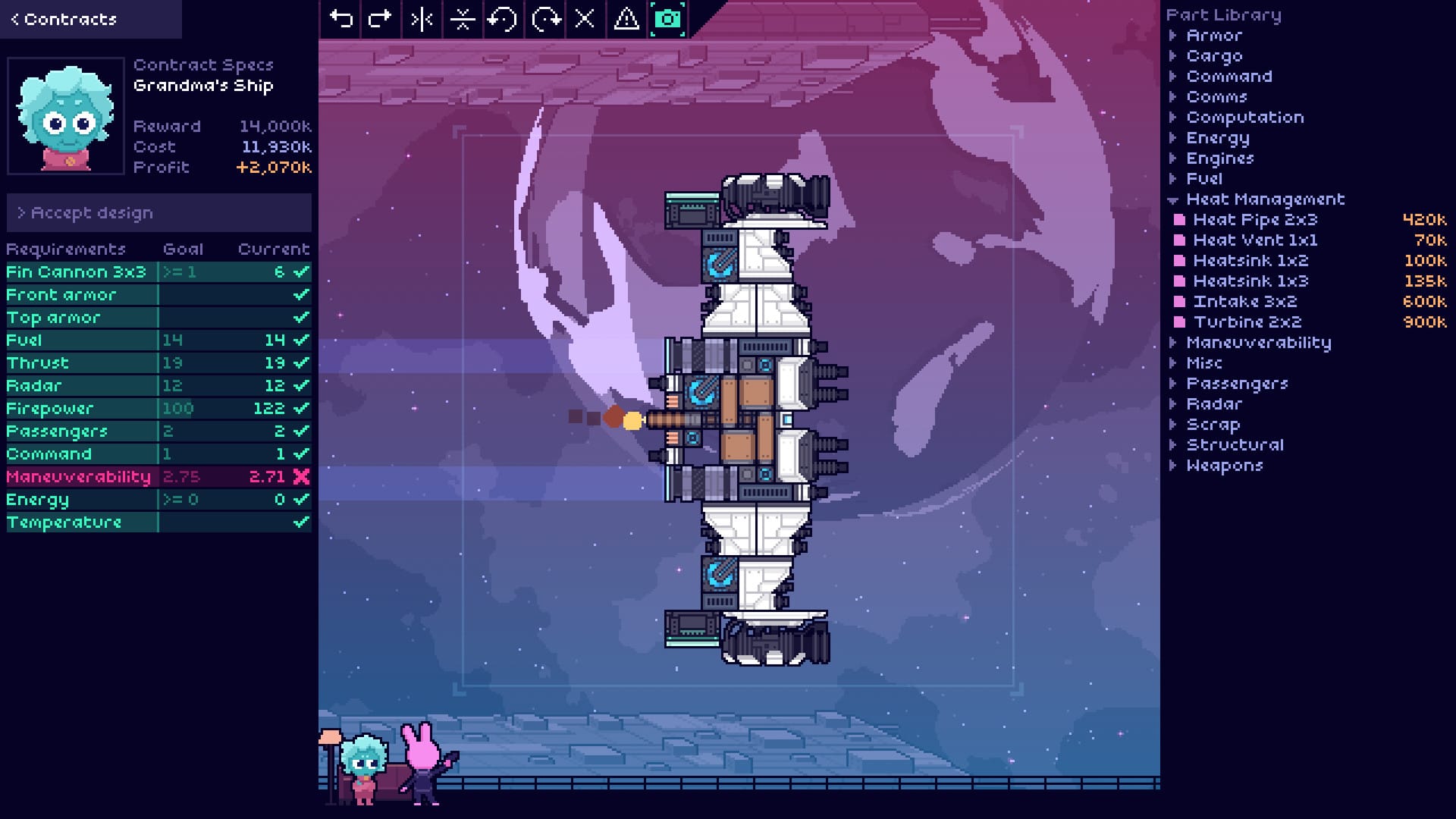
The loop is deceptively plain. A client arrives. They state a need. You open the parts bin. You build. You submit. You get paid, and someone says something funny.
What makes it work is where the friction lives. In a conventional puzzle game, friction is finding the answer. Here, the answer is trivially findable — slap on a bigger engine, add another fuel tank, done. The friction is fitting it into the space and the budget, and those two constraints pull in opposite directions with real tension. Cheap parts are bulky. Compact parts are expensive. Powerful engines demand reactors, reactors demand fuel routing, fuel routing demands grid tiles you were planning to use for the cargo bay the client actually asked about. It's a resource-allocation problem wearing an engineering costume, and the interlocking subsystems mean a change in one corner of the ship cascades outward in ways you have to physically re-plan.
This is also where the game's central gamble becomes visible. Because there is no optimal solution being scored, the difficulty curve is something you set yourself. Build the ugly minimum-viable barge and levels take ninety seconds. Decide the client's freighter deserves symmetrical engine nacelles and a color-coordinated hull, and the same level eats twenty minutes. The game never tells you which you should have done. For a large slice of players, that's liberating. For anyone who needs external validation to feel progress, it will read as a game with no teeth.
I'd argue the teeth are there — they're just optional, and correctly placed. The daily challenges exist precisely for players who want a number to chase, and quarantining competitive optimization into a separate mode is a smarter piece of design architecture than it gets credit for. Zachtronics-likes have a well-documented onboarding problem: the histogram makes new players feel bad on level three. Rocket Rat Games removed that pressure from the campaign entirely and gave it a home elsewhere. Two audiences, one game, no compromise between them.
Onboarding and Interface
Parts-bin games live or die on how fast you can find a component and how obvious its connection rules are. Sunshine Heavy Industries handles the first problem well — the bin is legible, and parts read at a glance from their pixel silhouettes rather than requiring a hover-and-read on every icon. The second is where the difficulty of the game genuinely lives, and it's mostly earned. Understanding that a subsystem needs a physical path, not just co-location, is the game's real lesson, and it teaches it early through failure rather than through a wall of tutorial text.
The reservation: with 100+ parts and dozens of subsystems, mid-campaign inventory management gets busier than the UI's density really supports. When you're deep in a build and hunting for a specific mid-tier reactor variant, you feel the absence of stronger filtering. It never becomes a wall, but it's the one place where the interface's charm outruns its ergonomics.
Narrative as Pacing, Not Payload
The writing is doing structural work here, not just decoration. Each client is a small tonal reset between builds — a joke, a bit of characterization, a piece of the pirate subplot — that prevents 50+ levels of grid assembly from flattening into a spreadsheet. The comedy is warm rather than sharp, more affectionate ensemble sitcom than satire. The business-partner-wrecks-your-reputation arc gives the campaign a spine it would otherwise lack, because a pure contract-fulfillment game has no reason to end.
It's not deep. It doesn't need to be. It's paced correctly, which is the harder achievement and the more common failure.