

Overview
There’s a particular kind of vertigo that comes from playing a 1999 game and realizing it is smarter than most of what shipped last year. System Shock 2 produces that feeling early — around the time you find your first audio log, register that nobody is coming to help, and understand that the wrench in your hands is a real long-term tool and not a tutorial prop.
The original was a collision of two studios at their peak: Looking Glass Studios, the architects of the immersive sim, and Irrational Games, then a brand-new outfit that would later spend a decade chasing this game’s shadow through the BioShock series. It fused first-person shooting, RPG character progression, and survival horror at a moment when the industry had not yet decided those were separate aisles in the store. It sold poorly. It became canon anyway.
Nightdive Studios — the preservationist studio that has spent a decade dragging Turok, Quake II, Blood, and the first System Shock into the present — has rebuilt it on the KEX engine as the 25th Anniversary Remaster. The emphasis belongs on remaster. This is not the ground-up reimagining Nightdive gave System Shock 1 in 2023. The level geometry, the encounter design, the economy, the script, the pacing: untouched. What changed is everything around them. Support for high resolutions and high refresh rates, proper widescreen, rebuilt character and weapon models, new animations and lighting, achievements, competent controller support, and the headline addition — cross-platform online co-op for up to four players.
Market position is unusual. This isn’t competing with current releases so much as with its own 1999 listing, its own modding scene, and the memory players already have of it. On Steam it sits at Very Positive, though below the rating the legacy version held. That gap is the whole story, and it has almost nothing to do with the game.
Key features
- Class-Seeded RPG Progression: Three military branches — Marines, Navy, or the psionic O.S.A. — seed your starting skills before the first shot, then cybernetic modules buy upgrades across weapons, hacking, repair, research, and psi powers. Modules are finite. The build is the playthrough.
- A Hostile Resource Economy: Ammunition is scarce, firearms degrade and jam, and enemies respawn. Every trigger pull is an accounting decision, not a reflex.
- Audio-Log Archaeology: The plot is already over when you wake. You reconstruct it from the recordings of a dead crew while The Many and SHODAN work opposite sides of the same trap.
- KEX Engine Rebuild: High-resolution output, widescreen, enhanced models and lighting, full controller support, achievements — without touching level or systems design.
- Four-Player Cross-Platform Co-Op: The 1999 co-op mode, dragged out of jank and onto modern matchmaking.
- Bonus Archive Gallery: Concept art, original design documents, and period magazine coverage. Genuine primary-source material, not a gallery of marketing renders.
Analysis
The Gameplay Loop
Most horror games manufacture tension by taking things away from you. System Shock 2 does something harder: it gives you a full toolkit and then makes every tool expensive.
The loop is plain on the surface. Explore a deck. Find logs, nanites, and modules. Decide what to spend them on. Push further. What makes it bite is that the three currencies — ammunition, nanites, cybernetic modules — are all scarce and interchangeable in ways that punish indecision. Nanites buy ammo, but they also buy repairs and hacking supplies. Modules bought into Standard Weapons can’t be unbought when you find a wonderful energy rifle you have no skill to hold. Firearms degrade as you fire them; a pistol you’ve been leaning on will start jamming at the exact moment a Hybrid rounds the corner shrieking apologies at you.
Then there’s the respawning. Recyclers reseed cleared areas over time, and this single design choice inverts the entire genre’s grammar. In most shooters, killing an enemy is progress. Here it’s a withdrawal. A monkey that costs you a handful of rounds and a weapon durability tick is a net loss; the correct answer is often to sprint past it, or to spend a psi point, or to stand still and let it wander off. The game never tells you this. It lets you learn it by going broke.
The class system compounds the effect. An O.S.A. run is a genuinely different game from a Marine run — not “same encounters, different damage numbers,” but different verbs. The psionic build turns invisible, sets things on fire with its mind, and treats ammunition as a fallback. The Marine kicks in the door. Both are viable. Neither is comfortable. That’s the point: the game’s difficulty ceiling is set by your planning, not your aim, which is why a 25-year-old shooter with stiff gunplay still holds up against titles with vastly better recoil modeling.
Narrative as Interface
The audio-log structure has been copied so thoroughly that it’s easy to forget how disciplined the original use of it is. These logs aren’t lore collectibles. They are navigation, tutorialization, and characterization delivered in the same object — a code for a locked door arrives wrapped in someone’s last coherent thought before the infection takes them. You are not being told a story. You are performing forensics on one, and the game trusts you to assemble it without a quest marker holding your hand.
And SHODAN remains an effective antagonist — not because of the stuttering vocal processing, though that still works, but because of a structural trick the game plays with the player’s own compliance, one best left unspoiled for anyone arriving fresh. The reveal lands because the game spends its opening stretch training you to do something without examining why.
Where the Seams Show
A remaster is a contract: fix the presentation, don’t touch the design. Nightdive honored it, and that honesty has costs.
Melee combat is still bad. The wrench swing is a floaty, ill-telegraphed lunge with hit detection that belongs in the last century, because it is from the last century. For a game that opens by handing you a wrench and expecting you to use it for a long stretch, that’s not a minor rough edge — it’s the roughest part of the onboarding, and it’s exactly where a remake would have intervened.
The interface is similarly preserved in amber. Inventory Tetris, a research screen that reads like a spreadsheet, and a hacking minigame that has aged into a chore. All navigable, none delightful. Newcomers should expect real onboarding friction in the early hours and should understand that this friction is the price of admission, not a bug.
The co-op is the genuine new toy, and it’s also where the remaster’s polish is thinnest. The Von Braun with three friends is a wonderful, tonally destructive setup — horror evaporates, tactics improve, chaos ensues. But community reports flag a late-game progression blocker where a door fails to open, and patch cadence on the multiplayer layer has been slow. Shipping a headline feature that can strand a four-person party deep into a campaign is the kind of thing that should have been caught before launch.
Visuals & performance
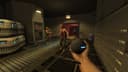
The art direction was always the load-bearing element, and it survives untouched: cramped industrial corridors, sickly green-and-amber palettes, biological growth creeping over clean sci-fi surfaces like mold through a hospital. The new lighting pass is the most valuable upgrade here, because it deepens shadow rather than flattening it — plenty of remasters “fix” dark games by brightening them into a well-lit diorama. Nightdive resisted.
The model work is where taste enters. Enhanced character, weapon, and enemy geometry plus new animations make the Hybrids read more clearly, but a higher-polygon monster occasionally loses some of the ambiguity that low fidelity gave it for free. It’s a fair trade, not a free win.
Technically, the KEX build targets high resolutions and refresh rates with proper widescreen and modern input handling, and a 2D-era game of this scope is light enough on hardware that it suits handheld play. The remaster did introduce some bugs of its own that weren’t in the original, which is the recurring tax of engine ports. Against that: this is finally a version that installs and runs, versus the old ritual of hunting down a widescreen patch, a texture pack, and a resolution fix from three different forum threads.
Platform nuances
On Steam, mouse and keyboard remains the definitive way to play — the game is built on precise looting, precise aiming, and an inventory that wants a cursor. Handheld play is the surprise: the game’s slow, deliberate pacing suits short sessions better than a modern open world does, which makes it a natural fit for portable hardware.
The controller support deserves specific credit. Radial menus and remapped inventory handling make a 1999 PC-native UI playable on a pad without dumbing down a single system. That’s difficult work and it’s usually done badly.
On Nintendo hardware, set your expectations by the platform, not the spec sheet — the high-resolution headline is a PC and current-gen console figure, and the handheld build trades resolution and frame ceiling for portability. What matters more is that the interface work holds up on a small screen: dense text logs and inventory grids are exactly what tends to break in a handheld port. The Von Braun with headphones on is, frankly, the correct way to meet SHODAN for the first time.
Not For
- Players who need modern shooter feel, generous checkpointing, or a quest marker.
- Anyone who already owns the 1999 version with mods installed and doesn’t care about co-op or achievements.
Final verdict
Judge the game alone and it belongs among the medium’s essential texts — one of the few titles where the reputation undersells the thing. Judge the product and the assessment comes down a notch, not because Nightdive did poor work, but because the surrounding decisions were cynical. Delisting the cheap legacy version while charging a premium for a build that partly formalizes what modders gave away for free is the reason a beloved classic is drawing protest reviews alongside the praise. Those negative reviews are protest votes, and they’re not unreasonable ones.
What Nightdive actually delivered is a careful, respectful restoration by people who clearly understand why this game matters — the lighting pass, the controller work, and the archival gallery are all the work of enthusiasts, not contractors. They just didn’t fix the wrench.
We recommend it if you’ve never boarded the Von Braun, or if you want co-op or a clean handheld version. If you have a working modded install and no interest in playing with friends, wait for a sale and don’t feel bad about it.
Reviewed by the Rankeno RPG & Adventure Desk. Scores are out of 10; the overall score is the desk’s editorial judgement, informed by the four sub-scores above. How we review