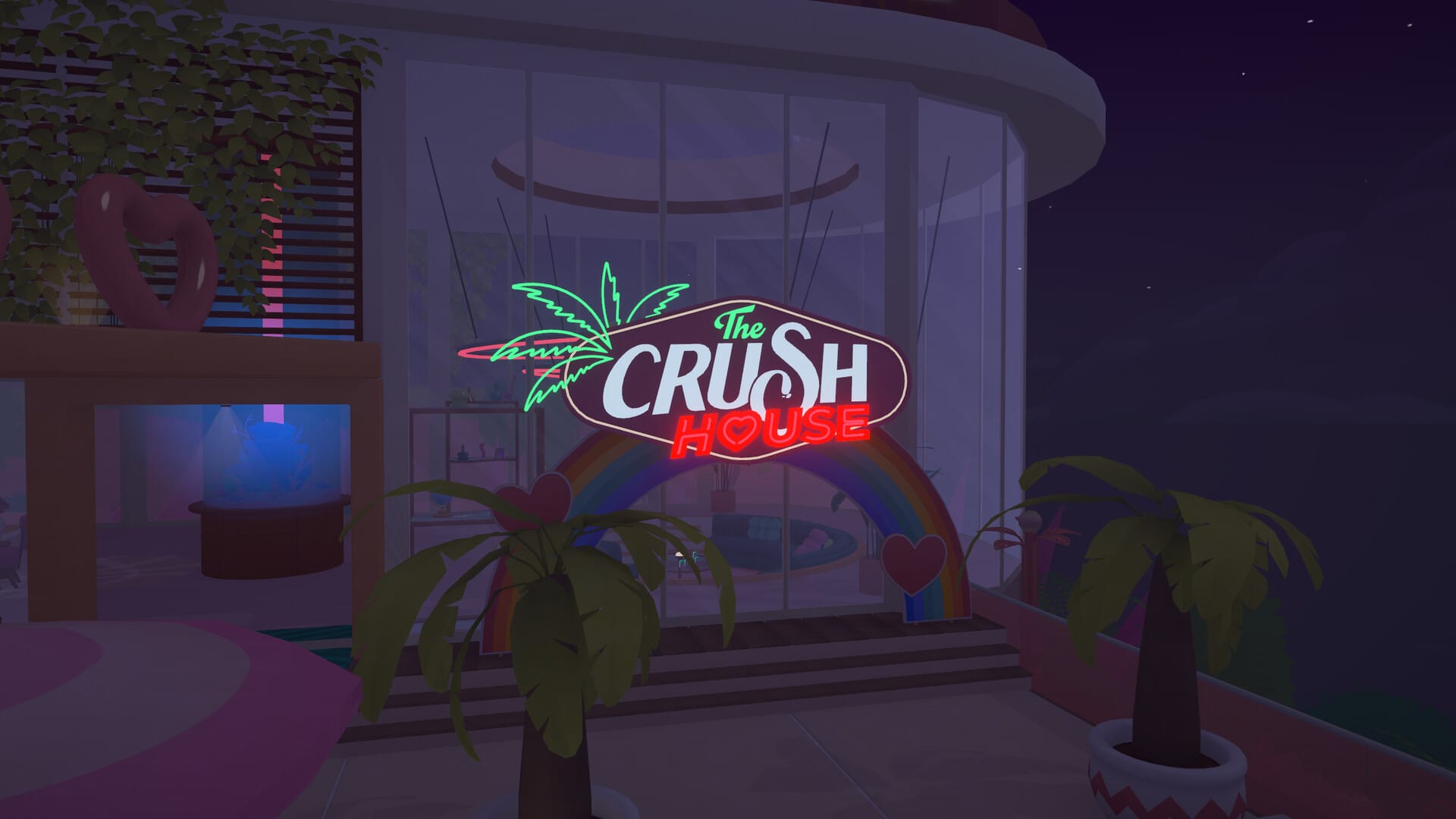




Bottom Line: Nerial built a game where the gun is a camcorder and the ammunition is other people's dignity — a wickedly smart satire of reality TV that runs out of mechanical road well before it runs out of ideas. Brilliant for six hours, tired by ten.
The Gameplay Loop
The daily rhythm is clean: film during the day, cut an episode, check the ratings, then explore at night. It reads well on paper and plays well for the first several hours, largely because the writing carries it. The script is genuinely sharp — the cast are stupid in specific, well-observed ways rather than generic-reality-show ways, and the voice acting sells it. When two housemates spiral into an argument about nothing and you sprint across the lawn to catch the good angle, the game achieves something few comedies manage: you laugh and feel complicit at the same time.
The problem is that pointing is a thin verb. Shooters compensate for the thinness of aiming with recoil, cover, movement, enemy variety — friction that makes each shot feel different from the last. The Crush House has less of this than it needs. By the middle of a season, you have internalized where the Foodies get fed and where the Romance quota gets filled, and the act of filming degrades from observation into errand-running. You stop watching your cast and start scanning them for tags. That's a savage irony for a game about the flattening effect of content quotas — and I'm not fully convinced it's intentional, because the game doesn't do anything with it.
The Quota System
Here's where the design gets contentious, and where I part company with the game's more forgiving reviews. The audience demands are the engine, but they're also the friction point. When a segment wants something the house isn't currently producing, you're left circling rooms hoping the simulation coughs up the right beat. Reviewers used the word "arbitrary," and while I'd soften that to opaque, the complaint is legitimate. The feedback loop between "I filmed this" and "the numbers moved" is muddier than a systems-driven game needs it to be. You often can't reconstruct why an episode underperformed, which converts a strategy layer into a slot machine.
The casting system is the strongest counterweight. Twelve personalities and four slots means real combinatorial variance, and the grudge-and-attraction web produces storylines you didn't author but feel responsible for. This is where the simulation earns its keep — and it's also the clearest signal of the game Nerial could have built with another year. The Crush House gestures at the emergent-narrative depth of a Sims or a Dwarf Fortress, then walks it back to something closer to a well-decorated quest checklist.
Structure and the Conspiracy
The night sections are the best writing in the game and the least developed system. Talking to the cast as people — after spending the day treating them as content — is the emotional hinge the whole thing pivots on, and the Crush Juice mystery starts strong. It does not finish strong. The conspiracy resolves faster than it builds, and the multiple endings land more as toggles than as earned divergence. Several critics called the mystery under-developed relative to the premise. Correct. The setup promises a satire of network power; the payoff delivers a twist.
The counterargument, which I'll grant: this is a compact game at compact-game pricing, and its brevity is partly a mercy given the loop's decay rate. It ends roughly when it should. But the strongest version of this game is one where the day-to-day filming keeps generating surprise deep into the run, and that version doesn't exist yet.