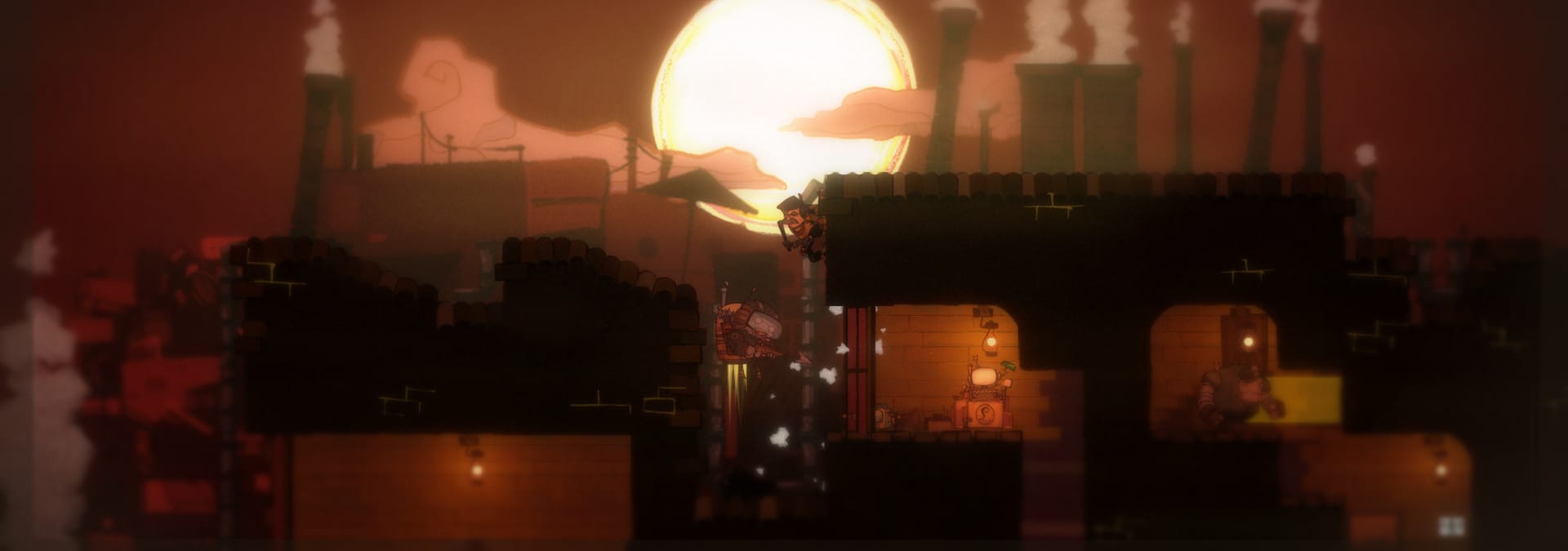



Bottom Line: Size Five Games built one of the sharpest risk/reward loops in the roguelike canon and then bolted it onto platforming controls that can't carry the weight. When it works, it's electric. When it doesn't, you'll blame the game — and you'll usually be right.
The Gameplay Loop
Strip away the steampunk and the loop here is nearly perfect on paper. You drop into a building. You case it. You hack terminals for small money, crack safes for real money, and every action you take raises your exposure. Cameras sweep. Automatons patrol. The floor might be a trap. Somewhere above you is a roof, and the roof is the only place your money becomes money.
That last clause is where the design earns its keep. The Swindle's core tension isn't stealth — it's greed. Stealth games usually ask "can you get through?" This one asks "when do you stop?" You've got £4,000 in your pocket and there's one more safe two rooms over, behind a camera you haven't mapped. The safe is worth £2,500. Dying costs you £4,000 and a thief you've been babying for six runs. There is no correct answer, only a read on your own nerve, and that's the sensation good roguelikes are built to manufacture.
The tech tree feeds this beautifully. Because upgrades persist through death, a catastrophic run is never a total write-off — you bank what you learned even when you don't bank what you stole. That softens the permadeath enough to keep the loop turning, and the district-unlock gating gives the 100 days real shape. You're not just getting stronger. You're deciding how fast to escalate, knowing that every tier up multiplies both the payout and the failure cost.
Where It Breaks
Then you jump, and the whole thing wobbles.
The platforming is the load-bearing wall, and it isn't rated for the load. The jump is floaty. The edge-grab is inconsistent enough that you can't build muscle memory around it. In a game where a single mistimed input deletes a fully-upgraded character and a run's worth of accumulated cash, imprecision isn't a rough edge — it's a betrayal of the core contract. Spelunky is brutal, but Spelunky is honest; when you die there, you know exactly which of your inputs was wrong. Here, a meaningful share of deaths land in the ambiguous zone where you genuinely cannot tell whether you misjudged the gap or the game failed to register the grab.
That ambiguity poisons the greed mechanic. The "one more safe" gamble only works if you trust the execution layer to honour a correct decision. Once you don't, the rational play becomes cowardice — bank early, take nothing, run the roof. The design wants you to push. The controls teach you not to. Those are two systems fighting each other, and the player loses.
The procedural generation has a shorter fuse than it should, too. The first several hours are genuinely surprising. Somewhere around the ten-to-twelve hour mark, the generator's vocabulary becomes legible — you start recognising room grammar rather than reading rooms, and the buildings blur into a set of recombined modules. For a game whose entire promise is "no level is ever repeated," having players report that it feels repeated is a damning technicality. Novelty of layout isn't the same as novelty of experience.
Onboarding and Pacing Friction
The 100-day limit is defensible design and a genuine source of complaints, and both things are true at once. It's the right call for the fantasy — the Basilisk is a deadline, and a deadline you can ignore is set dressing. But it collides head-on with the permadeath economy. Lose a couple of high-tier thieves in a bad stretch and you can enter a spiral you can't dig out of, watching the clock burn while you rebuild. The game offers no meaningful pressure valve. Players who wanted to learn the systems at their own pace found the door locked, and telling them they wanted the wrong thing doesn't make the friction disappear.