

Overview
Nobody asked for a first-person network administration game. That’s precisely why Tunnet works.
Released on Steam on December 1, 2023 by solo developer puzzled_squid, Tunnet drops you into the chassis of a freshly booted robot technician with a work order and a drill. The job: wire up a decaying underground bunker complex. Not metaphorically wire it. Actually wire it. You carve tunnels through dirt and rock with a handheld drill, break into sealed rooms, and physically drag cable from one endpoint to another until packets start moving. It is, functionally, a game about being the person who crawls through the ceiling with a spool of Cat6 — and it is far more compelling than that sentence has any right to be.
The market positioning is unusual and, it seems, largely accidental. Tunnet sits in the same neighborhood as the cozy-automation crowd — your Factorio logistics obsessives, your Satisfactory belt-optimizers, your Opus Magnum min-maxers — but it approaches from a completely different door. There’s no factory. There’s no throughput graph climbing toward infinity. There’s a bunker, a topology problem, and a credit payout that scales with how elegantly you solved it. The comparison that comes most naturally is laying out rail networks in Factorio, and that’s the right instinct: the pleasure is in the routing, not the volume.
Its reception reflects the niche. The game has found its exact audience and almost nobody else. The people who love it are, disproportionately, people who have actually run cable, actually debugged a broken segment, actually stared at a topology diagram at 2 a.m. wondering why a switch went dark.
That specificity is Tunnet’s greatest asset and its hardest ceiling.
Key features
- Player-Authored Tunneling: The drill is the whole spatial layer. You are not navigating a level designer’s corridors — you’re excavating your own, which means your cable runs are only as efficient as your digging was foresighted. Bad pathing early becomes expensive later.
- Genuinely Real Networking: Switches, routers, repeaters, endpoints, signal degradation over distance. The vocabulary isn’t set dressing. Traffic visibly flows along links you built, and payout is tied to topology efficiency, not just completion.
- Incident Tickets: Later chapters hand you dead segments, congested links, and misrouted traffic to diagnose. This is the closest any game has come to a friendly, low-stakes network-admin sim — a troubleshooting loop rather than a construction loop.
- Toolkit Progression: Drill upgrades and expanded tooling gate the facility open gradually, giving the exploration a Metroid-adjacent rhythm without ever announcing itself as such.
- Environmental Storytelling via Terminal Logs: The story of what happened underground is assembled from text you choose to read. No cutscenes. No voiceover. Bunker archaeology.
- Near-Zero Combat: A handful of creepy monsters guard specific machines. They exist to create tension and route-planning constraints, not to be fought.
Analysis
The Gameplay Loop
Tunnet’s loop is a three-beat rhythm, and it’s remarkably clean: survey, excavate, connect.
You arrive at a job with endpoints scattered across the facility — some visible, some behind rock, some sealed until you’ve upgraded the drill. You survey. You form a mental topology. Then you drill, and this is where the game reveals its cleverness: the tunnel is the cable route. There’s no abstraction layer between your spatial decisions and your network decisions. A lazy dig means a long cable run. A long cable run means repeaters. Repeaters mean cost. Cost eats your payout.
That coupling is the design’s central achievement. Most puzzle games about networks are top-down, abstract, and grid-locked — you’re moving nodes around a diagram. Tunnet makes you walk the topology. The distance between two switches is felt because it was drilled. When a loop finally closes and packets start moving along a hand-carved run, the payoff lands in a way a diagram never manages.
The economic layer is lighter than it first appears. Credits scale with efficiency, which theoretically pressures optimization — but the design is deliberately forgiving, built so that a sloppy solution rarely carries real consequences. That’s a choice consistent with its cozy positioning, and it’s also the source of the most common legitimate complaint: the difficulty curve is gentle to the point of flatness. For anyone who has spent real time in SpaceChem or Zachtronics-adjacent territory, Tunnet will not test you. It will pleasantly occupy you. Those are different products.
The Networking Is Not a Costume
Plenty of games borrow technical language and wear it as flavor. Tunnet doesn’t. Switches behave like switches. Repeaters solve the problem repeaters solve. The distinction between a switch and a router matters mechanically, not just cosmetically. The game amounts to a legitimate practical demonstration of network design. The concepts are simplified, obviously, but they are not falsified. There’s no moment where the game asks you to do something a real network engineer would wince at.
This makes Tunnet quietly one of the better accidental teaching tools on the platform. Not a serious game. Not an edutainment product. Just a game whose fiction happens to be accurate, which turns out to be enormously more effective than any deliberate attempt at instruction.
Where the Incident Tickets Falter
The later-chapter pivot to diagnostics is the game’s most interesting idea and its weakest execution. Conceptually, moving from build the network to fix the network is exactly the right escalation — troubleshooting is the actual job, after all, and the shift from creation to diagnosis mirrors a real career arc.
In practice, the tickets run out of ideas before they run out of runtime. There are only so many distinct failure modes in the game’s model, and once internalized, diagnosis collapses into pattern-matching. A dead segment appears, the same three things get checked, the fault is found. The tension of the first few incidents — something is broken and nobody knows why — decays into procedure. That repetition is the complaint that surfaces most often, and it’s fair.
A deeper simulation with emergent failure states would have carried this section. What’s here is a good idea implemented to roughly two-thirds of its potential.
Pacing and the Ending
The run is short — a handful of evenings at most. And the ending arrives abruptly, enough that “it ends suddenly” is a recurring note rather than an outlier opinion.
The length and the ending deserve separate treatment, because they’re different problems. The length is correct. Tunnet’s loop is strong but not infinitely deep, and a fifteen-hour version would have exposed every seam. Knowing when to stop is a discipline most indie developers lack. But the ending itself — the narrative resolution to the terminal-log mystery — lands with less weight than the buildup earns. The environmental storytelling is patient and atmospheric right up until it isn’t.
Visuals & performance
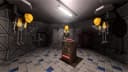
The aesthetic is functional-minimalist: low-poly geometry, flat lighting, readable silhouettes, a muted underground palette of browns, greys, and the occasional aggressive glow of an active terminal. It is not a beautiful game. It is a legible one, and in a title where you need to instantly distinguish a switch from a repeater across a dim room, legibility is the correct priority.
The visual design does real mechanical work. Active links are unmistakable. Traffic flow is communicated with enough clarity that a topology can be diagnosed at a glance. That’s UI thinking applied to world design, and it’s the kind of restraint that only shows up when a developer has actually watched people play.
Performance should be a non-issue by design — the geometry budget is modest and the simulation is light, so a 2D-scope game like this asks very little of the hardware.
One real caveat, and it’s not minor: first-person drilling is a motion sickness risk. The game spends a lot of time in tight tunnels with a bobbing camera and close geometry, a well-known trigger combination. Anyone sensitive to first-person movement in confined spaces should treat the refund window as a genuine test period. The monster-guarded sections compound this — they introduce sudden movement and disorientation into an otherwise calm experience, and their tonal fit with the rest of the game is debatable at best. They feel imported from a different, more conventional design.
Platform nuances
Steam, mouse and keyboard, and that’s the right and probably only home for it.
The precision demanded by cable placement and drill angling is mouse-native. Analog stick aiming would introduce friction exactly where the game needs to be frictionless — a job involves dozens of small placement decisions, and every one of them needs to be instant. Controller support exists but the design clearly wasn’t built around it.
The Steam context also shapes the value proposition sharply. At $5.99, a short game is an easy yes; the “too short” complaint that would sink a $30 title is a non-issue at this tier. This is the platform working correctly — a niche, focused, honestly-priced experiment finding the exact audience that wanted it.
Deck compatibility is worth verifying before purchase if that’s the intended device; the text-heavy terminal logs and precision placement are the obvious risk areas on a small screen.
Final verdict
Tunnet is a small game with a novel idea, executed with more confidence than polish. It takes the least glamorous job in technology — running cable, chasing dead segments, explaining to people that yes, it matters which port you plugged into — and finds the quiet satisfaction hiding inside it. That’s not a small achievement. Most games that borrow technical subject matter reduce it to aesthetic. Tunnet respects it enough to build mechanics on it.
The flaws are real and worth naming plainly: it’s brief, it’s easy, the diagnostic section thins out, the monsters don’t belong, and the ending doesn’t land the story it spent the whole runtime setting up. None of these are fatal at this price, but they keep it solid rather than special — a good game rather than the great one this concept could support. We recommend it to the right audience, and to them warmly.
What lingers is the loop. Standing in a tunnel, watching traffic move along a planned route, knowing the payout reflects how well it was thought through — that’s a feeling no other game currently offers. puzzled_squid found a genre-shaped hole nobody knew existed and filled it competently. A sequel with a deeper simulation model would be worth watching for.
Buy it. Finish it in a couple of sittings. Then go re-cable the closet.
Reviewed by the Rankeno RPG & Adventure Desk. Scores are out of 10; the overall score is the desk’s editorial judgement, informed by the four sub-scores above. How we review