



Bottom Line: Cygames built a genuinely brilliant management sim, wrapped it in one of the most technically accomplished presentation layers in mobile gaming, and then chained the whole thing to a gacha economy and a daily-login treadmill. It's superb. It will also eat your evenings.
The Gameplay Loop
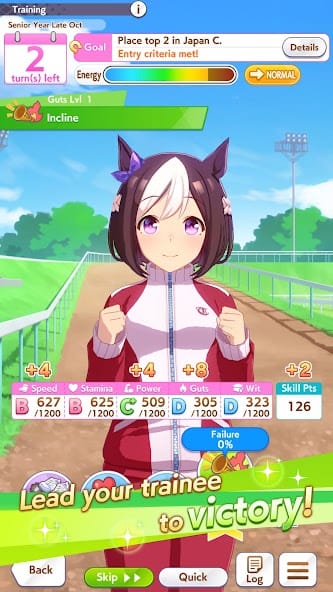
A career run is roughly 70-odd turns spanning three racing seasons, and the design achieves something most mobile games don't even attempt: every single turn is a real decision.
Here's the tension. Five training facilities, each raising one stat. Support cards randomly distribute themselves across those facilities each turn, and stacking multiple cards on one facility multiplies your gains enormously. So the optimal move is usually "train wherever the cards clustered" — except your trainee needs stamina to survive a 3,200-meter classic, and the cards keep piling onto speed. Meanwhile every training session adds fatigue, and pushing into the red risks an injury that can cost you ten turns and effectively end the run. Rest wastes a turn. Recreation wastes a turn but restores motivation, which multiplies all future gains. Races cost turns but grant fans, which some goals require.
Every option is correct in isolation. That's the trick. The game never presents you with a dominant choice; it presents you with five defensible ones and lets you find out at the finish line which was right.
And then it cheats. Career runs lean hard on RNG, and this is the most consistent criticism in the player base, appearing across Steam reviews and both mobile storefronts. You can execute forty turns of near-flawless play and lose the run to a randomly rolled injury on turn 41. You can make mediocre decisions and get carried by a lucky chain of rainbow training triggers. Over a large sample, skill dominates. Over any single run — the unit of experience you actually live through — variance is loud.
I'm split on this. Structurally, the randomness is defensible: it's a raising sim, plans falling apart is the genre's entire premise, and the "one more run" pull depends on outcomes not being predetermined. But the game asks for 30-plus minutes per career, and losing half an hour to a dice roll produces a specific, sour frustration that no amount of design theory smooths over. Cygames mitigates this with skip functions and auto-play for repeat content, and those tools are good. They don't fix the core issue; they reduce the tax on failure.
Deck-Building, or: The Paywall Wearing a Strategy Costume
This is the honest part of the review. Support cards are pulled from the gacha. Top-rarity cards get meaningfully stronger as you duplicate them, and a fully-limit-broken meta card is transformatively better than an unbroken one — not a 10% edge, more like a different game.
For Career mode and story content, this doesn't matter much. You can clear scenarios, complete character arcs, and win the emotional payoff of the whole enterprise on a modest free-to-play deck. Many reviewers say exactly that, and they're right.
For Champions Meeting, it matters enormously. Competitive play demands deck quality, deep inheritance stock built over dozens of runs, and meta foresight — reading which distance and surface the next tournament favors and preparing weeks in advance. The skill component is genuine and substantial. But it sits on top of a resource floor, and that floor is purchasable.
Cygames handles this about as gracefully as the business model permits. The competitive mode is optional and cleanly walled off. Free currency accrues at a reasonable clip. There's a pity ceiling. None of that changes the underlying arithmetic — it just means the game is upfront about it instead of sneaky.
Onboarding Friction
The tutorial is competent and far too short for what follows. It teaches you which buttons do what, then releases you into a system with roughly a dozen interacting subsystems — skill purchasing, race aptitude grades, mood multipliers, inheritance factor rolls, distance and surface fit — that it explains glancingly or not at all.
Within a week, most serious players are running a second screen with a community tier list and a stat-target calculator. A game this well-designed shouldn't be outsourcing its own documentation to Reddit. The information is all technically in the UI, buried under submenus, presented without the context needed to act on it. That's a real failure, and it's the kind that quietly costs a game half its potential audience in the first three days.