

Overview
First-person parkour usually borrows a shooter’s skeleton: a gun in hand, an enemy around the corner, movement as a means to a kill. VHOLUME strips that skeleton bare. There are no weapons and no combat. What remains is a citizen named Robert, a family whose ration tickets have been revoked, and a ruined capital of Afro-Eurasia that the all-powerful Ministry governs through concrete and paperwork. The goal is to get those tickets reinstated. The method is to run across the city’s crumbling brutalist megastructures until the bureaucracy relents.
The game comes from Nathan Grange, Léonard Lemaitre and Niels Tiercelin, a three-name credit list that places it in independent territory. The pricing matches that scale: VHOLUME sells for $8 on Steam, with a soundtrack and other add-on bundles sold separately. At that price it competes less with big-budget first-person platformers and more with the lean, replay-driven speedrun games that live on leaderboards and community routing.
Steam reception is strongly positive, and the goodwill does not appear to be fading as the audience widens. The recurring praise centers on momentum-based movement that recalls Source-engine games while being easier to learn, a decayed and surreal city with a distinctly melancholic mood, and the long tail that ghosts, leaderboards and Workshop levels provide. Criticism is thin. The main complaint concerns a character so fast that the toughest stages are the ones demanding short, slow, precise jumps.
That profile defines the pitch: a small, cheap, mechanically focused game with an unusually specific sense of place, aimed squarely at players who would rather master a route than win a fight.
Key features
- Momentum-based movement: Run, jump, wall-run, climb, crouch-slide and cling to walls, with speed carrying between actions so skilled chaining opens faster lines.
- Combat-free design: No weapons, no enemies to shoot. Traversal is the entire challenge.
- Target times and alternate routes: Every stage has times to beat and shortcuts to find, giving the campaign a built-in speedrunning layer.
- Hidden objectives and secret stages: Optional goals reward exploration and unlock additional levels.
- Ghost runs and Steam Leaderboards: Watch and share other players’ runs and compete for placement.
- Steam Workshop support: Community-made levels extend the content supply beyond the developers’ own output.
- A lived-in dystopia: Odd NPCs grumble about their jobs or explain the paperwork that runs their lives, building the world through dialogue.
- Broad localization: Audio and subtitle support across a wide spread of languages.
Analysis
Movement Is the Whole Game
The verb list is short and familiar: run, jump, wall-run, climb, crouch-slide and cling to walls. The design question is what binds those verbs together, and the answer is momentum. Speed carries between actions, so a crouch-slide into a wall-run into a jump becomes a chain where each link inherits energy from the last. That structure turns route-finding into a physics problem rather than a memorization drill. A player who understands how to preserve speed sees a different level from one who only knows where the next ledge is.
Steam reviewers compare this to Source-engine movement, the lineage of bunny-hopping and air-strafing that built entire speedrun communities, while noting that VHOLUME is easier to learn. That trade is deliberate and, in our view, correct for a game with a narrative frame. Source-style movement carries brutal onboarding friction; softening the entry while keeping momentum as the governing rule widens the funnel. The risk is that a gentler floor compresses the gap between average and expert play. The presence of shortcuts, alternate routes and target times indicates the developers built the skill ceiling into level geometry instead of arcane input tricks, which is a sound way to preserve depth without gatekeeping it.
Levels, Routes and the Clock
Every stage carries target times, and every stage is built to be broken. Alternate routes and shortcuts reward players who read the space aggressively, which gives a nominally story-driven adventure a speedrunning spine. This is the smartest structural decision in the package. A first pass works as traversal and sightseeing; a second pass works as optimization. The same concrete corridor serves two audiences without a separate mode.
Hidden objectives push replay in a different direction. Instead of asking players to go faster, they ask them to look harder, and they pay out in secret stages. That pairing of speed for one kind of player and discovery for another keeps the replay loop from collapsing into pure time trials. The level count is generous rather than sparse, which matters at $8: the value equation does not hinge on whether a player falls for leaderboards.
A City Run on Forms
The premise is the most distinctive thing about VHOLUME. Game dystopias usually express power through soldiers and surveillance; this one expresses it through ration tickets, ministries and paperwork. Robert is an ordinary citizen on an errand, and the errand is bureaucratic. That framing gives the non-violent design a thematic logic. A citizen punching the Ministry would make no sense here; a citizen sprinting across its monuments to fix a clerical injustice does.
The inhabitants carry the theme. Odd characters grumble about their jobs or explain the paperwork that governs their lives, which turns NPCs into world-building rather than quest dispensers. It is a cheap, effective technique: a few lines of complaint from a functionary say more about a regime than any lore codex. The surreal tone keeps the melancholy from tipping into misery. The open question is how much narrative weight the ration-ticket arc can bear across a long level list. A premise this specific makes a strong hook, and the setup alone does not reveal whether it develops or remains a frame around the running.
Where the Design Strains
The single recurring criticism is revealing. The character is fast enough that the hardest levels are the ones requiring short, slow or precise jumps. That is a tuning tension rather than a bug: a controller built for flow will always resist being asked to stop. When difficulty spikes come from fighting the movement model instead of mastering it, those sections risk playing like a different, less comfortable game. Players who come for the momentum may find the precision stretches the least rewarding part of the campaign.
The no-combat stance also narrows the audience. Players who need enemies, upgrades or a skill tree to stay invested will find nothing to hold onto; progression is measured in seconds, routes and secrets.
Longevity Beyond the Campaign
Online features carry the long tail. Players can watch and share ghost runs, which doubles as a teaching tool: a faster ghost is a route tutorial nobody had to write. Steam Leaderboards give those ghosts stakes, and Steam Workshop support means the level supply is not capped by a three-person team’s output. The caveat is that this tail depends on the community staying active, and that is not something the design can guarantee.
Visuals & performance
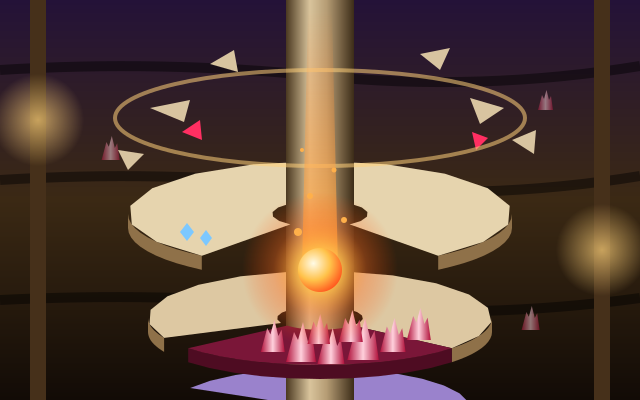
The art direction commits to brutalism: huge, decayed concrete structures in a surreal, melancholic city. It suits a speed game better than it first appears. Brutalist architecture is all slabs, ledges, ramps and repeating geometry, which is natural parkour furniture, and its scale makes a lone runner look small against the state. That visual relationship is the thematic point. The surreal edge is there to stop a palette of grey from turning monotonous.
The danger with a concrete-heavy look is readability. In a game graded against target times, a ledge that blends into a wall costs a run. Brutalism’s flat, uniform surfaces make that a real risk, and the way lighting and composition separate climbable surfaces from decorative ones decides whether the style helps or hinders routing. Steam reviewers single out the art style for praise, which points toward the balance landing on the right side.
Performance matters more here than in most genres. A momentum game with leaderboards and ghost comparisons depends on consistent frame pacing and responsive input far more than on visual fidelity; a single hitch can invalidate a record attempt. A small team building large concrete spaces has every incentive to keep scenes efficient, but players on older hardware should treat smooth performance as an expectation rather than a guarantee.
Platform nuances
VHOLUME is a Steam release, so the platform questions concern integration rather than parity.
- Input: A first-person platformer built on fast camera turns and jump timing naturally favors mouse and keyboard, where aim and directional changes are most direct.
- Online features: Ghost-run sharing, Steam Leaderboards and Steam Workshop levels all run on Steam’s infrastructure, which is where the competitive scene lives.
- Account features: Steam Achievements, Cloud saves and Family Sharing are supported, so progress follows players between machines and a household can share one purchase.
- Localization: Broad audio and subtitle support, a meaningful inclusion for a game whose world-building lives in NPC dialogue.
- Pricing: $8 for the base game; a soundtrack and other add-on bundles are sold separately.
Final verdict
VHOLUME succeeds by narrowing its focus. It drops combat, builds everything around momentum, and wraps the result in a dystopia whose villain is a filing system. The movement model is approachable enough for newcomers and open enough for route-hunters; the level design layers target times, alternate paths and secret stages so that one stage serves several kinds of player; and Steam’s ghost, leaderboard and Workshop features give it a life well beyond the campaign. The weaknesses are real but contained: precision platforming sits awkwardly on a character built for speed, and anyone who needs enemies or upgrades will drift away. At $8, we recommend it with real reservations to anyone who finds satisfaction in a cleaner line through a level.
Reviewed by the Rankeno Puzzle & Casual Desk. Scores are out of 10; the overall score is the desk’s editorial judgement, informed by the four sub-scores above. How we review