
Bottom Line: A brutally honest little kingdom sim that understands something most strategy games refuse to admit — governing is mostly deciding which of your people you're willing to fail. Short, bleak, occasionally opaque, and one of the most emotionally durable indie games of its generation.
The Gameplay Loop
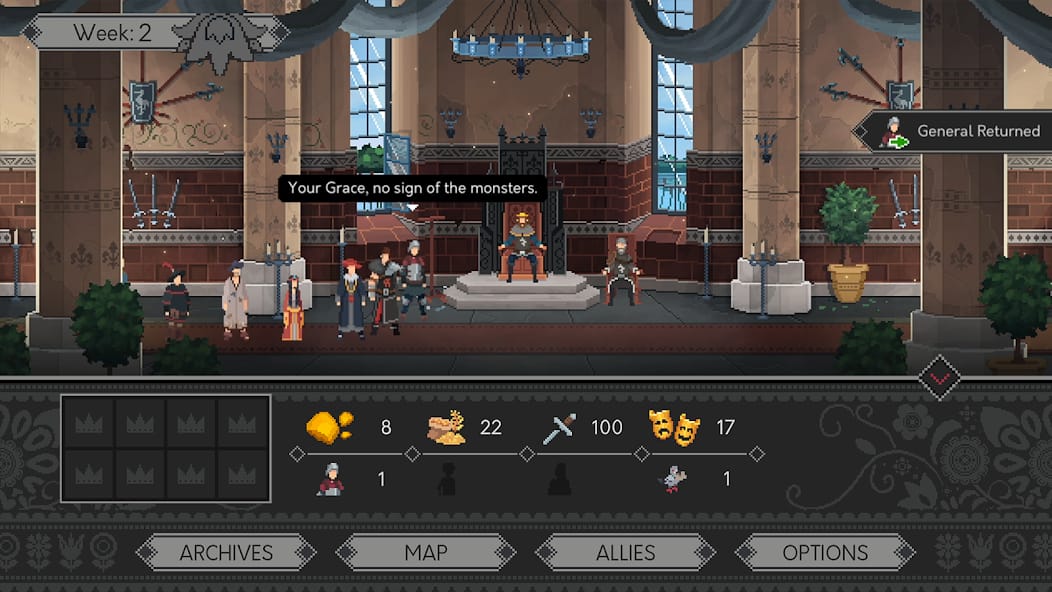
The structure is almost aggressively simple. Sit on throne. Hear petition. Choose. Advance week. That loop repeats for the entire game, and by hour two you understand every mechanical verb available to you.
That simplicity is a trap, and it's the best design decision in the game.
Because what Brave At Night actually built is an economy of deferred pain. A petitioner asks for 30 gold to rebuild a bridge. You don't have 30 gold — or rather, you do, but you've earmarked it for mercenaries. So you refuse. Three weeks later the trade route that used the bridge dries up and your weekly income drops. Now the mercenaries are unaffordable too. The game rarely punishes you in the moment; it punishes you in the third act, with interest, and by then the causal chain is long enough that you can't quite point to the decision that killed you.
This is genuinely sophisticated systems design masquerading as a visual novel. Frostpunk did something similar with heat and hope, but Frostpunk gave you dashboards. Yes, Your Grace gives you a man in a hat asking for grain.
The Interface Is the Argument
There is no forecast panel. No projected-income tooltip. No "if you take this action, your food reserve will fall below threshold in four weeks" advisory. You see current stocks and you see a request, and you're expected to hold the rest of the model in your head.
Purists will call this elegant. I'll call it half elegant and half evasive, and the distinction matters. The opacity is thematically perfect — real governance is decision-making under fog, and the anxiety of not knowing is the entire emotional payload. But there's a version of that fog that respects the player and a version that just withholds information. Yes, Your Grace occasionally crosses into the second. Some petitions have consequences so lateral, so far downstream, that no reasonable player could have modeled them. That's not tragedy; that's a gotcha wearing tragedy's clothes.
The scarcity has a sharper failure mode too, and it's the most legitimate structural complaint in the player base: you can starve your run into a corner. Mismanage the middle chapters and you arrive at the war with an army that mathematically cannot win, having spent hours getting there. The game does not clearly signal that you've crossed the line. For a title that discourages rewinding — and its whole rhythm assumes you live with what you signed — that's a real cost, not a purist's badge of honor.
The Family Is the Actual Game
Here's where it separates from everything adjacent to it.
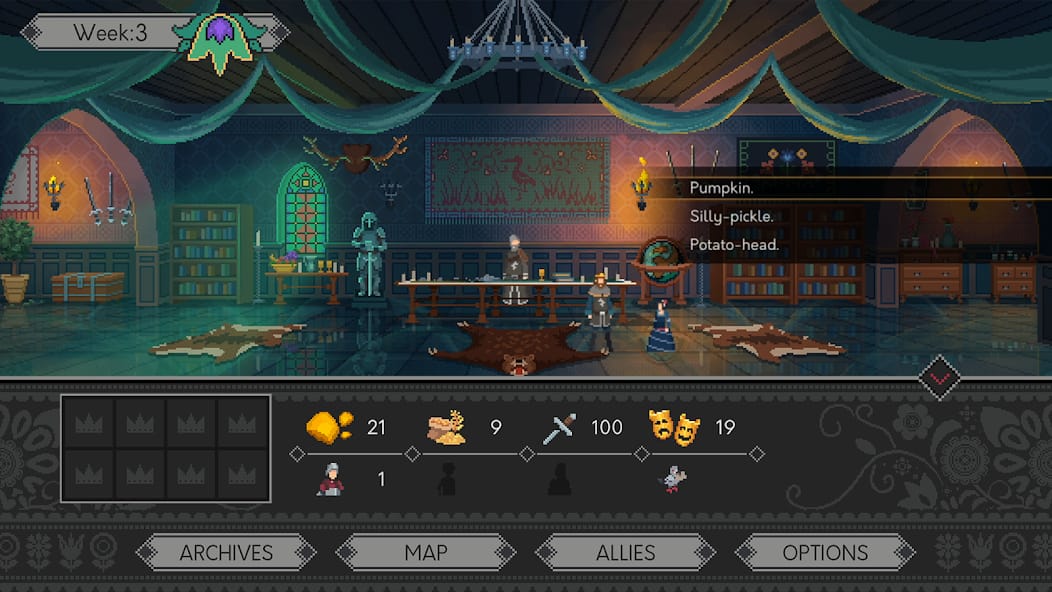
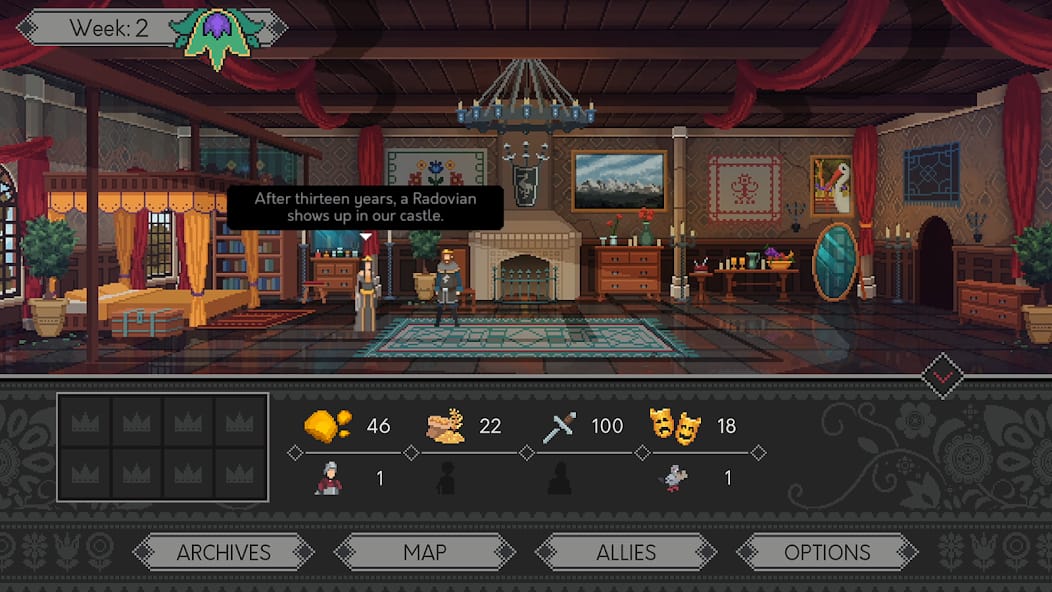
Strategy games have been treating relatives as stat containers for twenty years. Marry the daughter, gain the alliance, +15 opinion. Yes, Your Grace makes that transaction available and then forces you to look at it. Your daughters have preferences. They have people they love. They have opinions about being currency. The alliance you need to survive the invasion runs directly through one of their lives, and the game will let you make the cold, correct, strategically optimal choice — and then it will make you sit in the room afterward.
The writing carries this. It's restrained where it could be melodramatic, and it commits to a Slavic-folkloric register — fatalistic, wry, uninterested in Anglo high-fantasy nobility — that gives even minor characters a specific gravity. Players consistently report that the family reads as people rather than resources, and that's not a happy accident. It's the result of a script that refuses to give you a dialogue option that resolves the guilt.
Where the Seams Show
Two honest criticisms.
First, the sim is thinner than the fiction. Once you internalize the resource rhythms — roughly by the midpoint — the optimization layer stops surprising you and the game runs almost entirely on narrative momentum. That momentum is strong enough to carry it, but strategy-first players will notice the machine is smaller than it first appeared.
Second, 6 to 10 hours is short, and the game's own ambition works against it. The final act moves fast, and threads that took hours to develop get resolved in minutes. The much-debated ending divides players not because it's bleak — the bleakness is earned — but because it arrives with less breathing room than the setup promised. I'd rather have a game that ends too soon with something to say than one that pads to thirty hours with nothing. But the compression is real, and pretending otherwise is doing you a disservice.