
Overview
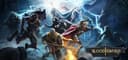
Gamebook adaptations usually fail in one of two ways: they either stay so faithful that they amount to an e-reader with dice, or they sand away the source until nothing distinctive survives. Blood Sword attempts a third route. Prime Games, the studio behind Fabled Lands, has taken the cult-classic gamebook series by Dave Morris and Oliver Johnson and rebuilt it as a party-based tactical RPG with turn-based battles on a hex grid.
The setup is traditional in the best sense. A party drawn from Warrior, Trickster, Sage and Enchanter pushes through forests, cathedrals, crypts and the Battlepits beneath Kalugen’s Keep. Class skills unlock as heroes rise in rank. The story branches, promises multiple endings, and carries heroes and their progress from one act to the next.
That last point matters, because this is an Early Access release and an incomplete one. The current build contains only part of the planned campaign, alongside a modest set of enemies, items, spells, shops, inns, card and dice games, and achievements. Later acts, smaller party sizes, a new class, and Italian and Bulgarian translations are scheduled to follow, with the remaining content planned over time.
Blood Sword launched on Steam on November 12, 2026, as a single-player, Windows-only, English-language game at $14.99. Early reception is positive but thin, a sample too small to carry much weight. The positioning is clear enough, though. This is a modestly priced, niche tactical RPG aimed at players who value rules and consequences over spectacle, and at the audience that remembers the books. It competes on mechanical character, not production scale, and the question is whether an unfinished campaign is enough to buy into now.
Key features
- Class-Based Party Combat: Warrior, Trickster, Sage and Enchanter fight together in turn-based battles on a hex grid, with class skills unlocking by rank.
- Skills With Costs: Skills can be combined, but power has a price. Spells can backfire, and the Sage’s healing drains the Sage’s own life.
- Branching Story Across Acts: Choices lead to multiple endings, and heroes and their progress carry over between acts.
- Multiple Difficulty Settings: Tactician adds permadeath; Ironman makes every decision irreversible.
- Early Access Content: Only part of the planned campaign, with a modest set of enemies, items, spells, shops, inns, and card and dice games.
- Steam Integration: Steam Cloud saves and achievements.
Analysis
Combat and Class Design
The class structure is the strongest design decision here, and it comes straight from the source. Fixed archetypes in a small party mean every class has a seat, and the interest lies in how they depend on each other. A hex grid suits that, giving positioning more texture than a square grid, and a small party makes each placement count.
The more interesting choice is the insistence on cost. Most tactical RPGs treat healing as a resource drawn from a mana pool, which turns the healer into a battery. Here the Sage heals by spending the Sage’s own life. That converts every heal into a trade: one hero’s health for another’s, with the party’s total pool unchanged at best. It rewards players who prevent damage through positioning instead of repairing it afterwards, and it makes the Sage a risk to manage instead of a safety net.
Spells that can backfire push the same idea onto the Enchanter. A caster whose strongest tools may misfire has to be planned around, not leaned on. We think this is the right instinct for a game adapted from dice-driven books. It keeps uncertainty in the system. The risk is equally plain: backfire mechanics frustrate players who want deterministic tactics, and with a narrow spell list in the current build, the Enchanter’s toolkit may make a bad run of misfires feel punishing instead of dramatic.
Progression and Depth
The skill tree is compact rather than sprawling. The claim that skills can be combined carries much of the weight here; if combinations across classes are plentiful, the available skills are ample, and if they are few, builds will converge quickly. The planned new class and the option of smaller party sizes are the features most likely to extend the game’s life, since both force players to solve encounters without a full set of roles. Neither exists yet.
Story Structure
Branching choices and multiple endings are easy promises to make and hard ones to assess at this stage. With later acts unreleased, no ending can currently be reached, so the consequences of early decisions remain theoretical. Carrying heroes and progress between acts is the sensible structure for an episodic release, and it means time invested now should not be wasted when later acts arrive. Still, anyone who buys a branching narrative for its payoffs is buying on trust.
The side content of shops, inns, and card and dice games adds texture between battles. Dice games in particular fit the gamebook lineage neatly.
Difficulty
Multiple settings is a generous spread for a game of this size. Tactician’s permadeath has unusual bite in a small party where each class fills a distinct role: losing the Sage removes healing entirely, not a fraction of it. Ironman, which makes every decision irreversible, pairs naturally with a branching story, since it removes the temptation to reload a choice. Both modes serve the hardcore audience well. Lower settings give everyone else a way in, which matters given how unforgiving the self-damaging and backfiring mechanics could be.
Visuals & performance
The design tells us more about what the presentation has to achieve than any storefront material can. A hex-grid tactics game lives or dies on legibility: unit facing, skill ranges and the cost of an action all need to read at a glance, especially when a heal hurts the healer and a spell might turn on its caster. A gamebook adaptation with branching choices will also be text-heavy, so typography and the layout of choice screens matter as much as battlefield art.
As a design-level expectation, a turn-based game of this scope should be light on hardware. Early Access status means interface polish and balance are still subject to change, and buyers should treat the current presentation as provisional.
Platform nuances
Blood Sword is a Steam-only, Windows-only release. No iOS, Google Play or Nintendo eShop listing exists, so there is no cross-platform parity to weigh.
- Input: Turn-based hex combat and menu-driven choices are a natural fit for mouse and keyboard. Controller support is not confirmed.
- Steam features: Steam Cloud saves and achievements are included.
- Language: English only at present; Italian and Bulgarian translations are planned.
- Price: $14.99 for the Early Access version.
- Multiplayer: None. This is strictly single-player.
Final verdict
Blood Sword’s best ideas are its oldest ones. A Sage who bleeds to heal and an Enchanter whose magic can turn on the party give this tactical RPG a mechanical identity that many larger games lack, and the class-based, small-party structure makes every loss matter. The difficulty range is well judged, and $14.99 is a fair ask.
The larger problem is size and completeness. Much of the campaign is missing, the branching story cannot yet pay off, and the features that would add the most replay value are still on the roadmap. Early user sentiment is favourable but drawn from a tiny sample.
We rate it as hard to recommend for most players right now. Gamebook devotees and tactics players who like sharp-edged systems may find enough in the cost-driven combat to justify Early Access, but everyone else loses nothing by waiting for the remaining acts. The score has room to rise if Prime Games delivers them.
Reviewed by the Rankeno RPG & Adventure Desk. Scores are out of 10; the overall score is the desk’s editorial judgement, informed by the four sub-scores above. How we review