

Overview
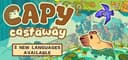
Zoo animals have escaped in Toronto before. Kitten Cup Studio, an indie team based in the city, took the real story of the capybaras that slipped out of High Park Zoo and pushed it somewhere stranger. A devastating flood scatters a zoo’s residents, and a capybara pup named Capy washes up alone on the mysterious Castaway Island. There Capy meets Corvi, a chatty, clever crow, and the pair set out to explore the island, solve environmental puzzles, help lost and stranded animals and uncover the island’s hidden story.
Published by Big Blue Sky Games, Capy Castaway launched on Steam on August 6, 2026, at $19.99, with Steam Deck as an explicit design target. It sits in the cozy narrative-exploration lane where A Short Hike lives, and it leans on that association hard. Mark Sparling, the composer of A Short Hike, scores this game too, and the shared composer invites direct comparison.
Co-op separates it from most of its neighbours. Solo players control both animals. A second player can take one of them in local shared-screen or split-screen play, and Steam Remote Play Together carries those modes online. Branching choices and multiple endings add a layer of consequence that most cozy explorers skip.
Reception has been mixed rather than enthusiastic. The art, the duo and the music are the strengths. The recurring weaknesses are navigation, pacing and tone.
Key features
- Asymmetric duo: Capy sniffs out scent trails, digs, swims and plays music. Corvi flies, fetches items that are out of reach and carries Capy across gaps to new areas.
- Scent-trail tracking: Capy can follow scent trails through the world, the most distinctive mechanic in the game.
- Flexible co-op: One player can control both characters, or two can play in local shared-screen or split-screen co-op. Steam Remote Play Together is also supported.
- Choice-driven narrative: Player decisions shape the story and lead to multiple endings. The themes are friendship, home and loss.
- Painterly storybook art and a Mark Sparling soundtrack: The art and music give the island a hand-illustrated identity and tie it to the composer of A Short Hike.
- Toronto roots: The premise comes from the real High Park Zoo capybara escape, and the island is full of Toronto easter eggs.
Analysis
A Toolkit Split Down the Middle
The best idea in Capy Castaway is to divide its verbs between a ground animal and an air animal. Capy covers earth and water with scent trails, digging, swimming and music. Corvi covers the sky with flight, fetching out-of-reach items and carrying Capy across gaps. Neither animal can work through the island alone, so every environmental puzzle draws on both toolkits.
Corvi’s carry ability holds the structure together. Because it takes Capy across gaps to new areas, it also acts as the game’s traversal gate. Progress depends on the two characters working together, not on one hero collecting upgrades. That suits a game about friendship, because the mechanics make the same argument as the story. Interdependence is the loop.
Scent-tracking is the most distinctive mechanic, and the design shows why. Following a trail by nose is diegetic wayfinding: it guides players through the world without a floating quest marker, and it suits a capybara far better than a compass would. Capy’s music ability is the other good fit, because it gives the protagonist a direct link to a score by one of the cozy genre’s most recognisable composers.
Lost at Sea
The most persistent problem is unclear navigation, especially across large stretches of water where it is hard to tell whether you are heading the right way. That suggests a gap between the island’s layout and its signposting. A scent trail helps only where the level design gives it something to lead toward, and open water offers few landmarks.
Some disorientation fits a story about a washed-up pup far from home. Cozy games, though, promise low friction above everything else. Players give up challenge in exchange for comfort, and not knowing where to swim next is the friction the genre handles worst. A failed puzzle invites another attempt, but a long swim in the wrong direction just wastes time. We consider this the game’s most damaging flaw, because it undercuts the calm mood every other system is built to protect.
Uneven pacing makes it worse. Exploration-led games rely on a steady stream of discovery: a new animal to help, a new area to open, a new story beat. When that rhythm stalls, the open water reads as emptier still.
Story, Choice and the Weight of Loss
Capy Castaway asks more of its narrative than most of its peers do. Choices shape the story and lead to multiple endings. The themes are heavy for the genre: friendship, home and loss, all set off by a flood that tears zoo animals away from everything they know.
The tone is a real risk. The darker material can sit awkwardly against the child-friendly look, even when the handling of grief is gentle. We side with the ambition. The premise is a disaster story, and a version that ignored the loss built into it would ring hollow. The problem is execution. The writing is uneven, and a tonal balance this delicate needs consistent writing to hold. That weakness falls hardest on Corvi, because a chatty companion is where much of a script like this lives, and a talkative sidekick is only as good as its lines.
Multiple endings promise replay value, but a second run only appeals if the journey is pleasant enough to repeat. With navigation and pacing already working against it, that is a harder sell than it should be.
Co-op by Design
The ability split pays off most in co-op. One player takes the air and the other takes the ground. That asymmetry suits pairs with different skill levels, such as a parent and child or an experienced player and a newcomer, because each person gets a distinct job and a distinct personality. Local shared-screen and split-screen modes cover couch play, and Steam Remote Play Together extends both to friends elsewhere.
Solo play is fully supported, with one player controlling both characters. The design risk is clear: a split built around two personalities can turn into busywork when one person handles both. Solo players will depend more on the charm of the duo to carry them.
The Toronto easter eggs and the High Park Zoo origin complete the package. The city tributes give the island a specific identity in a genre full of interchangeable meadows. Outside Toronto they add texture. For locals they are a reason to buy.
Visuals & performance
The painterly, storybook art style is the game’s most reliable strength, and it suits the premise: a picture-book look for a story about a lost animal finding its way home. It also creates the tonal tension the story runs into. Storybook illustration signals that a game is for children, so grief lands harder when the visuals promise comfort. With strong writing, that contrast can be affecting. With uneven writing, it reads as a mismatch.
The navigation problem likely involves the art direction too. Soft painterly palettes and broad sweeps of water look lovely but offer few hard landmarks. Readable silhouettes and distinct points of reference matter more in a game that asks players to find their own way. Strong art and strong wayfinding can coexist, but here the art seems to have cost the wayfinding something.
Performance expectations follow from the design goals. A stylised cozy explorer built to play well on Steam Deck should sit at the modest end of hardware demands. The Deck target also implies controller-first input and readability on a handheld screen. Split-screen co-op is the case to watch, since each player gets only part of the display.
Platform nuances
Capy Castaway is available on Steam, and it launched on August 6, 2026.
- Steam Deck: The game was designed to play well on the handheld, which suits a gentle, low-pressure adventure. Split-screen on a handheld display shrinks each player’s view, so shared-screen mode is the more sensible local option there.
- Input: Couch co-op effectively needs a second controller; two players sharing one keyboard is cramped. A controller is also the natural fit for the Deck target.
- Remote Play Together: Steam’s streaming feature carries the local co-op modes online, so a second player does not need to be on the same couch.
- Parity: The Steam release carries the co-op modes, Remote Play Together support and branching story as features of the game.
Final verdict
The problems come first: unclear navigation over open water, uneven pacing and uneven writing wear away the comfort a cozy game is supposed to deliver. They also make its bold choice to explore grief inside a storybook frame shakier than it should be.
The central idea is still strong. Capy’s ground abilities and Corvi’s air abilities depend on each other, turning friendship into a mechanic: a capybara that sniffs, digs, swims and plays music needs a crow that flies, fetches and carries. The co-op modes let two people share that interdependence on one couch or over Remote Play Together. The painterly art, Mark Sparling’s score and the Toronto tributes give the game an identity in a crowded genre.
We rate it Mixed: a co-op adventure with a strong central idea and a warm surface, but one that is hard to recommend for most players unless they have patience for its directionless stretches. Players hoping for a second A Short Hike will find a similar mood but not the same precision.
Reviewed by the Rankeno RPG & Adventure Desk. Scores are out of 10; the overall score is the desk’s editorial judgement, informed by the four sub-scores above. How we review