

Overview
Cozy games have a dishonesty problem. The genre’s default setting is the soft-focus fantasy: inherit a farm, dodge nothing, owe no one. Moonglow Bay opens with a funeral instead. Your partner is dead. The town is broke. The boat is a wreck, and so are you.
That’s the pitch from Bunnyhug, a small Canadian studio working with publisher Coatsink, and it’s a genuinely unusual one. The game is a slice-of-life fishing RPG set along the Eastern Canadian coastline in the 1980s — a specific, unglamorous, fog-and-diesel kind of place that almost no one builds games about. You play a rookie angler picking up a dead partner’s unfinished project: hauling a collapsing fishing town back from bankruptcy, one catch at a time. It launched on October 26, 2021, priced at $24.99, with a later port to Nintendo Switch.
Positioning-wise, it sits in the crowded post-Stardew Valley trench alongside Dave the Diver, Spiritfarer, and Cozy Grove — games that use a gentle loop as a delivery mechanism for something heavier. Moonglow Bay’s differentiator is tonal. Spiritfarer is about accompanying the dying. This is about what happens to the person left behind, in a town where the economy died at roughly the same time as the spouse. The grief and the collapsing fishery are the same story told twice.
The execution is where things get complicated. The game’s standing on Steam sits in “Mixed” territory, and that verdict is not a referendum on the concept — the complaints cluster overwhelmingly around bugs, lockups, and repetition rather than the premise. This is a game people wanted to love and frequently couldn’t finish.
Key features
- A full fishing toolkit, not just a rod: Rod and line, cast nets, traps, and ice fishing, each with its own rhythm and its own use case. A deep catalogue of aquatic species spans biomes that range from the plausible (glacial water, sulphur springs) to the frankly hallucinatory (astral zones), with legendary creatures gating story progress.
- A closed economic loop from hook to storefront: Catch fish, cook them into recipes, sell dishes from a shop you own and decorate, upgrade the boat and gear, then reinvest the profits into the town’s derelict buildings. Rebuilding the waterfront is the actual win condition.
- Drop-in local co-op: Full shared and split-screen support, and a second player can join or leave at any moment. No lobby, no second save file, no ceremony.
- Townspeople with actual questlines: Befriending residents unlocks new areas and services, which means social progress and mechanical progress are the same axis.
- An original Lena Raine soundtrack: The Celeste and Minecraft composer, working in a restrained, saltwater-and-synth register that is among the best work in the genre.
- Support systems: An aquarium for rare specimens, home and shop customization, and a photo mode that suits the chunky voxel art.
Analysis
The Gameplay Loop
The day is the unit. You wake, you provision, you take the boat out, you work a spot, you come home heavier than you left. Moonglow Bay understands the appeal of that shape and commits to it without apologizing, and early on the commitment pays off enormously.
What separates it from its peers is that fishing here is a set of verbs rather than a single minigame. Rod and line is the precision instrument — read the fish, manage the tension, don’t snap the line. Cast nets are volume plays for when you need forty of something mediocre for a recipe. Traps are passive income you set and forget. Ice fishing changes the geometry entirely, turning open water into a grid of holes and guesses. Each technique implies a different planning horizon, and choosing among them each morning is the smartest thing the design does. You aren’t picking a tool; you’re picking a kind of day.
The economic layer is likewise more ambitious than it needs to be. Fish aren’t currency. Fish are ingredients. Cooking is where the value multiplier lives, and the storefront is where it converts. Then the money goes back into hulls, gear, and — critically — the town itself. Rebuilding a boarded-up storefront isn’t a cosmetic reward; it unlocks a service you actually use. The grief narrative and the spreadsheet are wired to each other. Progress in the ledger reads as recovery in the character. That’s a real design idea, elegantly stated.
Where It Frays
And then it keeps going. The loop that feels meditative in the early hours feels mechanical deep into the back half. The problem isn’t that the game is slow — slow is the point — it’s that the difficulty curve is expressed almost entirely as volume. Later recipes and upgrades demand larger quantities of things you already know how to catch, in spots you’ve already worked, using techniques the first act already taught. The species catalogue sounds like variety, but the play of catching a late-catalogue fish is rarely distinct from an early one. New biomes bring new sprites and new prices; they rarely bring new problems to solve.
The legendary encounters are supposed to break this up, and the best of them do — they’re the game’s boss fights, mystical and strange and tonally weird in a way that suits the writing. But they’re spaced too widely, and the grind between them is the grind you were already doing. By the final arc, the game is asking for a time investment it hasn’t justified with new ideas.
Friction in the Fundamentals
Then there’s the moment-to-moment feel, and this is where Moonglow Bay’s ambition outran its resources. The camera is the chief offender: fixed and semi-fixed angles that look composed in a screenshot and obstruct in motion, particularly in tight town geometry and on the docks. Controls are heavier than the genre norm — sluggish movement and menu navigation that compounds over hundreds of repetitions. Menus in an economy game are infrastructure, and these ones are slower than the loop they serve.
At launch, the technical situation went well past friction: progression-breaking bugs, scripting hangs, menu lockups, audio dropouts, frame-rate dips during ordinary boat traversal. Bunnyhug patched aggressively, and the game today is a substantially more stable product than the one that shipped, but the Mixed standing is a permanent record of a launch that shouldn’t have happened when it did. A cozy game that eats your save has failed at the only promise the genre makes.
Co-op, at least, is handled with real intelligence. Drop-in, drop-out, shared or split-screen, no negotiation. It’s the most frictionless thing in the game, and the design lets a second player meaningfully change the economics of a fishing run rather than just tag along.
Visuals & performance
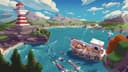
The art is the reason this game has defenders. Hand-crafted voxels are usually a shortcut — a way to sidestep the cost of real modeling — but Bunnyhug uses the chunkiness as a deliberate material. Moonglow Bay looks carved. Weather and light do enormous work: grey Atlantic mornings, the orange smear of a harbor at dusk, the specific cold blue of ice season. The photo mode is not a throwaway feature here; the fixed, painterly angles make for composable shots.
Lena Raine’s score matches it exactly — sparse, patient, occasionally letting silence and water do the work. It’s the rare soundtrack that improves a repetitive loop instead of grating against it.
Performance is the asterisk on all of it. Frame pacing on the water is the weakest technical area, and the UI never reaches the polish of the world it wraps around — small text, sluggish transitions, inventory screens built for small catalogs that get crowded during high-volume cooking sessions. Beautiful game. Average software.
Platform nuances
Steam: The strongest version on fidelity, with the caveat that it’s also where the launch damage is recorded. Mouse and keyboard is functional but clearly not the design target — the fishing minigames are built around analog stick tension, and a gamepad is close to mandatory. Uncapped frame rates help the traversal stutter that affects the console builds, though the small UI text remains a real problem on a handheld screen.
Nintendo Switch: The port arrived after the fires were out, and it’s the most thematically correct place for this game: something about sitting on a boat doing quiet work belongs on a handheld, in short sessions, at night. The trade-off is predictable — the build gives up resolution and smoothness for portability, and busy town scenes and open water are where the compromise shows most. Split-screen co-op on a single docked Switch is charming and cramped in roughly equal measure. If portability matters most, take the Switch build. If fidelity matters most, take Steam.
Final verdict
The idea here is excellent and specific: a fishing RPG about economic collapse and personal collapse happening in the same harbor, made by people who clearly know that coastline. The art direction is distinctive, the score is superb, and the decision to let the town’s literal reconstruction carry the protagonist’s emotional reconstruction is the kind of structural thinking that separates a good cozy game from a wallpaper one.
What it lacks is the engineering budget and the content depth to support that ambition across its full running time. The launch was a genuine failure — not a matter of taste, but of players losing progress in a game whose entire appeal is low-stakes calm — and while the patches and the Switch release have largely repaired it, the back half still asks for grinding it hasn’t earned. That gap is why this lands as a Mixed verdict rather than an easy recommendation.
Wait for a sale, play it on Switch in short evening sessions, and let yourself stop when the loop stops giving. The early hours contain something no other game in this genre has managed, and that’s worth the price of an imperfect twenty-five.
Reviewed by the Rankeno RPG & Adventure Desk. Scores are out of 10; the overall score is the desk’s editorial judgement, informed by the four sub-scores above. How we review