
Overview
Every few years a small studio finds a verb nobody in games has used before. In 2019 the verb was “ricochet,” and the studio was Flight School Studio, a Dallas outfit with more animation and VR credits than traditional game releases. Creature in the Well, published by MWM Interactive and released September 6, 2019 on PC and Nintendo Switch, is a top-down hack-and-slash in which you never hit an enemy. You hit balls. The balls hit everything else.
The setup is spare and confident. You are the last functioning BOT-C unit, a maintenance robot half-buried outside the town of Mirage. A sandstorm has been choking the town for what reads like generations, and the only thing that can stop it is a weather facility inside the mountain. You go in to turn the power back on. Something else lives there, and it has spent a very long time making sure the power stays off.
Market positioning is easy to read. The game launched at $14.99 and is a paid title with a Metacritic average of 82. This is a short, cheap, single-idea game, and the only question that matters is whether one idea can carry that length. The answer, on the evidence of its design, is “mostly.”
What this is not: a roguelike. Dungeons are fixed, hand-authored, and puzzle-first. The nearest relatives are Peggle and a Zelda dungeon, and the fact that sentence makes sense is the whole pitch.
Key features
- Charge-and-strike orb combat: Hold the charge button and dormant energy orbs orbit your robot, gaining power. Release to swing, and the orbs fly off at the angle you face, bouncing off walls, bumpers and switches. Every hit generates energy, and energy is the currency that opens doors.
- Eight themed dungeons: Each wing of the facility introduces one new rule. Turrets that fire orbs back at you. Timed gates. Walls that slide while orbs are in flight. The rulebook grows, though the room vocabulary does not grow with it.
- A deep bench of weapons and cloaks that change the physics: Two weapon slots, one for charging and one for striking, plus a clothing slot. Gear changes how many orbs you can hold, how fast they travel, and how your robot moves. This is the closest thing to a build system.
- The Creature: A huge, desperate thing that watches from the ceilings, interrupts rooms, and physically throws you out of the mountain when you fall. It is the game’s best character and its only real antagonist.
Analysis
The Loop
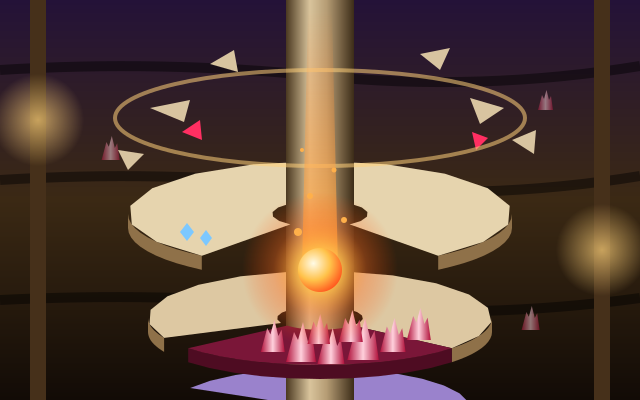
Picture a pinball table with the glass removed and you standing on the playfield. That is a room in Creature in the Well. Orbs sit dormant in the corners. You walk up, hold the charge, and they begin to circle you, humming louder as the power builds. Release, and they scatter off your blade toward the nearest bumper. The bumper lights up and pays out energy. A good shot chains three or four bumpers before the orb dies. A great shot, with five charged orbs released at once into a dense cluster, turns the screen into a fireworks display and fills the energy meter in a single burst.
The design insight here is that there is no aggression stat. Your sword does no damage to anything living. Skill is entirely about positioning and angle, and the game trusts that this is enough. For the first three or four dungeons, it is. Rooms have a power cost written on the exit door, and clearing them is a small optimization problem: which bumpers pay best, which orbs are worth charging, when to swing at a turret’s incoming shot to bounce it back into the machinery. The release is built for superb tactile feedback, all screen-shake and light bloom, and the escalating hum of a full charge is designed to make holding the button feel like drawing a bow.
Deflection is the second verb, and it is where the game stops being a puzzle and starts being an action title. Turrets and later the Creature itself lob orbs at you, and a well-timed swing sends them back with interest. Miss the timing and you eat the hit. Health is thin. Three or four mistakes in a busy room will end you, and dying is not a quick respawn. The Creature grabs you, drags you to the surface, and drops you in Mirage. You walk back. That walk is atmospheric the first time and tedious the fifth.
Where It Frays
The repetition problem is real, and it is a level-design problem, not a mechanics problem. Each dungeon adds a wrinkle, but the underlying rooms reuse the same handful of bumper layouts with the wrinkle bolted on. By the fifth dungeon you have seen the full vocabulary and are being asked to conjugate it faster. Contrast this with how Portal or Baba Is You keep inventing new sentences from old words; Creature in the Well mostly says the same sentence louder.
The difficulty curve does not curve. It kinks. The late dungeons demand angle precision the game has never trained, with orbs needing to thread between hazards at exact trajectories while the Creature actively wrecks the room. The first-time player hits a wall, dies, gets thrown out, walks back, and dies again. Some players will find the loop meditative; others will read it as padding an otherwise tight runtime.
Gear is the game’s hedge against sameness, and it half-works. A cloak that trades health for speed changes how you play a dungeon. A strike weapon that holds more orbs changes how you approach every room. But a large share of the catalog is marginal variations, and the hunt for them is more satisfying than the payoff. Secrets are hidden well and the exploration feels earned. The rewards do not always match.
Story and Tone
The narrative is told the way the best small games tell it: through the environment. Mirage’s buried houses, the Creature’s mournful animations, and a handful of sparse dialogue lines from the few remaining townsfolk sketch a story of a machine that outlived its purpose and a monster that may have once had one too. It is melancholy without being precious. The ending is quiet and will frustrate anyone who wants an explanation; those content to sit with ambiguity will not.
Interface
The HUD is minimal and correct. Energy sits as a single meter, door costs are printed on the doors, and the map is a clean schematic that never lies to you. Onboarding is light, maybe too light. The game teaches charging and striking in the first ten minutes and then trusts you to discover deflection timing on your own. That trust is admirable in the early game and a liability in the late one.
Visuals & performance
This is one of the better-looking games of its budget class. Flight School’s animation background shows in every frame. The hand-drawn comic-book style uses thick ink outlines, flat color fills and a limited palette per dungeon, so each wing has an identity you can read from a screenshot. When bumpers light up, the room floods with color and the ink lines glow, and the contrast between dead machinery and reactivated machinery does the storytelling that dialogue skips. The Creature’s design, all long limbs and eyeless intent, is genuinely unsettling in a game with no gore.
The soundtrack is atmospheric synth that stays out of the way, then surges when the Creature arrives. It earns its place. The sound design of a full charge release, that pinball clatter layered with electrical crackle, is the single best audio cue in the game.
A 2D game of this scope is light on hardware, and the design leans into that: the UI scales cleanly between a monitor and a handheld screen, and the room layouts are built to stay readable even with a dozen orbs in flight. Shipping that across multiple platforms at this price is a real achievement for a small team.
Platform nuances
Steam is the platform where the input model matters most. The game is designed around a controller: hold the trigger to charge, release to strike, and aim with the stick. Analog sticks are bad at the fine angles that late-game rooms demand. The stick’s dead zone and the game’s directional snap conspire against precision, and complaints about aiming are almost always complaints about a controller. Mouse and keyboard turn aiming into a point-and-swing affair that sidesteps the problem at the cost of the tactile hold-and-release feel of a trigger. If you are on PC and stuck in dungeon six, switch to a mouse. On Steam Deck, the controller-first design fits the form factor naturally and the ink art style is legible on a small screen, though the same aiming caveat applies.
Nintendo Switch is where the game’s shape fits best, and it deserves the reputation. The structure is built for handheld play: rooms take a couple of minutes, dungeons take twenty, and the game saves often. The art style survives downscaling with only a slight softening of line crispness in handheld mode. The caveat is that Joy-Con sticks are the worst possible input for this game. If you own a Pro Controller, use it docked. If you are in handheld, expect the late dungeons to be a little crueler than they should be.
Final verdict
Creature in the Well is the rare small game that would survive a pitch meeting on its verb alone. Charging a swarm of orbs and unleashing them into a dark room until it lights up is a feeling no other game offers, and Flight School Studio wrapped it in art direction that punches far above its budget. The problem is duration. The idea is good for five hours and the game is longer, and the extra time is spent replaying the same bumper layouts against a difficulty wall the game never prepared you for.
That is a real flaw, not a fatal one. We rate it a solid, unremarkable-in-spots but novel game, and we recommend it to the right audience: anyone curious about what a pinball dungeon crawler feels like, at fifteen dollars. Play it on Switch with a Pro Controller, or on PC with a mouse, and stop when the repetition sets in rather than pushing through it out of obligation. The best moments arrive early and often, and they are worth the ticket.
Reviewed by the Rankeno Action Desk. Scores are out of 10; the overall score is the desk’s editorial judgement, informed by the four sub-scores above. How we review