

Overview
Most fighting games bury you in move lists. Nidhogg gives you one sword, three heights to hold it at, and a screen that won’t stop moving. It isn’t a gentle introduction to the genre. It reduces every fighting game to its core question: what do you think the other person is about to do?
Nidhogg comes from Messhof, the one-person indie label behind a string of odd, confrontational arcade experiments. Here those instincts land on a tight design. Two duelists meet in the middle of a side-scrolling arena. Kill your opponent and you win the right of way, the privilege of sprinting toward your end of the map. Your rival respawns a few steps ahead of you to block the path. Reach the far end and you’re swallowed by the Nidhogg, the mythological worm from Norse legend, which in this game’s gleefully perverse logic counts as victory.
That structure is the important part. Nidhogg isn’t a best-of-three duel. It’s a tug-of-war over territory, where every kill buys only momentum, never safety. A lead of three screens can disappear in seconds, so you can’t coast. Each match stays under constant pressure, and even the player who’s far behind always has a real way back.
In the market, Nidhogg sits alongside TowerFall and Samurai Gunn: compact, local-first competitive games built for couches, conventions and late nights. It picked up festival recognition, including an IndieCade award, before its Steam release on January 13, 2014. A sequel with a different art style followed, but the original’s austere look and focused design still make it the version people cite. At $9.99 it’s cheap, it’s small, and it knows exactly what it’s for.
Key features
- Three-Stance Fencing System: You hold your blade high, middle or low. Matching your opponent’s height parries. Striking from the right angle disarms them. Switching stance at the right moment gets you past their guard. The whole combat model rests on this one idea.
- One-Hit Kills: A single stab ends an exchange. That removes health-bar attrition entirely and turns every approach into a high-stakes read.
- Expanded Movement Vocabulary: You can lunge, throw your sword, dive-kick, roll, jump over an opponent, wall-jump, or fight with your fists after losing your blade. Each option has a clear risk and a clear counter.
- Territorial Tug-of-War Structure: Kills earn you forward movement, not points. The match flows back and forth across multi-screen arenas.
- Multiple Modes: A single-player tournament against AI, local versus, online matchmaking, and bracket-style tournament modes for groups.
- Distinct Arenas: Castle, mines, clouds and a wilderness stage. Each one changes sightlines, footing and chokepoints.
- Daedelus Soundtrack: The electronic score from producer Daedelus shifts with the action and gives each match a jittery, propulsive pulse.
Analysis
The Gameplay Loop: Chess at 60 Frames per Second
Nidhogg’s strength is in what it leaves out. There are no combos, no meter management and no character select. There’s spacing, timing and stance, and those three variables produce a surprising amount of depth.
A typical exchange goes like this. You and your opponent close the distance with swords at mid height. They flick theirs low. Do you match them and parry, or go high and risk them reading you? Maybe you back off half a step to bait a lunge, then punish the recovery. Or maybe you throw your sword, a desperate, committal move that wins instantly if it lands and leaves you unarmed if it doesn’t. Either way, the exchange usually ends in under two seconds, and the loser has already respawned in front of you.
That respawn is the game’s most important design decision. Because the losing player reappears ahead of the winner, the game constantly tests the winner’s aggression. You have right of way, but you also have a problem: someone fresh, armed and angry is standing between you and the goal. Do you engage or try to slip past? Jumping over an opponent is legal, and against a player who has fixated on your blade height, it’s often the correct play. Rolling under a high guard works too. In Nidhogg, evasion is as important as offense. Few fighting games dare to make running away a legitimate win condition.
Depth Without Friction
The onboarding friction is close to zero. Hand a controller to someone who has never played a fighting game, and within a minute they’ll understand what up and down do to the sword. Within five, they’ll be throwing it. That accessibility is why the design suits parties. Nobody needs a tutorial, and nobody feels locked out.
The skill ceiling is steep, though. Experienced players learn to feint stance changes, flickering the blade between heights to draw a parry attempt and then punishing the commitment. Disarms become a primary goal rather than a lucky accident, because an unarmed opponent is forced into fistfights or a scramble for the dropped blade. Arena knowledge matters too. The mines’ tight corridors reward patient pokes, while the open clouds stage invites aerial dive-kicks. Two skilled players produce matches that look chaotic to onlookers but are really dense sequences of reads and counter-reads.
This is the same quality that makes Street Fighter endure, compressed into a game with about eight inputs. It’s a rare feat of design reduction.
The Weak Link: Playing Alone
Nidhogg’s structure is also its biggest limitation. The game gets nearly all of its value from another human’s psychology, so the single-player mode is a practice room at best. The AI tournament teaches you the systems, but the computer doesn’t bluff the way a person does. It doesn’t get tilted after losing three screens of ground, and it doesn’t do anything stupid out of spite. Once you’ve beaten it, there’s little reason to go back.
The content footprint is small too. Four core arenas carry a game meant for repeated play. The mechanics are deep enough that the matches stay fresh, but the scenery doesn’t. Anyone hoping for unlockables, cosmetic progression or a meaningful solo campaign will be let down. Nidhogg doesn’t pretend to offer those things, and that’s honest. It also means the game’s value depends almost entirely on your social circle.
Online Play: The Asterisk
Nidhogg’s design is extremely sensitive to latency. When one stab kills and exchanges resolve in a few frames, a network hiccup of 100 milliseconds isn’t a small annoyance. It’s the difference between a parry and a death. Player reports consistently describe online matches as laggy, inconsistent and hard to find, and the shrinking player pool of an older title makes matchmaking worse. Online play works as a backup option, but it’s not a reason to buy the game. Nidhogg was built for two people sitting next to each other, and that’s still where it belongs.
Tournament Mode and Group Play
The tournament and bracket modes are an underrated strength. At a gathering of four to eight people, Nidhogg becomes a spectator sport. Its readability is excellent: anyone watching can instantly see who has right of way, where the fight is, and how close someone is to winning. Every comeback gets a reaction from the room. Few games handle a pass-the-controller format this well.
Visuals & performance
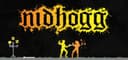
Nidhogg’s art direction is deliberately crude and entirely effective. The duelists are single-color silhouettes, one yellow and one orange, set against blocky, low-resolution backgrounds. At first glance it can look unfinished. It isn’t. Every visual choice serves legibility: sword heights read instantly, the players never blend into the scenery, and the bright, spattering pixel blood makes every kill unmistakable. Visual clarity is a competitive requirement in a game this fast, and Nidhogg treats it that way.
There’s also real atmosphere here. The wilderness stage’s swaying grass and the clouds level’s pastel sky have a woozy, dreamlike quality, and the grotesque worm finale is a sharp punchline. The Daedelus soundtrack lifts the whole package. Its skittering, glitchy electronic tracks match the stop-start rhythm of the fights, and the music responds as momentum shifts.
As a 2D game of minimal scope, Nidhogg is light on hardware, and its design keeps input response tight, which matters most. The technical weaknesses are all on the network side, as covered above. The menus are functional and plain, with few frills and little friction.
Platform nuances
On Steam, Nidhogg is best played with two gamepads. Shared-keyboard play is supported and works in a pinch, but two people crammed onto one keyboard invite missed inputs and elbow collisions that undercut a game this precise. Stance changes map naturally to a d-pad or analog stick, and the small action set fits comfortably on any modern controller.
The Steam version is also the natural home for Remote Play Together, which lets a friend join over the internet as if they were on the couch. It’s still subject to the same latency caveats, but it’s often a more practical alternative to native matchmaking, especially given how thin the online population is. System requirements are trivial, so the game suits low-end laptops and handheld PCs. The very low hardware barrier is part of its long-lived appeal as a party staple.
Final verdict
Nidhogg makes an argument that a lot of modern game design has forgotten: depth comes from interaction, not accumulation. It has no skill trees, no unlock grind and no roster to balance. It has two people, two swords, three stances and a hungry worm at the end of the road, and it produces moments of tension that big-budget fighting games often struggle to match.
The limitations are real, and they’re structural. Play mostly alone, or rely on online matchmaking, and you’ll hit the bottom of this game fast. Give it a second controller and a willing rival, though, and Nidhogg delivers some of the most exciting 10-minute matches available on PC. It isn’t a complete package, and the thin solo content, sparse arenas and shaky netcode keep it from the top tier. But the core is excellent, and for local multiplayer, that core is enough to recommend.
Reviewed by the Rankeno Action Desk. Scores are out of 10; the overall score is the desk’s editorial judgement, informed by the four sub-scores above. How we review