

Overview
How far would you go to get home if every step might kill you? Out There: Ω Edition asks that question and gives you almost nothing to answer it with. You play an astronaut who wakes from cryosleep far outside the solar system, in an unmapped and hostile stretch of the galaxy. You have a damaged ship, a cargo hold that is always too small, and a star map drawn from scratch every run. There are no lasers or dogfights. The enemy is arithmetic.
The developer, French studio Mi-Clos Studio, built a genre hybrid that still has few direct rivals. The game combines three things that rarely share a screen: roguelike permadeath, tight resource management, and choose-your-own-adventure storytelling. Its closest relative is FTL, but without the tactical combat. The core decisions sit closer to a text adventure: do you trust the alien signal, board the derelict, or spend your last helium on a jump into the dark?
The Ω Edition is the definitive version of the original release. It adds new art, more than 50 extra stories, new alien species and ships, an extra ending and achievements. A later free update, “The Alliance,” added more content. The package now has more than 350 hand-written branching encounters, 10 spaceships and four main endings plus the Ω addition, which is a lot of authored content for a $14.99 premium game.
The reception has been broadly positive. It sits at 4.4 out of 5 from 376 ratings on the iOS App Store. Its market position is clear. This is a premium, narrative-first survival game for people who would rather read a short story than fire a missile, and it makes no attempt to appeal to anyone else.
Key features
- Three-Resource Survival Loop: Every jump burns fuel and damages the hull, and oxygen drains steadily. You have to scan and mine planets for hydrogen, helium and metals, and find rare garden worlds to refill your air.
- 350+ Branching Text Encounters: Hand-written events fire when you arrive in a system. The outcomes range from windfalls to disasters, and the writing carries most of the game’s emotional weight.
- Alien Language Acquisition: You learn alien languages one word at a time. Early contacts are barely readable, and later ones become real conversations. This is progression through understanding.
- Crafting Under Constraint: You can build 20 alien technologies from 15 materials, but cargo space is tight, so installing a new drive can mean throwing away the fuel that drive would have used.
- 10 Ships and Derelict Swaps: Abandoned vessels can replace your current ship, and each has different stats. Swapping ships is often the most important decision of a run.
- Procedural Galaxies, Multiple Endings: Each galaxy is generated fresh, and a main story with four endings plus the Ω Edition’s extra conclusion gives the runs a destination.
Analysis
The Gameplay Loop
The loop is simple on paper and cruel in practice. You pick a star within jump range, arrive, read the event, then decide whether to probe, drill, land or leave. Each action costs something. Probing gas giants yields fuel, drilling rocky worlds yields metal for repairs, and garden planets give you oxygen. Your ship is always losing at least one of the three.
This is where Out There works best. The game turns opportunity cost into drama. A planet that might hold a rare material costs the fuel that could take you past a dead system. An unknown signal could hold a new ship or a hull-cracking trap. None of these decisions has a clean answer. They are bets, and the design is built so that each one carries weight.
Tension comes from scarcity, not spectacle. A run that ends at a garden world with a sliver of oxygen left is more memorable than most scripted set-pieces in games with a hundred times the budget. That is good systems design: the numbers create the story.
Writing and Encounters
The 350+ hand-written encounters are the game’s main asset. The writing is brief and dry, which suits the setting. Its best moments are unsettling rather than epic: a derelict whose crew died of something the text doesn’t explain, or an alien message you can only partly translate, so you act on half of it.
The language system is the smartest idea here. Early alien encounters show mostly untranslated glyphs with a few recognized words, so you choose options based on partial understanding. As your vocabulary grows across a run, the same kind of encounter becomes readable. Knowledge works as a resource, and nothing else in the genre handles it this way.
The limits appear with repetition. Even with 350 events, a player who clears several runs will start seeing familiar text, and its effect weakens once the outcomes are known. The Ω Edition’s 50 extra stories and The Alliance update help, but they cannot fully fix a structure where the authored content is finite and the runs are not.
The Luck Problem
This is the game’s main flaw. Out There leans heavily on randomness, and not always well. A star map can generate with no garden world in reach. A single encounter can strip half your hull with no warning and no way to avoid it. A careful run can be lost to one bad draw.
Good roguelikes make death feel earned. Out There often makes it feel arbitrary, which is a weaker emotion. It is not constant — careful play, reserves and safer paths reduce the risk — but the gap between a run you lost and a run that was lost for you is wider than it should be.
Crafting and Cargo
The crafting system adds depth, though it isn’t always easy to read. Twenty technologies and fifteen materials make a small but meaningful tech tree. The cargo limit is what makes it work: every slot holding a crafted part is a slot not holding fuel. Min-maxers will enjoy it. Players who don’t may never learn why their builds fail, because the game explains very little, and the endgame is opaque. Finding the conditions for the various endings takes experimentation, repeated failure or a wiki.
Onboarding Friction
Out There barely teaches you. The first few runs are likely to end in quick, confusing deaths while you learn which planets give what and how fast oxygen drains. Some of that is intended, since disorientation fits the premise. But the onboarding friction is real, and patience is required, not optional.
Visuals & performance
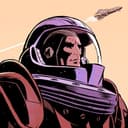
The art direction is the game’s second-best asset. The Ω Edition’s refreshed visuals use a comic-book, hand-inked style: bold outlines, flat saturated colors and a strong 1970s sci-fi paperback feel. Planets look like cover illustrations, and encounter screens read like panels from a graphic novel. It is striking and consistent, and it has aged much better than a cheap attempt at realism would have.
Siddhartha Barnhoorn’s soundtrack deserves its own paragraph. It is sparse, mournful and ambient, and it does a lot of the work of making the isolation feel real. Headphones are the right way to hear it.
The UI is functional but crowded. The cargo grid, resource gauges and star map compete for space, and the inventory screen — especially moving items between the hold and crafting slots — is built too small for its contents and gets fiddly as a run progresses. As a 2D, turn-based game of this scope, it is light on hardware, and modern phones and PCs should have no trouble with it.
Platform nuances
iOS: This is where Out There fits best. The turn-based pace, short sessions and tap-driven choices suit a phone, and the 4.4/5 App Store rating suggests the same. Reading dense encounter text on a smaller iPhone screen can be tiring, so an iPad is the better way to play.
Android: The core experience matches iOS. The game is the same, but a wider, more casual mobile audience is less likely to forgive the difficulty and randomness.
Steam: Mouse and keyboard make cargo management and star-map navigation more precise, and the larger screen helps the art. But this is clearly a mobile-first design on a monitor, and the $14.99 PC price is hard to justify next to the cheaper mobile versions. The content is the same, so desktop players are mostly paying more for a bigger screen.
Final verdict
Out There: Ω Edition is a small game with real ambition. It shows that a space game doesn’t need combat to feel dangerous and that a few hundred well-written paragraphs can do more than an expensive cutscene. Its language system is original, and its art and music build an atmosphere few mobile games match.
But the problems outweigh the pleasures for most people. The randomness is too blunt, the endgame is too cryptic, the onboarding too thin, and the authored content eventually runs out. On PC, the price is hard to justify when the phone version is the better fit anyway. The first dozen runs are memorable, and players with patience for unfair galaxies will find something worth reading here. For everyone else, this is a fascinating experiment rather than an easy recommendation — and on mobile, with headphones, is the only way we’d suggest trying it.
Reviewed by the Rankeno Strategy & Sim Desk. Scores are out of 10; the overall score is the desk’s editorial judgement, informed by the four sub-scores above. How we review