
Overview
There’s a particular kind of studio that keeps making the same argument in different clothes. inkle has spent a decade insisting that interactive prose deserves to be treated as a first-class system rather than a cutscene delivery mechanism — first with 80 Days, then Heaven’s Vault, both of which took IGF Excellence in Narrative. Pendragon: Narrative Tactics is the argument pushed into hostile territory: a turn-based strategy game, the genre least hospitable to a sentence.
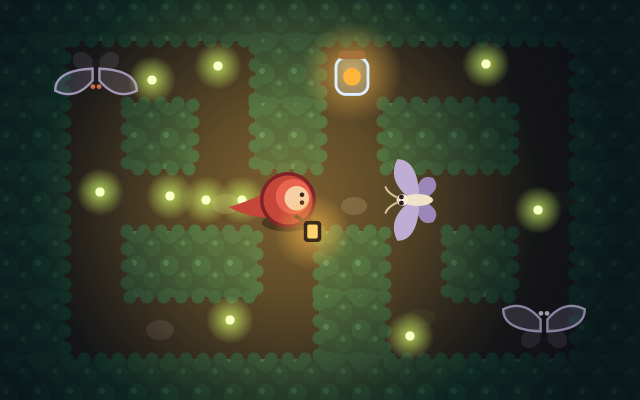
The setup is lean and grim. AD 673. Camelot has already fallen — you don’t get to prevent that. Arthur is riding to Camlann to meet Mordred, and the Round Table is scattered across a country that’s stopped believing in it. You pick one of nine protagonists — Lancelot, Guinevere, Kay, Bedivere and six others, each with their own motives, voice and abilities — and you march across a procedurally arranged board of forests, villages and burnt-out ruins, trying to reach Arthur before the battle settles the age of chivalry without you. A run is built to take roughly an hour.
Positioning matters more than power here. Combat is deliberately spare: adjacency, facing, retreat and terrain decide duels far more than any stat line, and death is permanent. What makes it inkle’s game rather than a competent little skirmish roguelite is what happens downstream of the fighting. Every tactical decision feeds the ink narrative engine. Rescue a companion and they join your party and start arguing with you. Abandon them and they’re gone — not respawned, not retconned. Lose a duel and the game doesn’t hand you a game-over screen; it revises the dialogue and lets the story absorb the wound.
That’s the pitch, and it’s a good one. The market, so far, has been unconvinced: Steam sits at “Mixed.” Critics have run considerably warmer than players, which is usually a tell — this is a game whose best ideas are legible in a single afternoon and whose limits only surface on the fifth run.
Key features
- The ink engine, wired directly into combat: Hundreds of story fragments react to board state. A death, a betrayal, a rescue — each rewrites relationships mid-run rather than terminating it. Failure is content, not punishment.
- Nine protagonists, nine framings: Lancelot, Guinevere, Kay, Bedivere and the rest aren’t stat variants with recolored portraits. Each carries distinct motives and a distinct voice, and the Arthurian legend bends around whoever’s telling it.
- Minimalist positional tactics: No sprawling ability trees, no damage spreadsheets. Facing, adjacency, retreat and terrain. Permadeath throughout.
- Hour-long runs, built for replay: Randomised boards, shifting alliances, multiple endings. The design bets everything on you wanting to come back.
Analysis
The Gameplay Loop
Every run is a march with a clock on it. Arthur is dying somewhere to the west, and the board is a series of tiles between you and him. You move, you meet people, you fight, you decide who’s worth the detour. The clock is the whole engine of tension: rescuing a knight means spending time you don’t have, and the game is perfectly happy to let you arrive at Camlann alone, late, and morally intact — or on time, well-armed, and having left three people to die.
The tactical layer is where opinions fracture, and the criticism is fair. The combat is thin. Not broken — thin by intent, and inkle clearly wanted duels that read like a beat of choreography rather than a math problem. The positional system has real elegance — stepping backward into a doorway to control facing is a small revelation the first time it clicks. The problem is that the trick has a bottom, and the design reaches it fast. Within a handful of runs, encounters resolve into a handful of memorized positional gestures, and what begins as elegant restraint starts feeling fiddly — a system with more cursor precision than decision-making in it.
Then there’s the randomisation. Procedural boards can generate sequences that are anticlimactic or effectively unwinnable, and when a run lasts an hour, one bad seed eats a meaningful chunk of an evening. The narrative engine papers over this better than most — a defeat becomes a story rather than a reset — but there’s a difference between a game that absorbs failure gracefully once and one that keeps doing it while offering little agency in return.
Where It Actually Wins
The writing is the reason to be here, and it’s very good. inkle understands that the Arthurian material is fundamentally about people who are too late — too late to save the marriage, the kingdom, the idea. Pendragon plays that key relentlessly and without camp. Companions argue with you. Guinevere’s version of events is not Kay’s version. The prose has actual rhythm, which is rarer in games than it should be.
And structurally, the ink integration is the real achievement, the thing worth the industry’s attention. Most narrative games treat mechanics and story as separate departments that agree to meet at checkpoints. Here the tactical layer is the input to the prose layer, continuously. A knight dying in the second act isn’t a branch selected from a menu — it’s a board state that propagates into dialogue, party composition and ending. That’s a hard piece of engineering and inkle makes it look effortless.
Where It Runs Out
The ceiling arrives sooner than the design needs it to. Players report story beats repeating verbatim after a handful of playthroughs — and verbatim is the killer word. Variation in sequence is not variation in text. Once exact paragraphs start repeating, the illusion of generating a new telling of the legend collapses into reshuffling a finite deck. Hundreds of fragments sounds like a lot until they’re being consumed at the pace an hour-long run demands.
At $16.99, that’s the crux of the complaint threading through the negative reviews, and it isn’t unreasonable. This is a purchase of a handful of fresh hours from a game whose entire structural promise is inexhaustibility.
Visuals & performance
The art is the least controversial thing about it. Hand-drawn, muted, deliberately unheroic — knights rendered as tired people in expensive metal rather than fantasy pin-ups. The presentation carries real melancholy, and the interface is built to stay out of the prose’s way, which is harder than it looks when you’re overlaying a tactics grid on a novel. Static screenshots undersell the atmosphere of the thing in motion.
Technically, this is a modestly scoped 2D game from a studio that ships clean builds — the kind of game that’s light on hardware by design, and unlikely to be the source of anyone’s complaints.
Platform nuances
Steam is the only place to buy it now — the Mac App Store release has since been delisted — and mouse-and-keyboard is the right fit. Positional tactics reward precise, unhurried clicking, and reading long passages on a desktop monitor beats squinting at them anywhere else. The one honest platform criticism: this is a game shaped like a handheld experience — hour-long sessions, high replay intent, tap-to-move simplicity — sitting on the platform least suited to how you’d actually want to play it.
Final verdict
Pendragon is more interesting than it is satisfying. inkle solved a legitimately hard problem — making combat write dialogue — and the early runs are among the more distinctive hours the genre has to offer. But the studio built a machine designed to tell infinite stories and then stocked it with a finite library, and the seam shows early. The Mixed Steam reception isn’t players failing to appreciate an art game; it’s players correctly identifying that the promise and the payload don’t match. We can’t recommend it to most people at full price — but for narrative-design obsessives willing to catch it on a discount, what it’s reaching for is worth admiring.
Reviewed by the Rankeno Strategy & Sim Desk. Scores are out of 10; the overall score is the desk’s editorial judgement, informed by the four sub-scores above. How we review