
Overview
There is a specific kind of game that gets made when a single person holds every creative lever at once. It has a point of view. It has strange edges. It has one or two things it does better than studios ten times its size, and several things it plainly cannot afford to do at all. The Falconeer is that game, and it wears both halves openly.
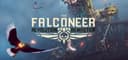
Solo developer Tomas Sala — with publishing from Wired Productions — built an open-world aerial combat game set on the Ursee, an ocean world where the land mostly lost and the water won. You are a Falconeer: a mercenary pilot strapped to a giant armored warbird, fighting over trade lanes, sea forts, and grudges that predate everyone currently holding a weapon. It launched on November 10, 2020, and is available on Steam and Nintendo Switch as a paid title at $19.99, with content since folded into the Warrior Edition and the free Revolution Remaster, which bundle the Hunter and Edge of the World DLC, a flyable Ormir dragon, guided pyro-pot rockets, a fully voiced cast, and an award-winning orchestral score.
Its market position is unusual and, honestly, kind of shrewd. Arcade flight combat is a genre that mostly evaporated after the PS2 era, surviving in Ace Combat sequels and a handful of Early Access sims. Sala didn’t try to compete on fidelity. He competed on atmosphere and authorship — a low-poly, high-contrast world you can read at a glance, wrapped around a control model that makes a bird feel like it has mass.
The design splits cleanly into strengths and weaknesses, and the split is consistent: repetitive objectives, long empty flights, and a lore dump that is hard to assemble into a story. Everyone can agree on what’s beautiful here. The problems are just as plain.
Key features
- Momentum-based flight: You dive to build speed, climb to spend it, and ride thermals and lightning storms to recover stamina and charge weapons. Energy is a physical resource you steal from the weather, not a bar that refills on a timer.
- The Ursee as a single continuous world: No stage select, no mission boundaries. One open ocean of sea forts, warships, floating settlements, krakens and leviathans, traversable in any direction from the first hour.
- Multi-faction campaigns: Several campaigns told from opposed political positions, so the same war reassembles itself differently depending on whose banner you’re flying under.
- Mount progression: Chits buy new bird classes, mutations, and ordnance — a build system that changes handling and durability, not just damage numbers.
- Warrior Edition / Revolution Remaster content: The Hunter adds a flyable Ormir dragon and guided pyro-pot rockets; Edge of the World adds side quests and boss encounters. Full voice cast and orchestral score throughout.
Analysis
The Flight Model Is the Whole Game
Get this part right and nothing else fully fails. Sala got it right.
Most arcade flight games treat altitude as a number. Here it’s capital. Your warbird has stamina, and stamina is spent climbing and regained by trading height for velocity or by finding a thermal and spiraling up it like an actual raptor. Storms do the same thing more violently — fly into lightning and you come out charged, faster, meaner, and slightly out of control. The result is that the weather is a mechanic, not a backdrop, and the design rewards pilots who learn to read the sky.
The dogfights inherit that weight. Turning costs something. Overcommitting to a chase drains you into a slow, vulnerable climb while a rival Falconeer sits above you with the energy advantage. It’s a real energy-fighting loop — the kind of thing that usually lives in study sims, translated into something playable with a stick and two triggers. When a duel goes long and both pilots are scraping the wavetops trading altitude for angles, this game is doing something almost nobody else does.
The Mission Design Does Not Deserve the Flight Model
Here’s the fracture. The verbs Sala gives you are excellent. The reasons he gives you to use them are not.
The mission diet is fetch, escort, patrol, intercept, cycled with modest variation across dozens of contracts. Escort a barge. Follow a barge. Intercept the people following a barge. Individually they’re fine — they’re scaffolding to hang flight on. Collectively they expose the game’s central budget problem: one person can build a magnificent world faster than one person can fill it with hand-authored situations.
Compounding this is travel. The Ursee is enormous and deliberately sparse, and while the first few crossings are the point — the horizon, the scale, the score swelling as a leviathan surfaces beneath you — the fifteenth crossing to fetch a crate is not exploration. It’s commute. The game offers fast-travel-adjacent conveniences, but the pacing still asks for real minutes holding forward across water that’s already been read. A game about the joy of movement should never make movement feel like overhead. Here, eventually, it does.
The Story Asks More Than It Gives
The multi-campaign structure is the most intellectually interesting thing in the design: fly for opposed factions, watch the same conflict re-narrate itself, assemble the truth from parties who each believe they’re the reasonable ones. Class conflict, imperial rot, buried history under the water. On paper it’s genuinely ambitious writing for a solo project.
In practice, the delivery buries it. The Ursee arrives pre-loaded with proper nouns — houses, orders, sects, treaties — introduced at speed, mostly through radio chatter playing while a dive demands attention. The voice cast is good. The problem isn’t performance; it’s information architecture. There’s no accessible in-game reference that lets a confused player rebuild the map of who hates whom and why, so the lore lands as texture rather than plot. The players who love it are the ones who accept it as mood. The players who bounce are the ones who try to follow it as a story. Both reactions are predictable from the design, and both are the game’s fault.
Progression and Friction
The chit economy works better than it reads. Buying a new bird class isn’t a stat bump — it’s a different aircraft, with different turn authority, durability, and stamina economy, which means the upgrade path meaningfully re-tunes the thing players spend all their time touching. Mutations and ordnance layer on top. It’s a good loot system disguised as a shop.
Difficulty is spikier than it should be. Certain dogfights and boss encounters assume energy-management fluency the game never formally teaches, so the curve reads as flat, flat, flat, wall. That’s an onboarding failure, not a balance failure — the skills required are all present in the systems, just never surfaced.
Visuals & performance
The art direction is the reason this game has an audience.
Sala’s approach is stylized geometry and enormous color: hard-edged low-poly forms, a limited palette pushed to extremes, skies that shift from bruised violet to blown-out gold, and water that reads as an emotional state. It’s built to be cheap to render and expensive to forget, which is exactly the right engineering trade for a solo developer. It should still look good in ten years, because nothing here is chasing photorealism it would inevitably lose.
The orchestral score earns its awards. It does a great deal of the emotional work the mission text can’t, swelling on approach to a fort or a leviathan and knowing when to shut up over open water.
The UI is the weak layer. In-flight readability is fine, but the menus, mission log, and lore presentation feel like the parts of the project that got the last week of development rather than the first year. The stylized visual approach is light on hardware by design, which leaves generous headroom for the fast, rolling camera work — a sensible match of art and engineering.
Platform nuances
Steam. This is the definitive version, with one caveat: play it on a gamepad. Analog throttle and pitch are load-bearing here, and mouse-and-keyboard flattens a control scheme built entirely around gradients. PC also offers the headroom that fast rolls and dives benefit from, plus wide-display support that makes the horizon — the whole selling point — do more work.
Nintendo Switch. A real trade. The stylized art scales down cleanly where a realistic renderer would collapse, and handheld play suits the ambient, low-intensity stretches. But the compromise shows in resolution and draw distance, and that hurts in a game where enemies first appear as specks against a bright sky. Spotting contacts at range on a small handheld screen is materially harder, which quietly raises the difficulty of the parts that were already the spikiest. There’s also a duration problem: this is a game of long holds on a single stick, which is not what Joy-Con sticks are famous for surviving. Take the Switch version for couch and travel play; take the Steam version if you only buy one.
Final verdict
The Falconeer is a game whose best parts belong to a better one. The flight model, the world, and the score are the work of someone with real authorial confidence and nothing to prove to a focus group. The missions wrapped around them are filler, and no amount of beautiful sky fixes an escort quest that repeats six times.
What keeps it afloat is that the good parts are the parts players actually touch. Most of the time is spent flying, and the flying here is designed better than in games with a hundred times the budget. We rate it a mixed recommendation: worth it only for players who will buy it for the sky — on Steam if there’s a choice, with a controller in hand — then ignore the contracts entirely and go look at the edge of the map. The game is better when you stop taking its orders.
Reviewed by the Rankeno Strategy & Sim Desk. Scores are out of 10; the overall score is the desk’s editorial judgement, informed by the four sub-scores above. How we review