
Overview
Match-three has spent two decades as the genre of the waiting room. It’s what you play on a phone while the dentist runs late, a loop engineered for idle thumbs and, too often, for monetization. Nobody builds a prestige strategy game on top of it. AP Thomson did anyway.
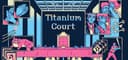
Titanium Court comes from the New York-based developer and is published by Fellow Traveller, the label behind narrative-forward oddities like Citizen Sleeper and Paradise Killer. It bills itself as a game “for clowns and criminals.” That tagline isn’t a throwaway. It’s the right joke. This is a surreal strategy game that welds together three systems: the tile-swapping of match-three, the lane-holding logic of tower defense, and the run-based structure of a roguelike. You command the Court of the title and wage war against rival Courts on a battlefield built entirely of tiles. Around that war, Thomson has written a darkly comic mystery about the Court’s residents, a missing queen, and her equally missing keys.
It launched on April 23, 2026, for Windows and macOS through Steam, and the reception has been strong. It holds an 85 on Metacritic. It also took both the Seumas McNally Grand Prize and Excellence in Design at the 2026 Independent Games Festival Awards. That pairing, the IGF’s top honor plus its design award, tells you the jury thought the systems were exceptional, and not only the vibe.
In market terms, Titanium Court sits in an awkward, interesting gap. It isn’t a casual puzzler, and it isn’t a traditional strategy game. Its closest ancestor is Puzzle Quest, which bolted match-three onto an RPG in 2007, but that game’s board was an abstraction, a stand-in for combat. Here, the board is the territory. That one decision defines the whole game.
Key features
- The Two-Tide Battle Loop: Battles alternate between High Tide, when you swap and match terrain tiles to collect resources, and Low Tide, when you spend them on soldiers, farmers, spells, and buildings.
- Terrain as a Weapon: The puzzle grid and the battlefield are the same surface, so every match reshapes the map. You can shove a mountain into an enemy’s path to stall its advance.
- Roguelike Runs with Career Paths: Runs branch into careers with names that read like a rap sheet: Warlord, Arsonist, Celebrity, and Insurance Fraudster.
- A Darkly Comic Court Mystery: A surreal story about the Court’s residents, a missing queen, and her missing keys runs alongside the campaign.
- Flexible Scope: The store page quotes 6 to 30 hours of single-player play, depending on how deep you go.
Analysis
The Tidal Loop
Every battle swings between two phases, and the naming fits. High Tide is income: you work the board and harvest what it yields. Low Tide is expenditure: you convert that haul into units, structures, and spells. It’s the same earn-then-spend rhythm that drives a deckbuilder’s energy system or an RTS build order, compressed into discrete, readable beats.
The phases aren’t sealed off from each other, and that’s why the loop works. In most genre hybrids, the puzzle layer is a vending machine. You put matches in, resources come out, and then you go play the “real” game somewhere else. Titanium Court refuses that separation.
The Board Is the Battlefield
Because the puzzle grid is also the map, every match changes the terrain. The headline example is dragging mountains into an enemy’s path to slow it down. That move is a resource decision and a defensive decision at the same time, and the design gets its teeth from that overlap. A match that pays for your next Low Tide might also reshape the ground in ways that help or hurt your position. So the game asks you to price two things on every swap: what it earns, and what it does to the map.
That double valuation is the source of the depth critics keep pointing to, and it’s why the IGF jury handed over a design award. Tower defense usually gives you a fixed map and asks you to optimize placements. Match-three usually gives you a disposable board and asks you to chase points. Titanium Court makes the map disposable and the matches consequential, which reverses each genre’s usual priorities. The result is a genuinely new problem to solve, and given how many strategy games ship each year, new problems are rarer than they should be.
Runs, Careers, and Replay Structure
The roguelike structure gives individual battles a longer arc. The career paths are the clearest sign that Thomson understands the premise. In this Court, power isn’t only won on the field. It’s also performed (Celebrity), burned down (Arsonist), and fraudulently claimed (Insurance Fraudster). A Warlord sits alongside those as just one option among several ways to climb.
The 6-to-30-hour range on the store page is unusually wide, and it reads as honest. The likeliest interpretation is that a story-focused player lands near the floor, while someone determined to explore every career path ends up near the ceiling. That’s a healthy structure: the game doesn’t pad itself for one audience at the expense of the other.
Writing as a System
Strategy games rarely earn praise for their writing, and when they do, it’s usually for lore codexes nobody opens. Here the script is the main event. Critics keep reaching for unusual comparisons. Rock Paper Shotgun invoked David Lynch and Alice in Wonderland, and one reviewer called it “a tremendous piece of narrative game design.”
That last phrase matters, because it isn’t praise for a good story stapled onto a strategy game. It’s praise for a story built from the same material as the systems. A missing queen, missing keys, and a career called Insurance Fraudster all point to a world where the comedy and the mechanics share one value system: everything is a scheme, and every tile is leverage.
Then there’s the interactive shower. It’s a small thing, and small things like it tell you who a game is for. It contributes nothing to the strategy loop. What it does contribute is a statement that Thomson cares more about texture than about the checklist efficiency that governs most of the strategy market.
The Match-Three Tax
Here’s the problem, and it isn’t a small one. Every system in Titanium Court routes through the match-three board. Resources, terrain, and tactics all start with swapping two tiles. PC Gamer, the most notable dissenter at 74/100, put it bluntly: “you’re going to need to love match-three to want to stick around.”
That’s correct, and it isn’t a cheap shot. Putting strategic depth on top of match-three doesn’t remove match-three’s core sensation; it raises the stakes on it. If scanning a grid for three-in-a-row feels like busywork, sharper writing won’t change that, no matter how many hours in. The design is sharp at making matches mean something. It can’t make anyone enjoy matching.
There’s also a structural tension in the genre mix itself. Match-three boards carry inherent variance, and roguelikes add more on top. That combination can produce memorable comebacks. It can also produce runs where the board simply won’t give you what your plan needs. How much luck you’re willing to tolerate will shape how much the career-path long tail appeals to you.
Visuals & performance
The surreal tone is the selling point, and the presentation has a harder job than most because the board must read as a puzzle and a battlefield at once. Terrain types need to be distinguishable at a glance for matching, and they also need to communicate tactical properties. A mountain has to look like an obstacle, not just another colored gem. That double legibility is the real UI challenge here. The critical consensus focuses its complaints on genre taste rather than readability, which suggests Thomson largely clears it.
On performance, this is a tile-based strategy game of modest scope, and it should be light on hardware by design. The criticism that does surface is about design, specifically the match-three dependency, and not about stability. That’s the right kind of criticism for a game to attract.
Platform nuances
Steam is the only storefront at launch, with native builds for both Windows and macOS. Mac support is a quiet win. Strategy players on Apple hardware are routinely told to wait or to wrestle with compatibility layers, and here they get day-one parity.
Mouse input is the natural fit. Match-three grew up on the PC (PopCap’s Bejeweled was a browser game before it was a phone game), and click-to-swap gives you the precision that matters when one misplaced tile can reroute an enemy. The obvious irony is the lack of a mobile version. The genre’s native home is the touchscreen, and the turn-structured tides would seem to suit one.
Steam Deck owners should check the store page’s compatibility rating before assuming a good handheld experience. A grid this dense lives or dies on input precision and on how legible text stays at small sizes.
Final verdict
Titanium Court does the one thing genre hybrids almost never manage: it makes its genres depend on each other. The match-three board isn’t a minigame stapled to a strategy game. It’s the ground the war is fought on, and that turns a casual mechanic into one with real consequences. Add writing that critics compare to Lynch and Lewis Carroll, plus a premise confident enough to include an interactive shower, and you have one of 2026’s more distinctive releases. Its IGF Grand Prize looks earned, not generous.
It isn’t for everyone, and it doesn’t pretend to be. Its central bet is that you’ll keep swapping tiles for hours, and if that bet doesn’t pay off, nothing else in the game will make up for it. If it does, you get a strategy game that couldn’t exist in any other genre — which is why we recommend it, with the match-three caveat stated plainly.
Reviewed by the Rankeno Strategy & Sim Desk. Scores are out of 10; the overall score is the desk’s editorial judgement, informed by the four sub-scores above. How we review