
Overview
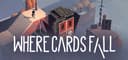
Some games want to test you. Where Cards Fall wants to remember with you. Developed by The Game Band and published by Snowman, this is a spatial-puzzle adventure that arrived on iOS, Steam, and Nintendo Switch, releasing on September 19, 2019 at a paid price of $19.99. It carries serious pedigree, and its reputation for craft is deserved—mostly.
The premise is deceptively literal. You build houses of cards. Not as metaphor first and mechanic second, but the reverse—the game has you physically raise, resize, and collapse decks of oversized playing cards to sculpt platforms, staircases, and bridges across dozens of isometric dioramas. The goal is to guide a nameless character from one point to another. Simple. The trick is that every structure assembled also carries the emotional weight of a scene: a first crush, a friendship fraying, the specific terror of a house party where you don’t know where to stand.
There is no dialogue. None. The entire coming-of-age arc—high school, first love, the drift into early adulthood—is told through environment, animation, and a lush original score. That’s an audacious bet, and The Game Band mostly wins it. Positioned squarely in the “cozy prestige” lane alongside Gris and Journey, this is a game selling feeling over challenge, atmosphere over friction. It knows exactly what it is. Whether that’s enough depends entirely on what you came for—and at this price, the answer is often no.
Key features
- Card-Stacking Spatial Puzzles: Raise and collapse decks of cards to build platforms, bridges, and staircases across dozens of hand-crafted isometric levels. The core verb is construction, not combat.
- Wordless Coming-of-Age Narrative: A complete emotional story—friendship, insecurity, first love—told entirely through animation and environmental staging, with zero text or dialogue.
- Tabletop-Diorama Art Direction: Soft lighting, warm palettes, and a tactile, miniature-model aesthetic that makes every screen look like a display piece.
- Original Score: A lush, mood-driven soundtrack that carries the narrative load in a game with no voices.
- Failure-Free Design: No timers, no death, no game-over. Puzzles reward experimentation and spatial reasoning instead of reflexes.
- Platform-Tuned Controls: Separate input schemes for touch, gamepad, and mouse across iOS, Switch, and PC.
Analysis
The Gameplay Loop
At its best, Where Cards Fall is built to make the player feel clever without ever feeling stupid. A diorama opens with a character on one ledge and a destination on another. Between them, a scattering of card decks can be pulled upward into towers or slammed flat into walkable platforms. The puzzle is spatial arithmetic—raise this deck to bridge that gap, collapse this one to form a floor, then reroute.
The mechanic is elegant because it’s tactile. Cards don’t just appear; they unfold, splaying into structures with a physicality that sells the fantasy of building something delicate. When a solution clicks—when a staircase materializes exactly where the eye predicted—there’s a small, real hit of satisfaction. The game trusts spatial reasoning and rarely holds a hand.
Here’s the problem. That trust has a ceiling, and the game hits it early. For most of its runtime, the puzzles ask a single question—how do these cards get reshaped to reach there?—and rarely complicate the answer. There’s little compounding difficulty, few genuine “aha” walls, and almost no risk of being stuck long enough for a solution to feel earned. The store rating—a 3.8 out of 5 from 243 ratings—reflects the split: the recurring complaint is puzzles too easy, too repetitive, over too quickly. That gap between warm admiration for the craft and lukewarm feelings about the challenge is the game’s central tension, and it’s not an accident of ports. It’s a design philosophy meeting a broader audience’s expectations.
Narrative as Mechanic
Where the game recovers its footing is story. This is a wordless experience, and it commits totally. A friendship forms on a schoolyard. A crush turns into something and then into distance. The vignettes are staged with real craft—a character’s posture, the way a scene’s architecture literally crumbles as a relationship does. The metaphor of building fragile structures out of cards, only to watch them collapse, is not subtle, but it works because the game earns it moment to moment.
The best puzzles are the ones where mechanic and meaning fuse. Rebuilding a structure that keeps falling while navigating an emotionally turbulent scene makes the theme playable. When The Game Band nails this synthesis, Where Cards Fall is genuinely moving. When it doesn’t, the puzzle and the story sit politely next to each other, neither adding anything to the other.
The UX Flow
The experience is frictionless by design—no death states, no fail screens, no punishment. That’s the point, and it makes for an unusually gentle onboarding. Nobody gets lost, frustrated, or bounced out. But frictionless cuts both ways. A game with no stakes asks a lot of its atmosphere to keep anyone engaged, and over a full run the lack of tension can tip from serene into slack. The runtime is short, which is honestly the right call. Any longer and the thin challenge would wear through completely.
Visuals & performance
This is the department where the game doesn’t just deliver—it dazzles. The tabletop-diorama aesthetic is stunning. Each isometric scene looks like a hand-built miniature under warm gallery lighting, all soft shadows and cozy palettes. The art direction pulls from contemporary fine-art sensibilities without ever feeling pretentious about it. This is screenshot bait of the highest order. The animation carries enormous narrative weight, and it’s expressive enough to sell an entire emotional arc without a single line of text—a genuine craft achievement.
The original soundtrack deserves equal billing. In a game with no dialogue, the score isn’t decoration; it’s the narrator. It swells and recedes with the emotional beats, and it’s the primary tool doing the heavy lifting of mood. Take away the music and half the feeling goes with it.
As a 2D game of modest scope, this is light on hardware, and the design poses no obvious technical demands. The persistent asterisk is the camera: the control scheme on the later Switch and PC ports never fully sheds its touch-first origins, and a camera that fights the player in a game this precise about spatial relationships undercuts the whole premise.
Platform nuances
Where this is played matters more than usual, because the controls were born on a touchscreen and everything else is an adaptation.
- iOS: The native home. Direct manipulation—tapping and dragging cards with a finger—is the purest expression of the mechanic. This is where the game feels designed rather than ported, and it’s no coincidence the warmest reception lives here.
- Nintendo Switch: Gamepad control adds a layer of abstraction between player and cards. It’s competent, and handheld mode suits the cozy vibe, but the analog-stick-and-cursor approach feels a step removed from the tactile immediacy of touch. The camera quirks are most noticeable here.
- Steam / PC: Mouse-and-keyboard is functionally fine—the mouse approximates the point-and-drag intent reasonably well—but this is also where the “too short, too easy for the price” critique lands hardest. PC buyers pay full freight and bring different expectations than a subscription audience. The middling store rating is as much about value framing as it is about the game itself.
Final verdict
Where Cards Fall is a beautiful, tender, slightly frustrating thing. As an emotional experience, it’s a small triumph—proof that a full coming-of-age story can be told with no words, just cards, light, and music. As a puzzle game, it’s the softer sibling: pleasant, forgiving, and rarely demanding enough to justify the “puzzle” in its genre tag. The split reception isn’t a mystery. On iOS, with touch controls and the purest version of the mechanic, it’s a lovely, near-essential little gem. On Steam at $19.99, judged as a puzzler first, it’s a lovely afternoon that asks buyers to pay for the atmosphere and forgive the challenge.
We rate it for people who want to feel something, not solve something—those players will be rewarded. Come for a mental workout and the cards will feel like decoration. It’s a house built to fall beautifully—just don’t expect it to make anyone sweat holding it up.
Reviewed by the Rankeno Puzzle & Casual Desk. Scores are out of 10; the overall score is the desk’s editorial judgement, informed by the four sub-scores above. How we review