
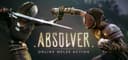
Overview
In 2017, a small Paris studio called Sloclap — staffed largely by Ubisoft veterans — asked a question nobody in the fighting-game space had seriously attempted: what if the move list was the character build? Not the stats. Not the loadout. The actual punches.
That question produced Absolver, published by Devolver Digital, and it remains one of the most conceptually daring melee games of the last decade. You play a masked Prospect dropped into the ruins of the fallen Adal Empire, nudged along by cryptic Guides toward joining an order of warrior-judges called Absolvers. The lore is deliberately thin and elliptical — Dark Souls by way of Journey, with Austin Wintory’s score doing an enormous amount of emotional heavy lifting. Nobody plays Absolver for the story. Sloclap knew that.
What they built instead was a shared, drop-in open world where you wander crumbling temples and coastal ruins and periodically bump into another masked stranger. There’s no chat. There’s a bow emote, a wave, and your fists. That ambiguity — is this person a partner, a duelist, or a predator? — is the most quietly brilliant social design in the game, and it works because the combat underneath it is worth having an opinion about.
Commercially, Absolver landed in an awkward slot. Too systems-heavy for the action-RPG crowd, too loose and lag-prone for the FGC, too multiplayer-dependent for the single-player Souls audience it visually courted. The reception reflects the split: a Metacritic of 75 — the score of a game people love in parts and resent in others.
Sloclap’s subsequent career is the real epilogue. The lessons from Absolver’s combat engine went directly into Sifu, a far tighter, far more successful single-player game. Absolver is the prototype that got left in the field — still running, still online, still unmatched at the one thing it does.
Key features
- The Combat Deck: A fully user-authored move set. You collect individual attacks by absorbing them from opponents mid-fight, then sequence them into personal combo strings across four stances. This is character creation as choreography.
- Four-Stance Directional Combat: Every attack you throw rotates your body into a new stance, which determines what you can throw next. Offense and positioning are the same variable. There is no neutral to return to.
- Combat Styles: Four defensive philosophies — Forsaken (parry), Windfall (dodge), Kahlt (absorb damage into a delayed pool), and Faejin (alternating light/heavy pressure, added free with Downfall) — that fundamentally change how you read an opponent rather than just adding a button.
- Shared Open World: Seamless PvPvE zones with no chat, where cooperation and betrayal are negotiated entirely through emotes and body language.
- Schools: Create a school, teach your deck to other players, and your combat philosophy propagates through the population like a lineage. It’s a genuinely novel social mechanic.
- Downfall Expansion (Free): Procedurally sequenced Adalian Mines runs with boss fights — a roguelike PvE mode bolted on post-launch to answer the “what do I do now?” problem.
Analysis
The Combat Deck is the whole review
Strip everything else away. What makes Absolver worth a look is that it treats a fighting-game move list as raw material rather than a fixed spec sheet.
Here’s the loop. You fight someone — AI or player — and as their attacks land on you, an absorption meter fills. Fill it, and the move enters your library. Then you open the deck editor and slot that move into one of four strings, each anchored to a stance. Because every attack ends in a stance, and every string begins in one, your deck isn’t a list. It’s a directed graph. A well-built deck flows: the alternate-side kick that ends in Right Forward feeds the overhead elbow that starts there, which dumps you into Left Back where your best sweep lives.
Build it badly and you’ll throw one good hit and then flail into a stance with nothing useful in it. Build it well and you become a specific, legible thing — a grappler, a rangey kicker, a feint-heavy pressure monster — that no other player is running in quite the same configuration.
It’s worth being precise about why this matters. In Tekken or Street Fighter, mastery means learning a fixed, designer-authored vocabulary. In Absolver, mastery means authoring the vocabulary and then learning it. The skill ceiling has two floors. Most players who bounce off the game bounce off at the first one, never realizing the second exists.
The moment-to-moment fighting is designed to be deliberate and weighty. Attacks have real startup. Feints exist and cost you tempo. Reading an opponent’s stance to predict which of their four strings is coming is the actual game being played, and against a good human it produces a mind-game density that stands alongside any dedicated fighter.
Where the structure collapses
The single-player campaign is a shrug. You wander a modestly sized, handsome, largely empty world, whack respawning Prospect husks, absorb moves, and eventually fight a few marked bosses. It functions almost entirely as a tutorial with delusions of being a Souls game. The Guides speak in portentous fragments. The world offers atmosphere and nearly zero direction.
This is the game’s central design failure, and it isn’t about content volume — it’s about onboarding. Absolver’s deck system is hard to understand. It needed a campaign that taught stance flow, string construction, and defensive-style tradeoffs through escalating, designed encounters. Instead it gives you an editor, a shrug, and a hope that you’ll find a good player who feels like teaching. The School system was the intended answer. It’s a lovely idea that requires a healthy population to function, which brings us to the other problem.
Netcode, and the population math
Absolver’s PvP runs on peer-to-peer connections, and in a game where the difference between a parry and a face full of elbow is a handful of frames, that is a load-bearing weakness. Against a nearby opponent on a clean line, duels can feel crisp. Against someone across an ocean, the design invites the rubber-banding, phantom-hit, “I definitely parried that” experience that has driven off a meaningful chunk of the playerbase. Server instability at launch made this worse and the reputational damage stuck.
Compounding it: the population has thinned dramatically since 2017. Sloclap moved on to Sifu and then Rematch. The servers are still up and the world still has strangers in it, but ranked matchmaking in a game this small means longer queues and a narrower spread of opponent quality — and Absolver is a game whose entire late-game is other people.
Downfall, and what it fixed
The free Downfall expansion was an honest, substantial response to the endgame void. Procedurally sequenced runs through the Adalian Mines, escalating floors, real boss fights, and the Faejin style. It gave solo players a reason to keep tuning decks and a place to test them that didn’t depend on someone else being online. It’s good. It’s also, structurally, a roguelike mode added to a game that needed a spine — a splint, not a skeleton.
The interface
The menus are bad. Not catastrophic, but clearly built by people whose passion was elsewhere. The deck editor — the single most important screen in the game — is fiddly, requires more clicks than it should to preview a move’s stance transitions, and does a poor job surfacing the one thing you actually need: what flows into what. A visual graph of your deck’s stance connections would have transformed the new-player experience. It never arrived.
Visuals & performance
The art direction is the second-best thing here. Muted, chalky palettes. Long shadows across broken Adalian stonework. Masks that read as character silhouettes from across a courtyard. It’s stylized enough to age gracefully — this game does not look like 2017 in the way that photoreal contemporaries do.
The animation deserves separate praise. Sloclap motion-captured real martial artists, and the transitions between stances have a physical continuity most fighting games fake with blends. Watching a good player chain a spinning backfist into a low sweep into a shoulder check is beautiful, and it’s readable — you can see the tell, which is what makes the mind games work.
A 3D game of this scope is light on hardware, and the technical complaints are network-side, not render-side. The design leaves room for rough edges — occasional animation hitches, the odd hitbox oddity, a menu that forgets what you clicked — and Sloclap’s patch cadence stopped years ago. What’s here is what you get.
Platform nuances
Steam is the only place to play it, and the platform’s realities matter more than usual.
Controller is effectively mandatory. Absolver maps four stances, four attack directions, feints, dodges, guard, and absorb onto a scheme that assumes an analog stick and shoulder buttons. Mouse and keyboard technically works and is, by design, a poor fit — directional attack inputs on WASD fight against movement in a way that costs fights you should win. Plug in a gamepad.
The Steam side also means regional matchmaking is entirely luck. With a small, globally scattered population, PvP quality is largely determined by whether other players in your region happen to be online tonight. Steam’s community hubs and the surviving Discord communities are, unofficially, the game’s real tutorial — the deck-building knowledge base lives there, not in the game.
One genuine platform positive: it goes on deep discount constantly, and Downfall is free. The price of entry is low enough that trying it for the combat system alone is an easy yes.
Final verdict
Absolver is the rare game whose central mechanic is worth more than the game containing it. Sloclap invented something real — a fighting system where the player authors the vocabulary — and then shipped it inside a hollow world with fragile netcode and a tutorial that isn’t one. Years on, the flaws haven’t been fixed and won’t be. The idea, meanwhile, still hasn’t been matched by anyone.
We can’t recommend it to most people at full price. On sale, with a controller and a friend, it’s a fascinating curiosity — a prototype of a masterpiece rather than the masterpiece itself. That prototype is still more interesting than most finished games.
Reviewed by the Rankeno Action Desk. Scores are out of 10; the overall score is the desk’s editorial judgement, informed by the four sub-scores above. How we review