

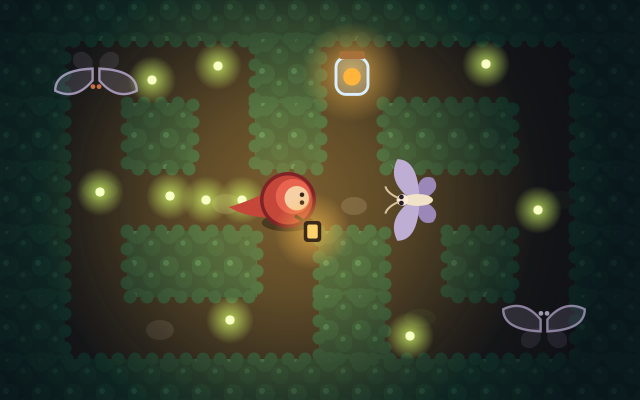
Overview
Can a detective game work without a single line of dialogue? Most of the genre leans on text: interrogation transcripts, case files, notebook entries that do half the thinking for the player. Hillthorn throws all of it out. Developed by Fool Moon and Finnegan Motors and published by Raw Fury, it launched on November 10, 2026 for Steam, Nintendo Switch, iOS and Android as a dark, card-based investigation in which every location, suspect, object and lead is a Clue card.
The premise is lean. An outsider arrives in a secluded mountain community to find a missing child. The locals distrust strangers, so nothing comes freely; information has to be coaxed out. There is no text and no spoken dialogue, which means the player reads the story from imagery, from the relationships between cards, and from what a combination of two cards opens up next.
The second pillar is time. Every action advances a clock, and the game deliberately hands out more leads than the clock allows. Some trails can be revisited, but at a cost. Nothing is carried forward except what the player has learned: no upgrades, no unlock tree, just knowledge that makes the next run sharper. Multiple endings give that knowledge somewhere to go.
It sits in a small, crowded corner of the market: short, atmospheric, replay-driven mysteries aimed at players who would rather deduce than be told. The game is paid at $14.99 and carries a 12+ content rating. The iOS store rating is 3.3 out of 5 from three ratings, too few to mean much.
Key features
- Clue cards as the whole interface: Locations, suspects, objects and leads are all cards. There is no separate map, journal or dialogue tree to manage.
- Three verbs: Each card can be Investigated, Explored or, sometimes, Talked to. The limited verb set keeps decisions legible.
- Card combination: Pairing cards opens new trails across Hillthorn Mountain, turning deduction into a physical act and not a menu choice.
- A ticking clock: Every action costs time. There are more leads than hours, and revisiting a path carries a cost.
- Knowledge-based progression: No upgrades or stat boosts. What the player understands is the only thing that persists between runs.
- Multiple endings: Replays uncover more of the story. Seeing all of them takes multiple short runs.
- No text, no voice: The entire narrative is communicated without written or spoken language.
- Paid release: $14.99 on Steam, Nintendo Switch, iOS and Android.
Analysis
The Card Grammar
Reducing a mystery to cards and three verbs is a risky act of compression. It pays off because the verbs map cleanly onto how investigation feels. Investigate is scrutiny, Explore is movement and Talk is social pressure. The fact that Talk is only available “sometimes” is a strong detail in the design. It encodes the community’s hostility into the rules. The locals do not refuse to speak in a cutscene; the option to speak simply is not on the card until the player has earned it. That is theme expressed through mechanics, and it does more work than a paragraph of grim exposition would.
Combination is the other half of the grammar. Asking the player to pair cards to open new trails forces a hypothesis: this object belongs with that person, this place explains that lead. Text-heavy detective games often let players brute-force a dialogue tree until the plot advances. Here a combination is a claim about the case, and making claims is what deduction should be.
The Clock
The ticking clock is what turns a pleasant puzzle box into a game with stakes. Because every action advances time and the leads outnumber the hours, each run is an exercise in triage. Following one thread means abandoning another. The revisit cost matters just as much: it keeps backtracking possible but never free, so a wrong turn hurts without ending the run.
This is also where the design will divide people. Players who want to exhaust every clue in a single pass will find the clock hostile. It is meant to be. The structure assumes failure, or at least incompleteness, on the first attempt.
Knowledge as the Only Currency
Progress comes from what the player learns, and that knowledge carries into later runs. No meta-currency softens the difficulty and no unlock makes run five mechanically easier than run one. The player gets better because they know which trails are dead ends and which cards belong together.
This is the right call for a mystery, and it is the reason the short runtime is defensible. A brief run that the player repeats with a better mental map is a different proposition from a brief stretch of content that ends. The multiple endings give the accumulated knowledge a purpose: each replay targets a part of the story the last one could not reach.
The trade-off is plain. Knowledge-based progression has a ceiling. Once every ending is seen, nothing is left to learn, and a game built on learning has no reason to be reopened. The full extent of the game is the run of replays needed to see every ending.
Wordless Storytelling
Telling a missing-child story with no text or speech is the boldest choice here and the least forgiving. It removes localisation barriers entirely, which suits a multi-platform launch. It also puts the whole burden of clarity on iconography and card art. When a wordless story lands, the player feels they worked it out alone. When it does not, ambiguity reads as obscurity. The wordless, card-based approach can land on the right side of that line, but players who want explicit answers should expect to interpret, not to be told.
The Length Problem
The “absurdly short” complaint is fair as a description and incomplete as a criticism. One run is brief. Anyone who stops there has seen a fraction of the game and will reasonably feel short-changed. The design asks for replay, and players who refuse the request get a thin experience. That is a real limitation of fit, and it belongs in any buying decision.
Visuals & performance
The art direction carries an unusual load. With no words available, the card illustrations are the script, the characterisation and the tutorial at once. The dark, atmospheric presentation is therefore doing structural work as well as setting mood. A cards-on-a-table layout also keeps the UI honest: everything the player knows is visible as an object, with no buried menus.
On performance, a card-based 2D game of this scope should be light on hardware across phones, Switch and modest PCs. That is a design-level expectation, not a measured result. Card-based presentation also scales well to small screens, provided the art stays readable at phone size; with no text to fall back on, legibility of the imagery is the one thing the mobile versions cannot afford to lose.
Platform nuances
- Steam: Mouse input suits picking and combining cards. Value will depend on what the storefront charges against a brief, replay-driven game.
- iOS and Android: Touch is the natural fit for a card game; dragging one clue onto another is the interaction the design implies. Short runs also suit mobile play. The iOS score of 3.3/5 comes from three ratings and should be read with caution.
- Nintendo Switch: Runs fit handheld play well. Controller input for card selection is inherently less direct than touch or mouse, so the quality of the cursor and selection scheme matters most here.
- Parity: A game with no text needs no per-platform language support. Value will depend on what each storefront charges against a brief run.
Final verdict
Hillthorn makes three hard bets — no words, no upgrades, not enough time — and each one reinforces the others. The clock makes knowledge valuable, the knowledge makes replays meaningful, and the cards make all of it readable without a sentence of text. That coherence is the design’s real strength.
Its limit is equally clear. This is a short game delivered in brief slices, and it gives little to anyone unwilling to go around again. At $14.99, we rate it a mixed proposition: a recommendation for deduction fans who accept replay, and a cautious one for everyone else.
Reviewed by the Rankeno Puzzle & Casual Desk. Scores are out of 10; the overall score is the desk’s editorial judgement, informed by the four sub-scores above. How we review