

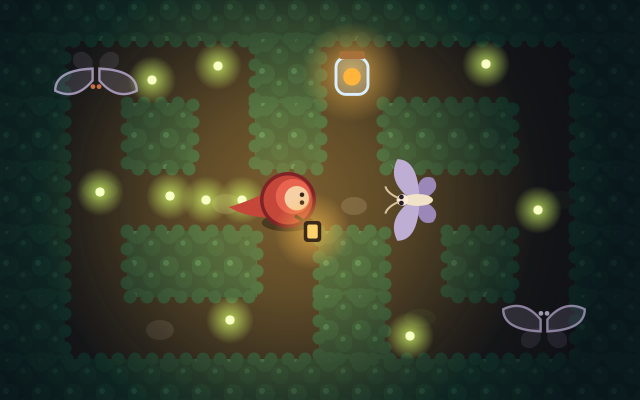
Overview
Block-pushing puzzle games have been iterating on the same warehouse for four decades. Snake-style puzzlers, where the body is both tool and obstacle, are a newer and more crowded corner. WOIM, from independent developer dogspawn.net, sits where the two meet and adds one idea of its own: the worm can cut itself in half, and the severed half becomes a second worm that helps solve the room.
The premise is plain. A worm burrows ever deeper underground through a compact run of worlds and puzzles, pushing blocks, flipping switches and eating apples to clear each one. The rules are familiar to anyone who knows Sokoban or the snake-puzzle lineage. The fiction is the odd part. On the way down, the worm meets characters who were once part of it, a detail that turns the central mechanic into a running joke and gives the game a surreal, humorous tone.
The positioning is equally clear. Its pitch is cute, relaxing, family friendly and exploration-driven, with time manipulation also part of the design. It is single-player and launched on October 21, 2026 for Windows, macOS and SteamOS/Linux at $9.99, alongside a separate soundtrack DLC and a Supporter Edition bundle. That price puts it in the compact indie puzzler bracket, where a game must justify itself on ideas per puzzle rather than hours of content.
The available reception is a small sample from an audience that sought the game out, so it is not a firm consensus. Even so, the response suggests the puzzles hold together for that audience. There is no console or mobile version; the official site links only to Steam.
Key features
- Self-splitting mechanic: The worm cuts itself in half to create a second worm, which turns a one-body puzzle into a two-body one whenever the player chooses.
- Sokoban and snake logic combined: Blocks to push, switches to flip and apples to eat, three well-understood verbs layered on a body that takes up space.
- Compact campaign: A short run of worlds arranged as a continuous descent rather than a flat level-select grid.
- Secrets and exploration: Many hidden discoveries sit alongside the main route, which gives completionists a reason to poke at the edges.
- Characters that were once you: The cast is made of former pieces of the protagonist, tying the story directly to the mechanic.
- Steam feature set: Achievements, Cloud saves and Family Sharing.
Analysis
The Cut
A good puzzle mechanic adds decisions without adding much to learn, and the split does that. In a snake-like puzzler, length matters in both directions: a long body can bridge, block and reach, while a short one can turn in tight spaces. Letting the player sever the body makes length a choice instead of a fixed condition. Where to cut, when to cut, and which half goes where become the central questions of a room.
The second worm matters as much as the shorter first one. Two bodies in a Sokoban space can hold a switch while the other passes, push from two sides, or stand in as a block themselves. This is cooperative puzzle logic for one player. It also carries the usual risk of that design: steering two bodies through a tight grid can become bookkeeping. The design’s success depends on how tightly each room is built; the available reception suggests it often is, though the sample is thin.
Familiar Verbs, Deliberately
Pushing blocks, flipping switches and eating apples are not new. That is the right call. When the signature mechanic is unusual, the supporting vocabulary should be instantly readable, so that the player’s attention goes to the new idea. Apples in snake-style games usually change the body, and blocks and switches are the genre’s basic grammar. The cut is what makes these stock elements interesting again.
The cost is that the first few rooms may look ordinary to genre veterans. A player who has cleared dozens of Sokoban variants will recognise most of the building blocks, and the game has only a compact set of puzzles in which to prove its combinations are fresh.
Structure and Scope
The compact campaign makes a short game by the standards of the genre’s largest entries, and brevity is defensible here. Puzzle games suffer more from padding than from running out. A campaign this size can introduce an idea, complicate it and move on before it wears thin. The exploration tag and the many secrets suggest the descent has more to it than a linear corridor, with optional depth for players who want a harder or stranger game under the main one.
The time manipulation idea is worth a mention. In a genre where one bad push can ruin a room, some way of winding back mistakes is close to essential, and it fits the relaxing label. No further detail on how it works is published, so its role in the puzzles themselves remains an open question.
Tone
The narrative conceit is a distinctive part of the design outside the puzzles. Meeting characters who were once part of the protagonist makes each cut mean something in the fiction as well as in the solution. It is a joke, and a slightly unsettling one, which is how a cute game earns the word surreal. Puzzle games often bolt a story onto mechanics that don’t need one. This one grows its story out of the mechanic.
The Caveats
The cute, relaxing, family friendly labels describe the mood. They do not promise an easy game. Sokoban-derived puzzles are rigorous by nature, and a calm presentation does not make a hard room any softer. Families buying on the tags alone should expect real thinking to be required. Replay value is also limited by the form: a solved puzzle stays solved, and the secrets are the only stated reason to return.
Visuals & performance
WOIM is a 2D game with a cute presentation, and the choice suits the material. Grid puzzles depend on legibility. The player must be able to tell at a glance which segment belongs to which worm, what can be pushed and what a switch controls. A clean 2D style serves that better than visual spectacle would, and the humour of the premise benefits from a light touch. The risk for any cute puzzler is that charm gets in the way of clarity.
A 2D puzzle game of this scope should be light on hardware by design, and native desktop builds suggest modest technical demands. No performance figures are published.
Platform nuances
WOIM is a Steam-only release, with no iOS, Android or Nintendo listing to compare against.
- Operating systems: Windows, macOS and SteamOS/Linux are all supported, so Mac and Linux players get native builds.
- Input: Grid-based movement maps naturally to a keyboard or a d-pad. A controller would make it a good fit for the couch or a handheld.
- Steam features: Achievements, Cloud saves and Family Sharing are included. Cloud saves let progress follow the player between machines, and Family Sharing fits the family friendly positioning.
- Pricing: $9.99 for the base game, with the soundtrack sold as separate DLC and a Supporter Edition bundle for those who want to pay more.
Final verdict
WOIM takes two well-worn puzzle traditions and adds one idea that changes how both behave. Cutting the worm in half is the controlling mechanic, the source of the story and the main joke, and that economy is the game’s clearest strength. The supporting elements are conventional and the campaign is short. Both follow from a design that would rather explore one mechanic thoroughly than run long.
The reservations are about evidence and scope. The available reception is a thin base for a firm consensus, and players who measure value in hours will find the campaign slight. For puzzle fans who measure it in new ideas, $9.99 is a reasonable price, and we recommend it to that audience.
Reviewed by the Rankeno Strategy & Sim Desk. Scores are out of 10; the overall score is the desk’s editorial judgement, informed by the four sub-scores above. How we review