
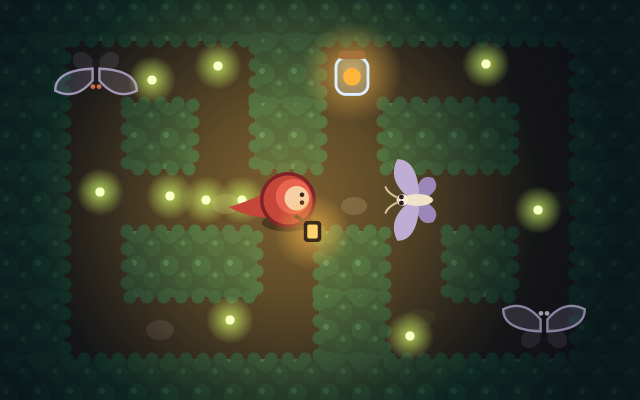
Overview
八名木Games, with Gamirror Games handling publication, has delivered Homicipher, a title that reshapes player engagement within the adventure horror genre by making language itself the puzzle. Released November 1, 2024 on Steam as a paid title, it is a descent into an alternate reality where communication itself is the most terrifying and rewarding puzzle. Players are confronted not by jump scares, but by the profound discomfort of incomprehension. The core loop eschews typical inventory conundrums in favor of observational linguistics: deciphering the arcane tongue of non-human entities. This mechanism forces a level of deliberate interaction rarely seen, demanding close attention to subtle expressions, environmental cues, and gestural language to construct a functional dictionary. This intellectual scaffolding supports a narrative deftly interwoven with romance, a bold juxtaposition against the backdrop of psychological dread. Homicipher positions itself as a carefully crafted narrative device, promising branching paths and multiple endings that react to player choices—choices often predicated on the player’s hard-won understanding of the alien lexicon. It is a game designed for the discerning player who values profound mystery and the slow burn of intellectual horror over cheap thrills.
Key features
- Linguistic Deciphering System: Players actively build a dictionary by observing gestures, expressions, and environmental context, turning communication into the primary, high-stakes puzzle mechanic.
- Branching Narrative & Romance: A complex story unfolds with significant player choice, incorporating unexpected romantic elements within its horror framework, leading to diverse outcomes and encouraging deep narrative exploration.
- Atmospheric Horror & Exploration: Beyond simple jump scares, the game cultivates a pervasive sense of unease through its alternate world setting and the constant challenge of understanding unfamiliar beings, fostering genuine psychological tension.
Analysis
Homicipher‘s audacity lies in making language—typically a transparent medium in storytelling—an impenetrable barrier and, subsequently, the player’s most potent tool. It is a foundational mechanic that reorients the entire horror experience. Where other games might rely on grotesque visuals or startling sound design, Homicipher taps into a more primal fear: the terror of the unknown and the frustration of miscommunication. The sheer act of piecing together meaning from fragmented alien utterances turns the classic point-and-click observation into an intellectual endeavor. Each successful decipherment should feel like a real breakthrough, a small victory against overwhelming otherness. This painstaking process isn’t for the impatient; it requires dedication, the kind of focus one might apply to an academic text. Yet the gratification of these moments is what fuels the persistent drive to understand why these entities speak as they do, and what they truly want.
The narrative structure, which marries horror with romantic elements, is a particularly dangerous tightrope walk. Too often, such blends collapse under their own ambition, diluting both genres. Homicipher, however, appears to wield this combination with a surprising degree of finesse. The romance elements do not detract from the horror but rather deepen it, introducing a vulnerable, human dimension to the terrifying unknown. When the stakes involve not just survival but connection, the emotional resonance intensifies significantly. This dual-genre approach isn’t a mere narrative embellishment; it’s integral to the game’s branching paths. Player decisions, often informed by their linguistic understanding, directly sculpt the relationships and the overarching plot, making replaying a necessity to fully grasp the narrative’s intricacies and consequences. This is intelligent design, encouraging players to revisit their assumptions and linguistic interpretations to unlock every nuance of the story.
The gameplay loop is built on controlled information release. Solutions are never handed over; they’re earned. This constant push for understanding creates a distinctive flow, blending periods of intense observation and deduction with moments of tense dialogue and narrative progression. The interface, while serving a complex function, is designed to stay unobtrusive—a crucial element for a game where the slightest visual cue can be a linguistic Rosetta Stone. The success of Homicipher fundamentally rests on the elegance and consistency of its language system. If the rules of the alien tongue were arbitrary, the entire edifice would crumble. The design suggests 八名木Games has engineered this system with rigorous internal logic, making the act of deciphering feel like a discovery of genuine principles rather than rote memorization. It’s an example of how intelligent game design can transmute a potential frustration into profound engagement.
Visuals & performance
Given its point-and-click lineage and focus on narrative and puzzle mechanics, Homicipher‘s visual presentation is more about atmosphere and nuanced character expression than graphical fidelity. The aesthetic leans into the evocative rather than the hyper-realistic. This choice is appropriate; a highly detailed environment might distract from the subtle cues essential for linguistic deciphering. The art style serves to amplify the horror elements, creating a world that feels alien and foreboding without relying on overt gore or shock value. Subtle visual storytelling, particularly in the expressions and gestures of the non-human entities, is paramount, acting as the visual bedrock for the core gameplay. And as a 2D point-and-click of this scope, it’s light on hardware demands—technical overhead is unlikely to be the obstacle here; the challenge is intellectual.
Platform nuances
As a Steam title, Homicipher operates firmly within the mouse-and-keyboard paradigm, a natural fit for its point-and-click mechanics. The precision afforded by a mouse is critical for inspecting minute environmental details and selecting specific phrases or gestures that constitute the linguistic puzzles. The interface is built for desktop interaction, supporting intuitive dictionary management and straightforward navigation through dialogue trees. The experience is tailored directly for PC players, which, for a game so reliant on intricate input and textual interpretation, is an unambiguous advantage.
Final verdict
Homicipher is a distinctive piece of work. It weaponizes communication, transforming the fundamental act of understanding into the game’s most formidable and rewarding challenge. 八名木Games has crafted a sharp, cerebral horror experience with a chilling narrative that lingers, one that compels players to revisit its intricate lexicon to grasp its depths. At $12.59, it’s an easy recommendation for players with the patience it demands—just know that its slow-burn, deduction-heavy approach won’t be for everyone.
Reviewed by the Rankeno RPG & Adventure Desk. Scores are out of 10; the overall score is the desk’s editorial judgement, informed by the four sub-scores above. How we review