
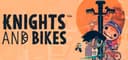

Overview
Every generation gets its own kids-on-bikes story. The 1980s had The Goonies and E.T., and the streaming era got Stranger Things. Games have rarely had a good one. Knights and Bikes fills that gap, and it runs on sincerity more than nostalgia.
The game comes from Foam Sword, a small British studio founded by Rex Crowle and Moo Yu. Both worked on Media Molecule’s LittleBigPlanet and Tearaway, and it shows. The art looks handmade, the props feel physical, and the whole game believes that play works best when it looks like something a child could have made at the kitchen table. Foam Sword funded the project on Kickstarter and released it through Double Fine Presents. That makes it a small indie with the art of a much bigger studio and the budget of a small one.
The premise is simple. It’s the 1980s on Penfurzy, a made-up British island. Nessa, a newcomer, teams up with Demelza, a local girl with more energy than caution. With their pet goose, Captain Honkers, they go looking for a legendary treasure and find an ancient curse instead.
The game is a top-down co-op action-adventure built on the Zelda formula: explore, fight, solve puzzles, collect new tools and open up more of the map. Its real niche is narrower and more interesting. It’s designed for two people sharing a sofa, and it made that pitch well before It Takes Two turned it into a mainstream selling point.
The reception has been steady rather than spectacular: a 79 on Metacritic, an IGF award for Excellence in Visual Art, and BAFTA and Game Developers Choice nominations. That’s the record of a cult favourite rather than a blockbuster, which is about where it belongs.
Key features
- Two heroes, one adventure: Play in local or online co-op, or alone and switch between Nessa and Demelza at will.
- Everyday weapons: Frisbees, water balloons, toilet plungers and a boom-box loud enough to wake the dead. Each one is both a weapon and a key for puzzles.
- Bikes as traversal and progression: Ride around Penfurzy, then upgrade and decorate the bike as the story goes on.
- Two-player puzzles: Many environmental puzzles need both girls working together.
- Treasure hunting and secrets: Hidden areas and collectibles reward going off the main path.
- Friendship moments: High-fives and petting the goose. Small touches that give co-op a social rhythm.
Analysis
The Gameplay Loop
The structure is classic adventure-game fare. Explore part of Penfurzy, reach an obstacle, find the tool that clears it, then fight through to a boss. What’s different is the tools. There’s no sword and no bow. Nessa and Demelza fight with frisbees, water balloons, toilet plungers and a boom-box, and most of them do two jobs: weapon and puzzle key.
That double duty is the best idea in the design. Each new item changes how the environment reads, not just how fights play out. When a puzzle needs two tools used by two characters at the same time, players have to talk to each other. That kind of coordination is what makes couch co-op feel like playing together rather than two people playing alone on the same screen.
Bikes drive the other half of the loop. They’re how players get around the island faster, and they’re where found treasure goes: upgrades and decorations. The cosmetic side sounds minor, but it isn’t. Choosing bike decorations is a way of taking ownership of a character, and that investment pays off when the story turns serious.
Co-op Design and the Solo Question
Knights and Bikes is built for two players and is at its best with two. Local co-op is the main event, and online co-op covers friends who live elsewhere. The puzzles that need both characters are where the design works best, because neither player can coast. The high-fives and goose-petting play a bigger role than they seem to: they build in natural pauses to celebrate a solved puzzle, laugh at a joke, or reset after a hard fight.
Solo play works, but it’s a compromise. Switching between the girls to handle two-person puzzles keeps the story intact but makes the game’s structure more visible. The whole emotional point of the game is two people choosing each other, and controlling both of them undercuts that. With a partner available, co-op is the way to play.
Combat: The Weak Link
This is where critics had doubts, and they’re right: combat is simple and gets repetitive. The weapons are clever on paper but shallow in practice. Everyday fights come down to a routine of attacking, moving and attacking again, and that routine barely changes over the course of the game. Boss fights are better because they treat the tools as puzzle pieces. The regular fights feel like filler between the parts Foam Sword clearly cared about.
Whether that matters depends on the second player. For a child or a less experienced partner, simple combat is a real advantage: nobody gets left behind and nobody gets frustrated. For anyone raised on action games, it wears thin by the halfway point.
Story and Pacing
The writing is the main reason to play. The humour is dry, British and occasionally silly, and Captain Honkers steals every scene. Under the treasure hunt is a story about friendship, loss and growing up, and Foam Sword handles it with restraint. It doesn’t lecture. It lets the girls’ situations carry the weight, and the emotional moments land because the game earned them through running jokes.
Pacing is the other fair complaint. Some stretches drag, especially when exploration sends players back over familiar ground or a fight stands between them and a story scene. A tighter edit would have made a better game. The problem is proportion, not ambition.
Visuals & performance
The hand-painted art has real texture — brush strokes and paper grain are part of the look — and the IGF award was deserved. The characters move with the bouncy, handmade energy of the Tearaway games, and Penfurzy feels like an actual place: a windswept seaside island past its best, drawn with affection rather than irony. The menus and interface share the same crafted look, so the style holds together throughout.
The art style also keeps the technical demands low. Painted textures don’t depend on high resolution or expensive lighting, so a 2D game of this scope is light on hardware and suits the Switch’s handheld screen. The one cost is readability in combat. Painterly art favours mood over crisp outlines, and in crowded fights enemies and effects are harder to pick out, especially on a small screen.
Platform nuances
Steam (Windows, macOS, Linux): Support for all three desktop systems is a real plus for an indie game. This is a gamepad-first design from developers with a PlayStation background, so plan on controllers. For local co-op on one PC that means two gamepads. Online co-op covers the friend in another city.
Nintendo Switch: This may be where the game feels most at home. A shared-screen story adventure that’s easy on the reflexes suits a console you can hand to someone on a train or a sofa. Couch co-op on a portable device is exactly what this game was built for. For longer sessions, use proper controllers: a small Joy-Con held sideways is uncomfortable for an action game where you aim your throws.
Final verdict
Knights and Bikes knows what it’s for: two people, one screen, a summer adventure and a goose. The combat never develops the way the rest of the game does, and some stretches could have been cut. But the art is remarkable, the co-op design makes players talk to each other, and the story handles loss with a lighter touch than most films manage. With someone to share the sofa with, it’s a solid recommendation. Played alone, expect a good game rather than a great one.
Reviewed by the Rankeno Action Desk. Scores are out of 10; the overall score is the desk’s editorial judgement, informed by the four sub-scores above. How we review