
Overview
What happens when a game strips out the upgrade tree, the combat and the tutorial, and leaves only a world and a player’s ability to reason about it? MONOMOON is Gentle Giant’s answer. The studio developed and published it, releasing it on Steam on November 11, 2026, at $11.99. Its store page uses the label “Metroidbrainia”: a non-linear exploration game in which progress is gated by what the player has worked out, with no unlockable abilities and no fighting.
The label carries a specific promise. In a conventional Metroidvania, a locked route opens when the character gains a double jump. Here, the route was always open; the player simply did not know how the world worked. MONOMOON commits to that idea without hedging. There is no explicit instruction of any kind. Players roam a small, compact open world, watch how it behaves, and deduce its rules themselves. The interaction model blends side-on platforming with point-and-click input, an unusual pairing that explains why the store page recommends keyboard and mouse over a controller.
The scope is modest and clearly deliberate. A first playthrough is short and dense, with further content to uncover afterwards, and the store tagline promises a path “reserved for the knowing and the daring”. It is a single-player game with interface and subtitle support and no voiced audio.
The appeal is narrow but coherent. A game that offers no hand-holding asks for patience and curiosity, and it rewards both with the specific pleasure of a rule clicking into place. That is a striking proposition for a design with no tutorial and no combat, and it suggests Gentle Giant has found the audience this structure was built for. The question is whether the same design has anything to offer players outside that audience.
Key features
- Knowledge-gated progression: No abilities, no keys, no stat upgrades. What the player understands about the world determines where they can go.
- Zero combat, zero instruction: There are no enemies to fight and no tutorials. Observation and deduction carry the entire game.
- Compact open world: A small, dense, non-linear space built for revisiting.
- Hybrid controls: Side-on platforming combined with point-and-click interaction. Keyboard and mouse is recommended; controllers are supported.
- Layered secrets: Secrets sit on top of secrets, with post-completion content and a path “reserved for the knowing and the daring”.
- Focused runtime: A short, dense first playthrough at a budget price.
- Interface and subtitle support: Localised text with no voiced audio.
- Steam feature set: Steam Achievements, Steam Cloud and Family Sharing.
Analysis
Progress as Understanding
The knowledge gate is the most demanding structure a puzzle designer can choose, because it removes every safety net. An ability gate tells the player when they have progressed: a new item appears and a door opens. A knowledge gate gives no such receipt. The only reward is the moment a rule clicks, and the design has to produce that moment reliably without ever saying what the rule is.
MONOMOON bets everything on this. With no fighting and no explicit instruction, nothing dilutes the loop: explore, observe, form a hypothesis, test it against the world. The payoff of that structure is that every breakthrough belongs to the player. The cost is that the game cannot rescue anyone who stalls. With no instruction of any kind, there is also no described hint system to act as a pressure valve. Players who hit a wall have their own notes and their own patience, and nothing else. We consider that an honest trade, but it is a real one, and it defines who should buy this.
Why a Small World Matters
The compact map is the smartest decision in the design. Knowledge-gated games depend on backtracking: a rule learned in one corner reframes something seen hours earlier in another. In a sprawling world, that reframing becomes a chore of travel. In a small one, the return trip is short and the density of meaning per screen stays high. A small, tightly packed space also means the player can hold the whole map in their head, which deduction requires. The scope aims to end before its rule set runs out of surprises.
Non-linearity supports the same goal. When one line of inquiry stalls, a non-linear layout offers another thread to pull. That is the closest thing this design has to a difficulty setting, and it is a reasonable substitute for one.
The Hybrid Control Model
Blending platforming with point-and-click is the riskiest mechanical choice here. The two input languages pull in different directions: platforming wants directional precision, while pointing wants a cursor. The store page’s recommendation of keyboard and mouse shows where the design sits. Controllers are supported, but an analogue stick emulating a pointer is a compromise in any game built around cursor interaction, and buyers who plan to play from a sofa should weigh that.
The benefit is a wider puzzle vocabulary. A character who can move through a space and a cursor that can interrogate it give the designers two separate channels for hiding information. For a game about deducing rules, a second channel doubles the places a rule can live.
Secrets on Secrets
The layered secret structure and the post-completion content give the runtime a second life. A first ending appears to be a milestone, not a finish line, and the tagline’s “knowing and the daring” signals that the deepest layer asks for more than the main route does. This suits the genre: knowledge carries forward, so late discoveries can recast early areas without adding a single new room. It also invites comparison notes and community theorising, which is fuel for word of mouth. That structure gives word of mouth something concrete to pass around.
The weakness is replay value in the traditional sense. Once the rules are known, they cannot be unlearned. This is a game built to be solved once, thoroughly.
Visuals & performance
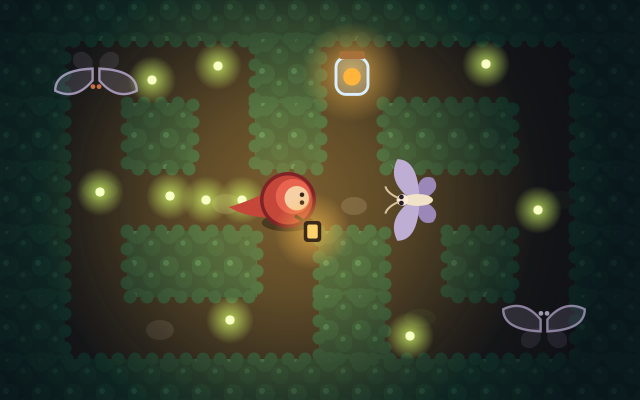
The presentation is side-on and text-led, with no voiced audio. That choice has a practical advantage: localised subtitles and interface text cost far less to deliver than dubbed dialogue, and for a game that communicates through world behaviour instead of exposition, the lack of voice work costs little. The harder UI problem lies elsewhere. A game with no instruction must make its interactive elements legible through art alone, and a point-and-click layer raises the stakes, because any ambiguity about what can be clicked reads as unfairness, not mystery. The design has to clear that bar through clarity of art and interaction, not through explanation.
On hardware, a 2D game of this scope is light on hardware; older laptops and office-grade machines are the natural target.
Platform nuances
MONOMOON is a Steam release. The price is $11.99.
Input is the main variable. Keyboard and mouse is the recommended scheme, and the point-and-click half of the design makes that recommendation worth following. Controller support exists as an option, not as the intended experience. Steam Cloud keeps saves in sync across PCs, which matters in a game where progress lives partly in the save file and partly in the player’s head. Family Sharing lets a household pass it around, and Steam Achievements give completionists a visible ledger for the layered secrets.
Final verdict
MONOMOON knows exactly what it is and makes no concessions to anyone who wants something else. Gentle Giant has built a small world, removed every mechanic that is not observation or deduction, and priced the result at $11.99. The design choices reinforce each other: the compact map serves the backtracking, the non-linearity softens the absence of hints, and the hybrid controls widen the range of puzzles. The costs are equally clear. The controller is a second-class input, the game offers no relief to players who get stuck, and the experience cannot be repeated once solved.
We rate it as a great puzzle game with real reservations: the design is coherent and the price is fair, but the lack of help and the controller compromise will narrow its audience. We recommend it clearly to players who enjoy being trusted, and we advise everyone else to take the “no explicit instruction” warning literally.
Reviewed by the Rankeno RPG & Adventure Desk. Scores are out of 10; the overall score is the desk’s editorial judgement, informed by the four sub-scores above. How we review