
Overview
How many puzzles is too many? Thekla, Inc. answers with a catalog most studios would treat as a typo: a very large set of hand-crafted, interconnected rooms, spread across four worlds that begin as separate games and end as one. Order of the Sinking Star released on October 8, 2026 for PC and Nintendo Switch 2, published by Arc Games.
The premise is structural rather than narrative. Each of the four worlds has its own rules, its own characters and its own story. Players control a cast of heroes with complementary abilities, including a queen, a thief, a warrior, a wizard and a talking boat, and each grid-based room asks how those powers interact. Then the worlds merge. Mechanics learned in isolation collide, and the game starts asking questions that no single ruleset could pose.
That positions it in a narrow but devoted corner of the market: the long-form thinking game, where the reward is comprehension rather than loot. It is single-player only, with a long main story and considerably more for completionists. A central mystery unfolds through play and collectible notes, but nobody should mistake this for a story-led adventure with puzzles attached. The puzzles are the product.
Reception is generally positive, with a Metacritic score of 84, but the game’s demands divide critics. Some are enthusiastic; others are cooler on its length and complexity. A game this uncompromising divides on temperament, not quality.
Key features
- A large catalog of hand-crafted puzzles: Grid-based rooms, individually designed and interconnected rather than procedurally generated. The volume is the headline; the hand-crafting is what makes the volume worth anything.
- Four worlds that merge: Each world carries its own rules, characters and story. As the game progresses they combine, so mechanics collide and produce new problem types.
- A cast of complementary heroes: A queen, a thief, a warrior, a wizard and a talking boat, among others. Each has distinct abilities, and rooms are solved by working out how those powers interact.
- Open structure: Explore at any pace, revisit areas and tackle puzzles in almost any order. Getting stuck in one place does not lock the rest of the game.
- Mystery told through play: A central mystery emerges from the puzzles themselves and from collectible notes.
- Broad language and platform support: Broad interface language support with English voice audio; Steam Achievements and Cloud saves on PC; TV, tabletop and handheld modes on Switch 2.
Analysis
Four Games, Then One
The merging-worlds structure is the smartest decision in the design. A puzzle game with a huge number of rooms has an obvious failure mode: repetition. Any single ruleset, however elegant, runs out of new things to say long before the catalog is exhausted. Thekla sidesteps this by building four separate vocabularies and then forcing them into the same sentence.
The pay-off is combinatorial. A player who has absorbed how one world’s heroes behave must re-examine that knowledge once another world’s rules arrive in the same room. Old certainties become new questions. This is how the game sustains a long campaign without resorting to simply making the grids bigger, and it is the feature most likely to sustain interest: the way mechanics from the four worlds combine is among the most consistently praised elements of its reception.
It also carries risk. Four rulebooks mean four onboarding curves, and a merged world means holding all of them in mind at once. The cognitive load at the back end of this game is, by design, heavy. That is the point, and it is also the reason the audience is self-selecting.
Characters as Mechanics
The hero roster reads like a fantasy party, but the roles are functional. A queen, a thief, a warrior and a wizard each bring a different ability to the grid, and the puzzle is the interaction between them. The talking boat signals that the design is not bound to genre convention; a hero can be a vehicle if the grid needs one.
Tying abilities to characters rather than to abstract tools is a quiet readability win. A named hero with a consistent power is easier to reason about than an inventory of unlabelled verbs, and it gives each world’s story and its mechanics the same vocabulary. When worlds merge, the cast merges too, which keeps the escalating complexity anchored to faces rather than rule sheets.
An Open Map as a Pressure Valve
Difficulty in a puzzle game is only a problem when it is a wall. The open structure addresses this directly: players can explore at their own pace, revisit areas and take on puzzles in almost any order. A room that refuses to yield can be left behind. In a game of this length, that freedom is structural necessity, not generosity. A linear sequence of so many puzzles would turn a single stubborn room into an uninstall.
The trade-off is direction. Openness on this scale can leave players unsure where meaningful progress lies, and a design that trusts players to find answers themselves also trusts them to find their own way. The design trusts that. Players who want a clear critical path and steady confirmation that they are on it should read that trust as a warning.
Story at Arm’s Length
A central mystery unfolds through play and collectible notes. That delivery method suits the format: it never interrupts a train of thought with a cutscene the player did not ask for, and it rewards exploration with context. It also makes the narrative optional in practice. Collectible notes are, by nature, missable, and a story distributed across an open map in arbitrary order has to tolerate being read out of sequence. The mystery is likely to function as texture and motivation rather than as the reason to play.
The Scale Question
A long main story, and considerably more for completionists, is an enormous ask for a genre built on concentration. The cooler critical responses show that not every critic was won over. For the right player, the volume is the value: a large set of designed rooms is content measured in months of evenings. For everyone else, it is a commitment that may never be finished, and no amount of open structure changes how much thinking the game demands in total.
Visuals & performance
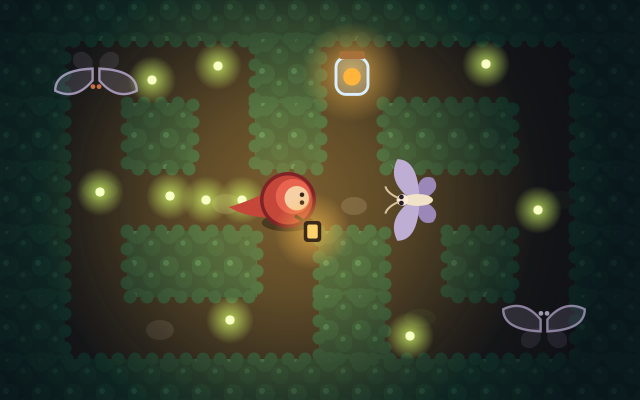
The art direction has one job above all others: legibility. A grid-based puzzle lives or dies on whether the player can read the full state of a room at a glance, covering who stands where, what each hero can do and which elements belong to which world’s rules. With four rulesets sharing the screen in the merged sections, distinct visual identities per world are a functional requirement, and the decision to give each world its own characters and story suggests Thekla treats them as distinct places rather than reskinned tile sets.
On performance, design-level expectation is all we can offer. Grid-based puzzle rooms reward thought rather than reflexes, so frame rate and input latency carry far less weight here than in an action game, and the format suits portable hardware well. No performance figures are available for either platform, so we make no claim beyond that. The interface supports broad language options, a meaningful reach for a text-light genre, though voice audio is English only, which leaves non-English speakers reading whatever the voiced characters say.
Platform nuances
Steam (PC): The PC version adds Steam Achievements and Cloud saves. Cloud saves matter more than usual here: a long save file in an open-structure game is not something anyone wants to lose or strand on one machine. Achievements give completionists a visible ledger for a game with a very large number of rooms to clear.
Nintendo Switch 2: The Switch 2 release supports TV, tabletop and handheld modes. Handheld play is the natural fit. A game made of discrete rooms, playable in almost any order, breaks cleanly into short sessions, and a puzzle left unsolved on a commute can simply be abandoned for another. Controller input suits grid-based movement without compromise.
Both versions launched on the same date, and nothing indicates content differences between them. The game costs $23.99, so the choice comes down to habit: desk and cloud continuity on Steam, or portability on Switch 2.
Final verdict
Order of the Sinking Star makes a clear bet: a puzzle game can be large without becoming filler. The merging-worlds structure is the main argument for that bet. Four rule systems, taught separately and then combined, give the many rooms new questions to ask, and the open map keeps a single stubborn room from holding the rest hostage. Reception is generally positive, with a Metacritic score of 84, but the game’s demands divide critics.
It is not a universal recommendation. The length is daunting, the complexity compounds, the story sits in the background and the design declines to steer. That makes it a good fit for players who want a long, rigorous puzzle project and a poor fit for anyone seeking a story-first adventure or a brisk finish.
We rate it as a solid but specialist purchase: the ambition is matched by structure, with scale justified by systems rather than padding. For players who treat a hard puzzle as a pleasure rather than an obstacle, it is easy to recommend; everyone else should weigh the time commitment before buying.
Reviewed by the Rankeno Strategy & Sim Desk. Scores are out of 10; the overall score is the desk’s editorial judgement, informed by the four sub-scores above. How we review