
Overview
Afterburn is a small Polish studio with a very specific talent: taking one mundane object — a golf ball, a bento box — and extracting an absurd amount of puzzle design from it. Golf Peaks and inbento proved the formula twice. Railbound proves it a third time, and it’s the studio’s most confident work yet.
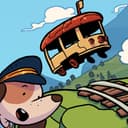
The premise is almost aggressively wholesome. Two dogs ride a train around the world, and the job on each hand-crafted board is to place, remove, and bend railway track so that numbered carriages roll off, avoid one another, and couple to the locomotive in the correct order. That’s it. That’s the whole game. And from that single constraint, Afterburn wrings out more than 240 puzzles across multiple scenic regions, each introducing a new train-flavored mechanic: tunnels that teleport carriages across the map, timed crossing barriers that hold cars in place, switches that alternate routes with every pass, and — added in a post-launch anniversary update — dual locomotives that double the choreography.
The market positioning matters here. The mobile puzzle space is a landfill of ad-riddled match-three clones, and premium puzzle games live or die on word of mouth. Railbound earned its word of mouth the hard way: a 4.8/5 App Store rating and a reputation as one of the more polished premium puzzlers on any platform. It ships on iOS, Android, PC/Mac, and Nintendo Switch, with the PC version adding a level editor with Steam Workshop sharing — a rare gesture of longevity in a genre that usually ships finite and stays finite. This is the boutique end of the puzzle market, and Railbound sits comfortably near the top of it.
Key features
- Order-based track routing: Numbered carriages must reach the locomotive in sequence without colliding. Every puzzle is a small logistics problem disguised as a picture book.
- Escalating train mechanics: Tunnels, timed barriers, alternating switches, and dual locomotives layer in world by world — each one recontextualizes everything learned before it.
- 240+ hand-crafted puzzles: No procedural filler. The difficulty ramps from gentle onboarding to optional brainteasers that can genuinely stall a solver.
- Level editor with Steam Workshop: The PC version lets the community keep the puzzle supply flowing after the campaign runs dry.
- Free post-launch content: The anniversary update added new regions and the two-locomotive mechanic at no extra cost.
Analysis
The Gameplay Loop
Every great puzzle game has a core verb, and Railbound’s is bend. Each board gives a limited budget of track pieces, and the tension comes from a beautifully simple economy: the direct route almost never works. Carriage 2 will beat carriage 1 to the coupling. Two cars will meet head-on in a corridor. The obvious solution fails, and the game trusts the player to sit with that failure until the reframe clicks — usually a detour, a deliberate delay, or a loop that sends a carriage the long way around so its sibling can pass.
That moment of reframe is the whole product, and Afterburn manufactures it with unusual consistency. The best comparison is Simon Tatham-style logic purity meets Monument Valley’s warmth — every puzzle is deterministic, readable at a glance, and solvable entirely in your head before you commit. There’s no execution skill, no timing, no luck. When a solution fails, the game replays the collision so the exact break in logic is visible. That replay is quietly the best teaching tool in the game: it never tells you the answer, but it always tells you the question.
Mechanical Layering
The pacing of new mechanics deserves specific praise, because this is where most puzzle games fall apart. The typical failure mode is either front-loading everything (overwhelming) or padding each mechanic past its welcome (boring). Railbound does neither. Tunnels arrive just as flat routing starts feeling solved, and they explode the possibility space — suddenly the board’s geometry is non-Euclidean. Timed barriers introduce tempo as a resource: routing carriages becomes a matter of scheduling them. Switches add state that changes as trains pass, which turns late-game boards into small programs executed mentally.
By the time dual locomotives show up, the problems being solved would look incomprehensible in world one, and the game never had to write a paragraph of tutorial text to get there. That’s design discipline doing the work of a manual.
Difficulty and the Optional Tier
The main path is approachable — a patient newcomer should clear most regions without walls. The real meat is the optional brainteaser tier, marked puzzles that are legitimately hard in a way premium mobile games rarely risk. These are the boards that follow a player off the device and ambush them in the shower. The one structural criticism: there aren’t enough of them. The hardest tier is where Railbound’s design is most alive, and the campaign leaves you wanting another two worlds of it. The Steam Workshop editor partially answers this on PC, but console and mobile players get no such relief valve.
The other honest knock: Railbound innovates within its formula, not on it. If you’ve played Cosmic Express or Trainyard, the DNA is familiar. Railbound executes better than both — cleaner reads, better pacing, warmer presentation — but it refines a lane rather than inventing one.
Visuals & performance
The comic-book art style is doing more work than it looks like it’s doing. Thick outlines and flat, warm colors are an information design choice as much as an aesthetic one. Track, carriages, obstacles, and interactive tiles are all instantly distinguishable at a glance, which matters enormously in a game solved visually. Nothing shimmers, nothing distracts, and the scenic region themes (each with its own palette) keep 240 puzzles from visually blurring together.
The soundtrack is gentle, melodic, and mercifully unobtrusive — the kind of score built to dissolve into long solving stretches. As for performance, a 2D grid game of this scope is light on hardware by design, and there’s nothing in the technical setup that should worry anyone on a phone, PC, or Switch.
Platform nuances
- iOS/Android: The native habitat. Drawing track with a fingertip is the most direct version of the interaction, and puzzle lengths fit commute-sized sessions perfectly. The premium, ad-free model is a relief on mobile. The Apple Vision version exists as a curiosity — pleasant, not transformative.
- Steam (PC/Mac): Mouse input suits the precision this game demands, but the real argument for this version is the level editor and Workshop. If you intend to exhaust the game and keep going, this is the platform. It’s the only version with a meaningful content afterlife.
- Nintendo Switch: Built for handheld mode, where touch controls carry over intact. Docked play with a controller cursor is serviceable, but the design is about direct manipulation, and a d-pad adds friction the touch and mouse versions don’t have.
If you’ll only buy once: PC for the editor, mobile for the ergonomics. Switch is the compromise pick, best for handheld players.
Final verdict
Railbound is what happens when a studio respects its players’ intelligence and their time in equal measure. It never pads, never condescends, and never asks for anything beyond its up-front price. The formula isn’t new, but the execution is consistently excellent — and in a genre defined by craft, execution is the product. Afterburn has quietly become one of the most reliable puzzle studios working, and Railbound is the strongest evidence yet. The one real complaint is that the top end isn’t crueler, longer, or harder. That’s the best kind of complaint a puzzle game can earn — and the main reason this lands as a strong recommendation with reservations rather than an unqualified one.
Reviewed by the Rankeno Puzzle & Casual Desk. Scores are out of 10; the overall score is the desk’s editorial judgement, informed by the four sub-scores above. How we review