Overview
Nobody has made another King of Dragon Pass. That’s the first thing to understand about A Sharp’s 1999 oddity, and it’s the most damning thing that can be said about the strategy genre. In the decades since, an industry that clones everything has failed to replicate a game built by a tiny studio around a simple, radical premise: what if the storytelling engine was the strategy engine?
You lead a clan of Bronze Age Orlanthi settlers into Dragon Pass, a haunted frontier in Glorantha — Greg Stafford’s mythic world, the same setting that underpins RuneQuest and 13th Age. Your job is survival first, then prosperity, then something grander: uniting the fractious tribes and crowning a King or Queen of Dragon Pass. Between you and that throne sit droughts, cattle raids, duck people, trickster cults, dragon politics, and roughly 600 hand-painted interactive scenes that fire based on your clan’s circumstances, history, and gods.
The structure is a hybrid that predates the vocabulary we’d now use to describe it. It’s a roguelike-adjacent narrative sim before “narrative sim” existed, a choice-and-consequence engine shipping years before Telltale, a procedural storyteller before Crusader Kings II made emergent drama a marketing bullet. HeroCraft’s ports brought it to iOS, Android, and Steam largely intact — which is both a gift and the source of every legitimate complaint about it.
The reception record backs the legend: 4.8 out of 5 from 210 ratings on the App Store. The game’s reputation endures for a reason. It was underplayed in 2011, and it’s still underplayed now.
Key features
- Myth as Mechanics: Heroquests send your leaders into the god-world to physically re-enact divine myths. Succeed and you reshape your clan’s fortunes; fail and a beloved noble may come back broken — or not at all. No other game treats religion as a playable system with this much conviction.
- The Clan Ring: A council of seven advisors, each with distinct skills, cult affiliations, and biases. Your war leader wants blood. Your Issaries trader wants markets. They’re frequently wrong, occasionally brilliant, and always in character — a diegetic tutorial and a cast of characters in one.
- Generational Consequence: Decisions ripple across decades of in-game time. Insult a neighboring clan in year three and their grandchildren will burn your steads in year thirty. The game remembers everything, and it holds grudges better than you do.
Analysis
The Loop That Shouldn’t Work
The core loop is simple: each season, you allocate labor across farming, herding, crafting, and defense, then respond to whatever the event engine throws at you. A stranger arrives claiming kinship. Elmali horse-nomads demand tribute. Your carls report a talking cow. Each scene presents four to six responses, and your Ring weighs in with advice that ranges from shrewd to catastrophically self-interested.
Here’s what makes it sing: the “correct” answer depends on context the game never surfaces directly. Gloranthan cultural logic — generosity earns standing, oath-breaking curses your bloodline, trickery has its place but a price — governs outcomes more than any visible stat. The game teaches its world the way a real culture is learned: by punishing ignorance. When the logic behind sacrificing to Ernalda before a harvest finally clicks, or why a guest must never be cheated, the knowledge feels earned in a way no tooltip could deliver.
The strategy layer underneath is genuinely load-bearing. Cattle are currency, dowry, and sacrificial capital. Weaponthanes eat resources but deter raids. Magic points harvested at the annual Sacred Time ceremony must be allocated across the year’s priorities, and shorting your war magic in a raid-heavy year gets people killed. The economy is tight enough that pure roleplaying without arithmetic will bury a clan by year five.
Where It Punishes
The learning curve isn’t a curve; it’s a cliff face with occasional handholds. The manual is nearly required reading, the mechanics governing event outcomes are deliberately opaque, and early clans are designed to die confusingly. Some of that opacity is design philosophy — the game wants players reasoning like chieftains, not optimizing like accountants — but some of it is 1999-era hostility to onboarding, full stop. A modern designer would surface the difference between “this failed because the dice hated you” and “this failed because you sent a diplomat with the charisma of wet leather.” King of Dragon Pass shrugs and lets you wonder.
The long game also softens. Once a clan is rich and feared, the mid-game settles into a comfortable rhythm of raid-harvest-sacrifice, and only the tribal-unification endgame and the rarer long-arc event chains reintroduce real tension. Short episodes and autosaving mitigate this — the game is honest about being a snacking experience — but a fifteen-hour campaign has a saggy middle third.
None of that dislodges the central achievement: replayability that emerges from systems, not content gates. A war-focused Humakti clan and a trade-focused Issaries clan don’t just play differently; they see different events, get different advice, and fail in different ways. The 600 scenes aren’t a checklist. They’re a deck the simulation deals from, and the hand changes every run.
Visuals & performance
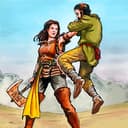
The hand-painted art is the game’s second miracle. Every scene gets a gouache-style illustration with a distinct, storybook-meets-Bronze-Age sensibility — no photorealism, no fantasy-airbrush clichés, just confident illustration that has aged the way good book covers age, which is to say barely. The character portraits on your Ring do heavy lifting, giving faces and implied inner lives to what are mechanically stat blocks.
The UI around that art has aged like the rest of 1999. Static screens, dense text panels, navigation that assumes patience. HeroCraft’s ports cleaned things up for modern resolutions and touch, but this is a restoration, not a remodel. Performance, at least, is a non-issue by design — a 2D game of this scope is light on hardware, and the constant autosaving means progress is rarely at risk. Clans will still be lost, but that’s on the chieftain.
Platform nuances
- iOS: The definitive version, and the 4.8 store rating reflects it. The scene-and-choice structure was accidentally built for touch two decades early — tapping through an event on a phone maps naturally onto the format, and the seasonal turn structure suits short sessions perfectly. Small-screen text density is the only friction, and it’s minor on anything larger than an SE.
- Android: Functionally identical to iOS via HeroCraft’s port. Same strengths, same small-text caveat on compact devices.
- Steam: The awkward middle child. Mouse input is fine but the interface visibly wasn’t designed for a 27-inch monitor — art scaled past its intended size, layouts that read as “big phone screen.” Desktop players get the same brilliant game wrapped in the least flattering frame. If there’s a choice, a tablet is the better home.
Final verdict
King of Dragon Pass demands things modern games have trained us out of giving: patience with failure, comfort with opacity, and a willingness to read. In exchange it offers something almost nothing else does — a strategy game where culture, religion, and myth aren’t flavor text but the actual machinery, and where losing a clan to a heroquest gone wrong produces a better story than most games’ scripted campaigns. The interface is dated, the difficulty is real, and the Steam port is merely adequate. We recommend it anyway, ideally on a tablet: go be a chieftain. Decades of imitators haven’t touched it because nobody else has been brave enough to try.
Reviewed by the Rankeno Strategy & Sim Desk. Scores are out of 10; the overall score is the desk’s editorial judgement, informed by the four sub-scores above. How we review