
Overview
Every turn-based strategy game since Advance Wars has trained you to read a grid, mass your units, and delete the enemy. Foolish Mortals Games, working under designer Michael Long, built an entire campaign around taking that away from you.
In Kaiju Wars, you are simultaneously the military commander and the mayor of Floatio City, a pixel-art metropolis about to be flattened. A three-hundred-foot lizard is walking toward your downtown, and your tanks do essentially nothing to it. Your jets do slightly less than nothing. The win condition is not elimination — it’s survival until the timer runs out, while your scientists finish a counter-serum somewhere off-screen. Everything you build, every unit you deploy, is a speed bump.
This is a deliberate and unusually confident pitch in a genre that has spent two decades iterating on the same core verb. The commercial reality reflects that: it’s a niche success rather than a breakout. Reception has been warm but measured — a sharp, idiosyncratic design that finds its audience and then asks a lot of them.
Positioning-wise, it slots into the same shelf as Into the Breach — another game about protecting buildings from monsters you can’t out-muscle — but where Subset Games went austere and puzzle-pure, Foolish Mortals went loud, campy, and systems-maximalist. There’s a Project card deck. There’s an ACE promotion economy. There’s base construction, a map editor with Workshop support, weekly leaderboard challenges, a local versus mode where a second player pilots the kaiju, and Twitch chat integration. It is a small studio’s game with a big studio’s feature list, and the seams show in both directions.
Key features
- The Unkillable Kaiju: You cannot win by damage. Monsters absorb everything, regenerate, and escalate. Victory means surviving a turn count, which reframes every unit you own as ablative armor rather than a weapon.
- Buildings as Bait: Kaiju pathfind predictably toward the nearest structure. Airfields, factories and city blocks become deliberate sacrifices — you place them to steer a monster into the long way around the map. This is the game’s real combat system.
- Project Card Deck: Between missions you assemble a deck of airstrikes, reinforcements, terrain effects and experimental hardware, drawn during battle. It grafts light deck-building onto a grid tactics chassis, and mostly it takes.
- ACE Progression: Surviving units earn medals and promote into named veterans with real stat advantages, giving you a reason to occasionally not feed a tank to the monster.
- Extras with Actual Legs: A full map editor with Steam Workshop sharing, weekly leaderboard challenges, local versus (one player as the kaiju), and Twitch chat integration for streamers.
Analysis
The Gameplay Loop
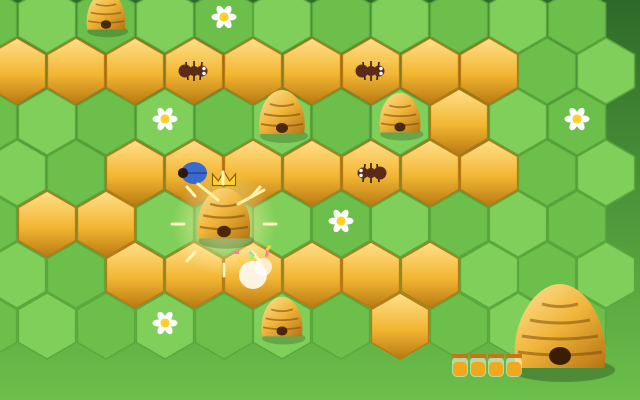
The opening stretch of Kaiju Wars is a re-education. You will send tanks at the monster. You will watch the damage number appear — small, insulting, almost decorative — and you will watch that damage regenerate. Then something clicks: the damage was never the point. Attacking a kaiju staggers it, distracts it, occasionally reroutes it. Your units are not artillery. They’re a matador’s cape.
Once that lands, the game opens up into something genuinely novel. Each map becomes a spatial problem: the monster wants the nearest building, so where you build determines where it walks. Drop an airfield on the far east edge and you’ve bought four turns of the kaiju marching away from your research facility. Those four turns are the currency. Everything — the cannon-fodder tanks, the submarines, the freeze rays, the mecha — exists to purchase turns.
It’s a rare strategy game where the correct play is frequently to throw something valuable into a woodchipper, and the emotional texture of that is unusual. You’re not optimizing a kill chain. You’re triaging a disaster.
Where the Systems Fight Each Other
The Project card deck is the most contested piece of the design, and the criticism is fair. Layering a draw-based randomizer over a genre defined by perfect information creates friction that isn’t always productive. When you need an airstrike on turn six and the deck hands you a terrain modifier, the failure doesn’t feel like a mistake you made. It feels like weather.
Kaiju pathing compounds this. The monsters are mostly predictable, which is the load-bearing assumption behind the entire bait-and-misdirect puzzle. When they deviate — and they do — a plan that was six turns in the making evaporates. In a game where a single mispositioned building loses the map, “mostly predictable” is a meaningful gap between the design’s promise and its delivery.
The Difficulty Wall
Act Two is where Kaiju Wars stops being charming and starts being demanding. The recurring complaint around the game is the same: difficulty spikes hard, and the design leans heavily on trial-and-error retries. Many missions are effectively puzzles wearing a strategy game’s clothes — there is a solution, you don’t have the information to find it on a first attempt, and the intended learning method is failure.
Some players love this. It’s the Into the Breach contract, and it produces real satisfaction when a map finally cracks. But Into the Breach ran short, tight missions. Kaiju Wars runs sprawling city sieges, and restarting a long map because you learned late that you needed a different deck is a structural mismatch between mission length and iteration cost. That’s the sharpest criticism of the game, and it’s not a difficulty complaint — it’s a pacing one.
Onboarding and Objectives
Onboarding friction is moderate. The game explains its systems adequately but doesn’t quite explain its philosophy — the mental shift from kill to stall is left for you to discover through defeat, which is thematically appropriate and practically annoying. Meanwhile, over the long campaign, mission objectives start to rhyme. “Survive N turns” is a flexible frame, and the game varies it with escort tasks and structure defense, but by the back half you feel the repetition. Five distinct kaiju across global locations does real work here, since each monster forces a different threat model, but variety of opponent isn’t the same as variety of goal.
Visuals & performance
The pixel art is the least complicated thing to praise. Foolish Mortals nailed the 1960s Toho B-movie register without tipping into parody-of-a-parody: chunky sprites, saturated destruction, newspaper-headline interstitials, and a script that knows exactly how seriously to take itself, which is barely. The campiness is a genuine achievement, not set dressing. Games that attempt this tone usually wink too hard.
Technically, a 2D turn-based game of this scope is light on hardware, and there’s little in the design that should get between you and the grid. The UI is the weak spot. There’s a lot of state to communicate here: unit health, kaiju behavior, card hand, building placement, turn counters. On a large display it’s dense but legible. Shrink it, and it stops being either.
Platform nuances
Steam is the definitive version. Mouse and keyboard suit a game built on precise tile placement and hovering to read unit tooltips, and the PC build is where the ecosystem actually lives — the map editor, Workshop sharing, weekly leaderboards and Twitch integration are all functionally PC-native features. If you intend to engage with the community layer at all, buy it here.
Nintendo Switch is a reasonable port with one real caveat: UI and text readability are built for a monitor, not a handheld screen. The interface was designed for a display, and compressing dense overlays and small stat text onto a portable screen asks for a squint. Docked, the problem largely disappears. Controller navigation of a grid is fine — this genre has been solved on consoles since the GBA — but the cursor-driven menus are slower than a mouse. Given that this game asks you to re-read a board carefully before committing to turns you can’t undo, a readability tax is not cosmetic. Handheld-first buyers should know what they’re getting.
Final verdict
Kaiju Wars is the kind of game that only gets made by a small team with a specific obsession, and it’s better for it. The central conceit isn’t a gimmick — it restructures every decision you make, and once you internalize that your units are currency rather than force, the design reveals a real intelligence underneath the rubber-suit charm.
But it doesn’t fully stick the landing, and the problems come first. The Project card randomness sits awkwardly against a genre built on knowing everything, the second act’s difficulty curve turns steep without adequately preparing you for it, and the retry-heavy structure asks for a patience that its long mission lengths actively punish. These are real flaws, not quibbles, and they’re why we rate this a mixed recommendation rather than an easy one.
The flaws are the flaws of ambition, not laziness. Foolish Mortals made a turn-based strategy game about stalling a monster instead of killing it, built a full campaign, a versus mode, a map editor and a Workshop pipeline around it, and priced it like an indie at $19.99. Buy it on Steam if you have the choice — and only if long, punishing retries sound like your kind of evening. Go in expecting to lose buildings on purpose. That’s the game.
Reviewed by the Rankeno Strategy & Sim Desk. Scores are out of 10; the overall score is the desk’s editorial judgement, informed by the four sub-scores above. How we review