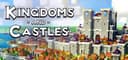

Overview
City-builders have a dirty secret: most of them are spreadsheets wearing a hat. You optimize adjacency bonuses, you balance budgets, and the “city” is really just a visualization layer over an economy sim. Kingdoms and Castles, from small indie studio Lion Shield, LLC, understands this — and pushes back in two smart ways. First, it simulates every peasant and every log of wood individually, so a settlement feels inhabited rather than abstracted. Second, it puts a sword to your throat. Vikings land on your shores. Dragons circle your granaries. Your pretty little hamlet is a target, and the game never lets you forget it.
That framing matters because Kingdoms and Castles launched into a crowded field in July 2017. Banished owned the survival-builder niche. Cities: Skylines owned scale. Stronghold, long dormant, owned castles. Lion Shield’s bet was that nobody owned the intersection: a builder where the fortifications you design are both expressive and load-bearing. The bet largely paid off, and the game has been iterated on through years of free updates (Infrastructure & Industry among them) plus optional DLC like Parks & Statues.
The result is a game with an unusually honest value proposition. It doesn’t pretend to be a grand strategy epic. It’s a focused, legible, tactile builder where the medieval fantasy — grow a village, raise a castle, repel the raiders — is delivered without friction or bloat. It’s a paid title on Steam at $9.99, and it has quietly become one of the genre’s more reliable recommendations.
Key features
- Freeform block-based castle construction: Walls, towers, and gates are assembled from stackable pieces rather than prefab structures. A fortress takes whatever shape you can imagine, and archer towers gain range with height, so verticality is a mechanic, not decoration.
- Fully simulated population and economy: Every villager is an individual with needs — housing, food, churches, taverns — and every resource moves through a real logistics chain of farming, forestry, mining, and trade.
- A world that fights back: Viking raiders arrive by sea to burn and pillage; dragons descend from the sky to torch food stores. Layout and defense planning have real consequences, which is rarer in this genre than it should be.
- Living presentation: A stylized procedural cloud system and a full seasonal cycle — lush summers into snow-blanketed winters — keep the voxel world visually alive across long campaigns.
- AI neighbor kingdoms: Trade with them, ally with them, or go to war. It adds a diplomatic layer to what would otherwise be a purely inward-facing sim.
Analysis
The Loop
The core loop is classic and cleanly executed: settle, feed, house, expand, fortify, survive. What distinguishes it is pacing. The early game is about scarcity — one bad harvest before winter can starve a family, and because villagers are individually simulated, that loss is specific and visible. That specificity gives the early game an emotional weight most builders can’t manufacture. When a Viking longship burns a house, someone lived there.
The economy is a genuine chain, not a slider. Wheat becomes bread through farms and bakers; stone moves from quarry to mason to wall. Nothing here is revolutionary — Banished did the survival math harder, and Anno does logistics deeper — but Kingdoms and Castles executes with unusual legibility. You can look at your town and read its economy at a glance. That readability is a design achievement, and it’s why the game onboards newcomers so gently while still rewarding players who min-max granary placement.
The Castle Is the Point
The block-based fortification system is the game’s signature, and it earns the billing. Because walls are freeform, defense becomes a spatial design problem rather than a checkbox. Do you ring the whole town and stretch your garrison thin? Build a citadel and accept that outlying farms will burn? Funnel raiders through a killbox gate under three-story archer towers? The height-equals-range rule is the quiet stroke of genius here — it makes tall, dramatic, castle-looking castles mechanically optimal. Form and function point the same direction, which almost never happens in this genre.
The threats give that design work stakes. Vikings probe your coastline; dragons ignore your walls entirely and go for the food supply, forcing you to think about redundancy and dispersal, not just perimeter. For a substantial stretch of the early and mid game, this tension is the game’s engine.
Where It Runs Thin
Here’s the firm part of the critique: the game plateaus. Once your economy is self-sustaining and your walls are tall, the threat model stops evolving. Experienced players can trivialize Vikings with tower spam and dragons with distributed granaries, and the mid-to-late game goes soft. The AI kingdoms help less than they should; diplomacy and war are functional but shallow, more flavor than system. Lion Shield’s post-launch updates have added breadth (industry chains, decorative content) but haven’t fundamentally deepened the endgame. This is a game of moderate length wearing the clothes of a 200-hour one, and it’s best bought knowing that.
We’d rather have this problem than the opposite one. A game that respects your time and ends gracefully beats a bloated sim that mistakes tedium for depth. But the job here is to name the ceiling, and this one is visible.
Visuals & performance
The voxel aesthetic is a deliberate, disciplined choice, not a budget compromise. Buildings read instantly at any zoom level, seasons transform the palette meaningfully, and the procedural cloud system — drifting, puffy, casting real shadows — does more atmospheric work than most AAA weather systems. It’s the kind of art direction that ages well precisely because it never chased realism.
A game simulating every citizen individually is inherently demanding at scale, and large late-game cities are built to tax the simulation as population climbs; a 2D-styled voxel game of this scope is nonetheless light on hardware by design. The UI is clean and mostly stays out of your way, though the production-chain information could surface more proactively — the menus make you dig to diagnose why bread output cratered.
Platform nuances
On Steam, this is the game in its natural habitat. Mouse-and-keyboard is the right instrument for freeform block placement — dragging wall segments, fine-tuning tower positions, and painting farmland are tasks built for that precision. Steam is also where the game’s long tail lives: years of free content updates arrive frictionlessly, and the game’s modest system requirements make it a strong candidate for aging laptops — an excellent “second machine” game. We recommend the PC version as the definitive way to play.
Final verdict
Kingdoms and Castles knows exactly what it is, and that self-awareness is its greatest strength. Lion Shield built a focused, warm, mechanically honest city-builder where the fortress on the hill is both your creative canvas and your insurance policy — and then supported it for years without nickel-and-diming its audience. The endgame runs out of teeth, and hardcore strategists will crave systems this game was never trying to build. But judged on its own terms — as an arc from starving hamlet to snow-dusted citadel — it succeeds more often than not. We rate it a solid Good: recommend it to the right audience, with eyes open about its ceiling.
Reviewed by the Rankeno Strategy & Sim Desk. Scores are out of 10; the overall score is the desk’s editorial judgement, informed by the four sub-scores above. How we review