
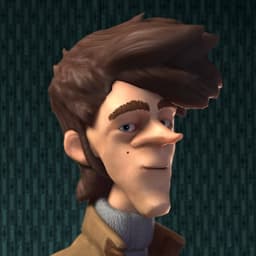
Bottom Line: Trüberbrook is the best-looking point-and-click adventure of the last decade and one of the least demanding — a ten-hour walk through hand-built miniature sets with a Cold War conspiracy thinly stretched over the top. Buy it for the craft, not the puzzles.
The Gameplay Loop
Trüberbrook's loop is the oldest one in the genre and it makes no apologies. You arrive somewhere. You click on everything. You pick up the four things that aren't nailed down. You talk to whoever is standing around until their dialogue tree runs dry. You combine two items, a door opens, you move on.
What's changed is the difficulty curve, and this is where the game makes its most consequential design decision. btf clearly looked at the genre's history of moon-logic puzzle design and decided the story was the point, so the obstacles were tuned down until they stopped interrupting. Almost nothing here will stop you for more than five minutes. The solutions are usually the only thing you're carrying that could plausibly work, and the game's small inventory means brute force is always available and rarely necessary.
I want to be fair to that choice, because it's a defensible one. Narrative momentum is real, and an adventure game that grinds to a halt for two hours over a rubber chicken is not a better game — it's just an older one. But there's a difference between fair and absent, and Trüberbrook keeps stepping over that line. A puzzle that resolves the instant you find the item isn't a puzzle. It's a fetch quest with better dialogue. When the game does reach for something more involved — a couple of mid-game sequences involving the physics equipment genuinely click — you feel the shape of what this could have been, and then it retreats to safety.
The difficulty is also uneven in a way that reads as inexperience rather than intent. Two or three moments spike sharply out of nowhere, usually because a hotspot is small or an object reads as background scenery rather than something interactive. That's not challenge; that's a legibility failure, and it's the one kind of friction the game should have designed out.
Story and Character
The writing is the second-best thing here, and it's carrying real weight. Trüberbrook is at its strongest in its first two-thirds, when it's mostly a village comedy with an unease running underneath — eccentric locals, a hotel with too many rules, a valley that doesn't want to be measured. The cast is memorably sketched. Gretchen, the anthropologist you fall in with, has actual comic timing. The tonal register — nostalgic postwar German cinema, gently sent up, slowly poisoned — is specific and confident in a way very few games attempt.
Then the third act arrives, and the game visibly runs out of road. Threads get bundled rather than resolved. Character motivations that were being carefully built get flattened into exposition. The ending doesn't land so much as stop, and enough players have said so independently that this isn't a taste issue — it's a production one. Something got cut, or the schedule ran out, and the last two hours are where you can feel the seams. Given that this is a ten-hour game, losing the final act to a rush is a much bigger percentage loss than it would be in a forty-hour RPG.
Interface and Friction
The control scheme is the least loved part of the package, and the complaints are legitimate. Navigation is stiffer than it should be: pathfinding hesitates, walking between hotspots takes longer than your patience allows, and the cursor doesn't always communicate what's interactive with enough confidence. There's a hotspot highlight, thankfully, and you'll lean on it more than the designers probably intended.
This is the recurring theme. Every rough edge in Trüberbrook is an interaction problem, never an art or audio problem. The people who built this knew exactly how to make a scene look and sound extraordinary. They were still learning how to make a room feel good to move through.


