Overview
Most wargames treat supply as an accounting problem. A number in a sidebar. A modifier applied quietly during the combat resolution step, noticed only when your panzers inexplicably fail to take a hex they should have crushed. Unity of Command II inverts that entirely — supply is the game, and everything else is set dressing.
Released 12 November 2019 by Croatian studio 2x2 Games, with co-production from Croteam (yes, the Serious Sam people, which explains the surprisingly capable custom 3D engine underneath), UoC II is the sequel to a 2011 cult hit that earned its reputation on the Eastern Front. The sequel flips the perspective: you command Western Allied forces through a branching campaign running from the North African desert, up the Italian boot, and into Northwest Europe. Several marquee battles let you take the Axis side.
This is not Gary Grigsby’s War in the East. It is also not Panzer General. UoC II occupies a deliberately awkward middle ground that almost nobody else has managed to hold — operational scale, hex-and-counter DNA, but with an onboarding curve measured in minutes rather than weekends. The tutorial doesn’t hand you a 200-page PDF. It hands you a broken front line and lets you figure out why your breakthrough stalled.
Market-wise, it landed in a genre that had spent a decade fragmenting between accessible arcade-strategy (Panzer Corps) and grognard simulations that demand spreadsheet literacy. UoC II refused to pick a lane, and the reception validated the gamble: the game holds a Metacritic score of 88, and the Steam community has settled at Very Positive overall.
The recent review window tells a different story, sitting at Mixed. More on why that happened later, because it has almost nothing to do with the game’s design and everything to do with how it was sold.
Key features
- Supply Lines as the Core Combat System: Every unit traces a logistics line back to a depot. Cut that line and the unit doesn’t just lose a combat bonus — it starts dying. Encirclement isn’t a bonus objective, it’s the win condition disguised as a tactic.
- Persistent Headquarters Meta-Layer: Between battles you reorganize divisions, attach specialists, and unlock command abilities. Your HQ carries forward across the campaign, turning individual scenarios into chapters rather than isolated puzzles.
- Theater Assets: Aerial recon, strategic bombing, sabotage, and partisan actions operate above the tactical layer, giving you strategic verbs that don’t reduce to “move stack, click attack.”
- Fog of War with Teeth: Intelligence must be earned through reconnaissance and prisoner interrogation. You are frequently guessing, and the game is honest about the fact that you’re guessing.
- Branching Alternate History: Bonus objectives unlock alternate campaign paths. Outcomes ripple forward, so a costly victory in Sicily reshapes what you’re handed in Normandy.
- Scenario Editor + Steam Workshop: A genuine, first-class editor shipped in the box — not a modding afterthought — with Workshop distribution.
Analysis
The Gameplay Loop
Here’s what makes UoC II click: the game is about geometry, not attrition.
In a conventional wargame, you win by having better units and grinding the enemy’s stack down. Combat resolution is the interesting part. In UoC II, frontal combat is almost always a mistake — expensive, slow, and strategically inert. What you want is a hole. Punch through a soft sector, drive an armored spearhead deep behind the line, sever the enemy’s connection to their depot, and watch three divisions you never fought suddenly become non-functional. It is the difference between arm-wrestling and judo.
That single design decision reorganizes everything downstream. Your recon units matter because you need to find the soft sector. Your armor matters because only armor exploits fast enough. Your infantry matters because someone has to hold the shoulders of the breakthrough while the tanks run. The unit roster stops being a power hierarchy and becomes a set of tools with distinct jobs. It’s one of the most elegant arguments for combined arms in a hex game.
The turn structure reinforces this. Scenarios run on tight turn limits, and the objectives are usually geographic. You cannot turtle. You cannot trade evenly and call it a win. The clock forces you to gamble, and the supply system means gambles compound — a breakthrough that succeeds accelerates, a breakthrough that stalls leaves your spearhead cut off from its own depot and dying by the same rules you were trying to apply to the enemy. The symmetry is vicious and completely fair.
The Headquarters Layer
Between battles, the HQ screen is where UoC II tries to be a campaign game rather than a scenario collection. You allocate divisions, attach specialists — engineers, bridging units, artillery observers — and spend prestige on command abilities. It works, mostly. Attaching the right specialist to the right formation before a river-crossing scenario is designed to feel like actual staff work, and the system rewards building a corps around a preferred style of play.
But the layer is thinner than its presentation implies. The decision space is narrower than the interface suggests, and after a few campaigns most players will converge on a preferred build and stop agonizing. It’s a good system that wants to be a great one. Compared to the tactical layer’s depth, it reads as supporting material.
The Interface Problem
Now the part that keeps UoC II out of the pantheon.
The math is opaque. When you queue an attack, the game shows you percentages. Those percentages are the product of terrain, supply state, unit quality, specialist attachments, entrenchment, and support fire — and the game is unwilling to fully show its work. Air strikes are the worst offender. You commit an asset, you get a result, and the causal chain between the two is frequently a mystery. This isn’t a minor UX complaint in a genre built on informed decision-making. When you can’t audit why a plan failed, you can’t learn from it — you just develop superstitions.
This is the most consistent complaint across the Steam reviews, and it’s legitimate. The tooltip system does gesture at explanation, but it’s layered, inconsistently detailed, and requires hovering discipline that breaks the flow of planning a turn. A wargame’s interface has one job: make the state of the board legible. UoC II makes the board beautifully legible and the rules frustratingly less so.
Pair that with the occasional difficulty spike — a handful of scenarios that demand a near-optimal opening you can only discover by failing first — and you get a game that intermittently feels like it’s withholding information it should be giving freely. Adjustable difficulty settings blunt this, and newcomers should use them without shame. But a slider is a workaround, not a fix.
None of this dislodges the core. A long branching campaign, a design idea nobody else has executed this cleanly, and a genuine reason to replay for the alternate-history paths. The friction is real. So is the achievement.
Visuals & performance
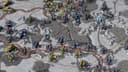
The custom 3D engine is the quiet hero. UoC II looks like a beautifully produced strategic map that happens to be rendered in three dimensions — dioramic, tactile, with units as stylized counters on terrain that reads instantly. Croteam’s involvement shows in the technical polish: a 3D game of this scope is light on hardware, which matters in a genre where the graphical bar has historically been “functional.”
The aesthetic direction is confident. Muted period palettes, clean iconography, terrain you can parse at a glance from any zoom level. It never sacrifices readability for spectacle, which is the correct priority and a discipline plenty of prettier strategy games fail.
The UI is a different verdict. Visually it’s clean and well-composed. Informationally it’s the weakest system in the game — critical numbers buried, calculation chains hidden, and a general assumption that you’ll intuit relationships the game never states. Form winning a narrow victory over function.
Platform nuances
This is a Steam release ($29.99), with Windows, macOS, and Linux/SteamOS builds — genuinely maintained, not token ports, which puts it ahead of most of its genre peers on Mac and Linux.
Mouse and keyboard is the only sane input. It’s a game of precise hex selection and hover-to-read tooltips, and that’s exactly what a pointer is for. Steam Deck is playable in a pinch given the Linux support, but the tooltip-dependent interface fights small screens and trackpad input. Treat handheld as a bonus, not a use case.
The Workshop integration is the platform’s real value-add here. A first-party scenario editor plus Workshop distribution means the community campaign library is a legitimate extension of the game’s lifespan, and it’s the best answer to the DLC pricing gripe short of a sale.
Speaking of which: the DLC volume is the reason recent reviews sit at Mixed. Blitzkrieg, Barbarossa, Stalingrad, Kursk, Berlin and more, each extending the Eastern Front or desert theaters, each priced separately. Individually they’re substantial and well-made. Collectively they present a storefront where the complete experience costs several times the base game. Buy the base game first. Buy the campaigns you actually want, on sale, one at a time.
Final verdict
Unity of Command II is the wargame we recommend to people who think they don’t like wargames. That dual citizenship — approachable enough for newcomers, demanding enough for veterans — is rare. 2x2 Games found a mechanic — supply as the primary axis of combat — and had the discipline to build the entire game around it instead of bolting it onto a conventional design.
What holds it back is a refusal to show its work. In a game this cerebral, hiding the math isn’t mystique, it’s friction. Fix the tooltips and the air-strike opacity and this would be an easy recommendation across the board. The DLC strategy has also soured a community that otherwise embraces the game — a self-inflicted wound visible in that Mixed recent-review score.
Buy the base campaign, learn to think in supply lines, and let the DLC wait for a sale. For the right audience, there is nothing else quite like it — but the friction keeps it from being an easy one for everyone.
Reviewed by the Rankeno Strategy & Sim Desk. Scores are out of 10; the overall score is the desk’s editorial judgement, informed by the four sub-scores above. How we review