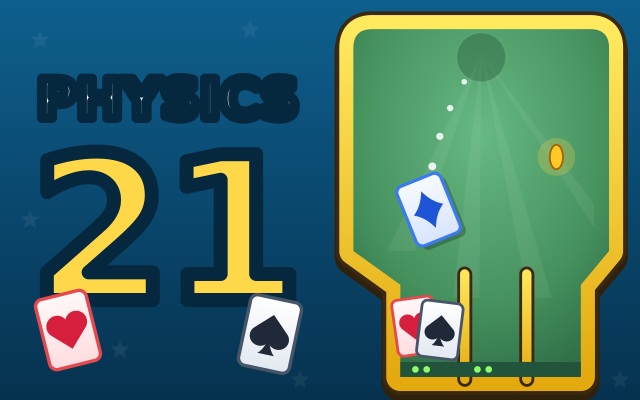
Bottom Line: Inti Creates took Mega Man Battle Network's grid, welded it to a Slay the Spire-shaped run structure, and then buried the whole thing under 300 voiced characters and 50 original vocal tracks. It's overstuffed, occasionally unbalanced, and one of the most confident genre hybrids in years.
The Gameplay Loop
Most deckbuilders are spreadsheets with art. You optimize a probability curve, you resolve it in a straight line, and the interesting decisions all happen at the card-reward screen. Combat is arithmetic.
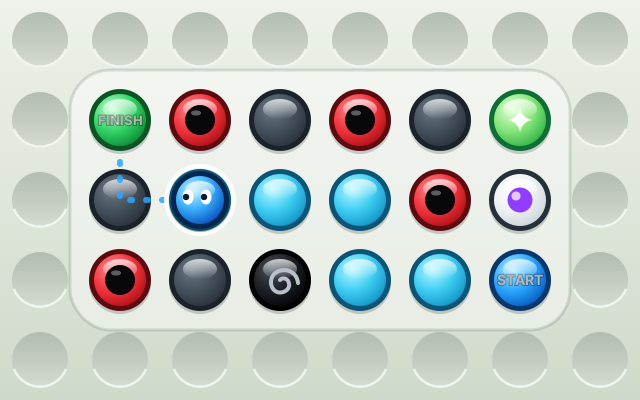
Card-en-Ciel breaks that by adding a second axis — literally. The 6x3 grid means a card isn't a value, it's a value plus a shape plus a position requirement. A card that hits the front column is a dead draw when the enemy retreats to the back. A card that clears a row is a war crime when three enemies line up and a shrug when they don't. Movement costs you tempo, so every turn is a negotiation between "play the best card in my hand" and "get to the tile where a card becomes the best card."
This is the design's central achievement, and it's why the community consistently cites positioning over draw luck as the reason the game holds up. Bad hands in a conventional deckbuilder are dead turns. Bad hands here are geometry problems. You reposition, you set up, you eat a small hit to make next turn devastating. The randomness gets converted into a puzzle instead of a tax.
The Card Economy
The card-as-character conceit could have been pure fan service. It isn't, because Inti Creates attached real mechanical weight to it. Leveling, duplicating, and fusing turn your collection into something you cultivate across dozens of runs, not something you assemble and discard. That's a meaningful departure from the genre's usual amnesia, where every run starts from a blank slate and the only persistent progress is unlock-gated variety.
There's a cost. A pool of 300+ cards is genuinely too large to hold in your head, and the game's onboarding does not adequately prepare you for that. Early runs involve a lot of squinting at unfamiliar characters trying to parse their attack shapes under time pressure. The information architecture is dense — arguably cluttered — and the learning curve is front-loaded in a way that will lose impatient players in the first two hours. That's a real design failure, not a matter of taste. A game with this much depth owes you a better ramp.
Difficulty and the RNG Problem
The most consistent criticism from players — and it holds up — is RNG swing in the later dungeons. The ten-tier difficulty system stacks rule modifiers, and the interaction between aggressive modifiers and unlucky event rolls can produce runs that are effectively decided before you've made a real decision. The design's defense is that modifiers are meant to be turned to your advantage, and clever builds genuinely can weaponize them. But that defense assumes system mastery the game doesn't reliably teach, and it doesn't fully account for the compounding variance at the top tiers.
The other honest knock: repetition. Ten-plus dungeons sounds like a lot until you're on run twenty-five and the event pool starts recycling. The 50+ random events are well-written, but a roguelite lives or dies on whether hour forty feels different from hour four, and the middle stretch sags.
The Story Problem
Pacing between battles is slow. The Gaming Chair Detective framing is charming and the dialogue is better than it has any right to be, but there is a lot of it, and it arrives in the gaps where a roguelite normally wants you clicking "next room." The rhythm of a run keeps getting interrupted by the rhythm of a visual novel. Both are fine. Together they fight.
And the crossover cast — this is the uncomfortable part — lands significantly harder if you already know Inti Creates' back catalogue. If you've played Gunvolt and Blaster Master Zero, the roster is a decade-long reunion. If you haven't, they're 300 anime strangers with good attack patterns. The mechanics carry it either way. The emotional payload does not.