Bottom Line: Heave Ho turns two floppy arms and a bottomless pit into one of the funniest, most chaotic couch co-op games around. It's short, it's punishing late on, and it's thin when you play alone, but with three friends on the sofa it's almost impossible to dislike.
The Gameplay Loop: Reach, Grip, Pray
Heave Ho's core loop is built on deliberate input friction. In most platformers, the designer's job is to remove the gap between intent and action. Mario jumps when you press jump. Heave Ho widens that gap on purpose. Wanting to reach a ledge is easy. Building the swing, timing the release and closing the right hand at the right moment is not.
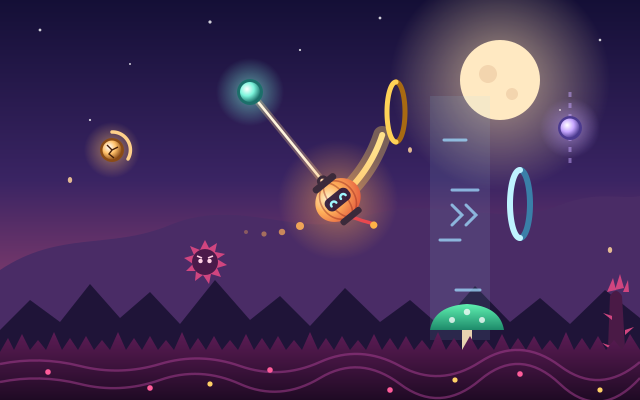
Solo, this plays as a dexterity puzzle. You learn the pendulum rhythm: build momentum with one arm anchored, release at the top of the arc, and reach with the other. It's satisfying when it clicks, and the physics are consistent enough that failures feel like your fault rather than the engine's. That consistency is the most important thing Le Cartel got right. Physics comedy only works when players trust the simulation. If outcomes feel random, the laughter turns into resentment.
The loop is short: try, fall, respawn, try again. Levels are compact, single-screen spaces, so a failed attempt costs seconds, not minutes. That pacing makes the high failure rate bearable.
Co-op: Where the Design Actually Lives
Add a second player and Heave Ho becomes a different game. Then a third. Then a fourth.
The killer mechanic is that players are grabbable objects. Your friend isn't just sharing the screen. They're terrain, rope and safety net. A group facing a wide gap might send its most confident player out on a swing while the others form an anchored chain behind them. When it works, it's a small piece of improvised engineering. When it doesn't, and someone lets go a beat too early, the whole chain drops into the pit together. That outcome is just as entertaining.
This is the game's real insight: failure is shared and readable. Everyone can see exactly who let go and when. That produces the yelling the marketing promises, but it's good-natured yelling, because blame is always one respawn away from redemption. The mid-air catch, where one player grabs a falling friend at the last possible moment, is among the best "you had to be there" moments in the genre.
It also creates a real social dynamic. Groups develop roles without being told to: the anchor, the swinger, the one who always falls. Few party games manage emergent teamwork this cleanly with this few rules.
Difficulty Curve: A Steep Final Climb
The criticism that later levels get "very hard and frustrating" holds up. Early worlds teach patiently. Later ones stack moving obstacles, collapsing blocks and long gaps that demand frame-tight timing from several players at once. Since the slowest link sets the pace in co-op, a mixed-skill group can hit a wall where the funniest game in the room turns into the most tense one.
That isn't automatically a flaw. Plenty of groups will treat the late game as a mountain to climb. But it does put the game at odds with its party audience. The players most likely to pick up Heave Ho, casual groups and family gatherings, are the least likely to enjoy its final stretch. The hidden gold coins address this well for skilled players by adding optional depth. Nothing equivalent exists at the other end, such as an assist mode or a gentler path for groups that just want to see the credits.
Single-Player and Versus
Solo play works mechanically, but it's emotionally hollow. The physics are just as good. What's missing is the audience, and Heave Ho is a game that needs one. Without someone to catch you or laugh at you, it becomes a precise but thin climbing puzzle. Buy it for solo play and you'll probably wonder what the fuss is about.
Versus mode is a smart reuse of the systems. Racing the same physics produces a different kind of chaos, built on grabbing an opponent's leg (well, arm) instead of lending them a hand. It's a good palate cleanser between co-op sessions, but it's a side dish rather than a reason to buy.
Length and Longevity
The game is fairly short, and the replay value depends on your group. Coin hunting and versus add some mileage. Still, this is a product you'll return to when friends visit, not one that fills a month of evenings. Given its typically modest price, that's an acceptable deal, as long as you go in with the right expectations.