Bottom Line: BirdNET is a serious scientific tool, and you can tell. It reliably identifies common birds by ear, costs nothing, shows no ads and every recording feeds real conservation research. It also asks more of you than it should, and its interface looks dated next to newer competitors.
The Core Loop: Record, Select, Submit
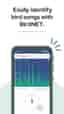
BirdNET's workflow is deliberate, and that's both its main strength and its main weakness. You hear a bird, open the app and record. The app then shows you a spectrogram, a visual map of sound with frequency on one axis and time on the other. You drag a selection box around the part that holds the call and submit it.
For a beginner, this is real onboarding friction. Most people have never read a spectrogram, and the first few attempts feel like being handed an oscilloscope and told to have fun. Which streak of grey is the robin? Which is the traffic? The app doesn't do much to teach you.
Stick with it, though, and something interesting happens. The spectrogram becomes a teacher. After a few weeks you start recognising shapes: the rising whistle of one species, the dense buzzy block of another. Without meaning to, you've learned a skill ornithologists use professionally. Merlin's real-time listening is more convenient, but it puts you in the passenger seat. BirdNET makes you drive, and drivers learn the roads.
That's the app's central idea, and I suspect it's partly intentional. You are an active participant in the identification, not just someone tapping a button for a magic result.
Accuracy: Strong Where It Counts, Brittle at the Edges
On common species with a clean recording, BirdNET is reliable. Users consistently report this, and it matches what you'd expect from a model trained on a large dataset dominated by frequently recorded birds. The dawn chorus in a suburban park or a single songbird on a fence post is BirdNET's home ground.
The trouble starts when conditions get messy. Noisy recordings degrade accuracy noticeably. Wind, traffic, overlapping birds and distant calls all push the model toward lower confidence or outright mistakes. Rare and uncommon species are the other weak point. This follows from how machine learning works: a model can only be as good as its training data, and uncommon birds are, by definition, under-recorded.
The confidence score is the safeguard here, and it's the most important number on the screen. A high-confidence result on a common local species deserves trust. A low-confidence result on something unexpected should be treated as a hypothesis, not an identification. Experienced users read it that way. Beginners may not, and the app could do much more to explain what a 40% match actually means.
Location and date filtering helps a lot. Weighting results toward species that should be present in your region and season cuts down on absurd suggestions, such as a tropical species in a Minnesota winter. It's a simple contextual prior, and it does a lot of work behind the scenes.
The Citizen Science Bargain
The reason to choose BirdNET over a more polished option is the research it supports. Every confirmed observation becomes a point in a global dataset on how birds move, where populations are shifting and how species respond to habitat and climate pressure. It turns a solitary hobby into a contribution, and unlike most "your data helps us improve" pitches, this one has a clear and worthwhile beneficiary.
It also explains the no-account, no-ads design. The project doesn't need to monetise you. It needs your recordings. That's an unusually honest arrangement in the app economy.
The Competitive Problem
BirdNET's real challenge comes from its own family. Merlin, from the same Cornell Lab, offers a more consumer-friendly experience with more polish. BirdNET Live, the project's newer on-device app, now covers what some users relied on the original for. That leaves the classic BirdNET app in an awkward spot. It's still a good tool, but its niche is shrinking. Its strongest remaining audience is people who want the deliberate spectrogram workflow and the closer link to the research project.